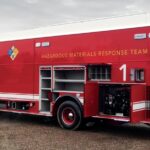

In today’s high‑risk industrial, urban, and transportation environments, emergency response units must be equipped with highly specialized apparatus capable of confronting hazardous materials (HAZMAT) incidents as effectively as they fight fires. Among the most important assets in a modern emergency services fleet is the Heavy Rescue HAZMAT Fire Truck — a vehicle purpose‑built not only for fire suppression but also for chemical detection, containment, decontamination, and rescue operations. This article explores these advanced vehicles, their capabilities, and opportunities for acquisition — particularly through CSCTRUCK Fire Rescue Truck, a leading international provider of emergency response vehicles.
The Critical Role of Heavy Rescue HAZMAT Fire Trucks
Hazardous materials emergencies — whether stemming from industrial chemical spills, transportation accidents, petrochemical facility failures, or toxic vapor leaks — present unique challenges that go far beyond traditional firefighting. Incidents of this nature can involve corrosive acids, flammable liquids, toxic gases, or even radiological threats. To manage these risks safely and efficiently, fire departments need vehicles that integrate advanced detection systems, protective gear, containment tools, and decontamination capabilities in a single, mobile platform.
A heavy rescue HAZMAT fire truck essentially functions as a mobile command center and laboratory that helps first responders rapidly assess complex chemical threats, coordinate multi‑agency responses, and protect both personnel and affected communities. These vehicles are a core part of any modern chemical emergency response strategy.

CSCTRUCK Fire Rescue Truck: A Leader in Emergency Vehicle Manufacturing
CSCTRUCK Fire Rescue Truck — featured on FireRescueTruck.com — is one of the world’s prominent manufacturers and exporters of specialized emergency vehicles, including HAZMAT fire trucks. Originating from Suizhou, China, the company has a long history dating back to the 1960s and has built a global reputation for customizable, durable, and high‑performance rescue apparatus.
Their product lineup includes a wide range of vehicles designed for diverse emergency needs — from pumper and aerial fire engines to specialized rescue carriers, airport rescue firefighting trucks, and of course, Hazmat Fire Trucks. Every unit can be custom‑built to match specific operational requirements, such as chassis brand, tank capacities, onboard equipment, and mission‑profile configuration.
Core Capabilities and Features of Heavy Rescue HAZMAT Vehicles
Modern heavy rescue HAZMAT fire trucks combine multiple specialized systems that set them apart from standard fire engines. Below are some of the most critical capabilities they bring to emergency response:
1. Advanced Detection and Monitoring Systems
At the heart of any hazmat response is the ability to identify and characterize unknown substances. Sophisticated detection tools installed on these trucks include:
- Multi‑gas detectors for oxygen depletion, combustible gases, and toxic atmospheres
- Chemical agent monitors to identify specific hazardous compounds
- Radiation detectors for gamma and beta emissions
- Photoionization detectors (PIDs) and spectrometers for detailed chemical analysis
These technologies allow rapid on‑scene risk assessment and guide tactical decisions — essential when dealing with volatile or life‑threatening materials.
2. Onboard Command and Communications Center
Heavy rescue HAZMAT trucks often serve as mobile command hubs equipped with communication consoles, GPS mapping, digital radios, and real‑time data links to municipal, police, medical, and environmental agencies. These systems enable seamless coordination, comprehensive situational awareness, and rapid dispatching of additional support when required.
3. Containment, Neutralization, and Protective Equipment
Containment tools — such as sealing kits, overpack drums, absorbent materials, and chemical neutralizers — help responders control leaks and spills before they expand. Meanwhile, advanced personal protective equipment (PPE) on board may include:
- Level A fully encapsulated suits with supplied air
- Level B splash‑protective suits
- Chemical‑resistant gloves, boots, and face protection
All of these components are designed to maximize responder safety in hazardous environments.
4. Decontamination Systems
Decontamination is a mission‑critical function in chemical emergencies. Many HAZMAT fire trucks include:
- Heated water systems
- Foldable shower tents or built‑in showers
- Wastewater collection tanks
These systems help prevent secondary contamination of personnel, equipment, and the surrounding environment.
5. Fire Suppression and Auxiliary Support
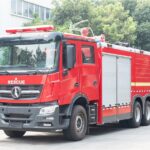
Although not the primary function, many heavy HAZMAT units still carry firefighting resources. For example, a model like the 10 Wheelers Chemical Hazmat Fire Truck from CSCTRUCK Fire Rescue Truck includes large water (7,200 L) and foam (2,100 L) tanks as well as a 3,000 kg dry powder system — enabling responders to tackle associated chemical fires or cool dangerous containers safely.

Example Models and Specifications
CSCTRUCK Fire Rescue Truck offers several variants tailored to specific mission profiles. 2 representative examples include:
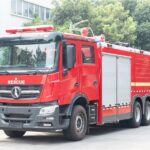
10 Wheelers Chemical Hazmat Fire Truck
- Chassis: Beiben 6×4
- Water Tank: ≥7,200 L
- Foam Tank: ≥2,100 L
- Dry Powder Capacity: 3,000 kg
- Fire Pump Flow: 100 L/s
- Dry Powder Cannon: 40 kg/s
- Top Speed: 89 km/h
This heavy unit combines firefighting capability with advanced hazard response systems, making it suitable for municipal and industrial deployments.
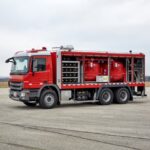
MAN 4‑Ton Chemical Hazmat Fire Truck
Built on a robust MAN TGS 26.480 6×4 chassis, this model is designed for rapid deployment and superior maneuverability in challenging conditions. It features a 4,000 kg decontamination tank, powerful generator systems for onboard tools, and advanced lighting for operations in low‑visibility environments.
Real‑World Deployments and Impact
CSCTRUCK Fire Rescue Truck’s hazmat vehicles have been delivered to emergency services worldwide, enhancing national chemical response readiness:
- In Poland, a 10‑wheeler chemical hazmat fire truck was formally integrated into the national emergency fleet, expanding capabilities for chemical risk zones and urban environments.
- In the Netherlands, a state‑of‑the‑art Hazmat Fire Truck was deployed at the Port of Rotterdam — one of Europe’s busiest and highest risk industrial hubs — to bolster readiness for large chemical incident responses.
These deployments underscore the strategic importance of advanced heavy hazmat units in safeguarding public safety and environmental health.

Conclusion: Investing in Chemical Emergency Preparedness
Acquiring a heavy rescue HAZMAT Fire Truck is a significant investment for any fire department, industrial safety team, or governmental agency. These vehicles extend far beyond traditional firefighting — serving as command centers, mobile labs, and life‑saving platforms that enhance response effectiveness, reduce risk to responders, and protect communities from complex hazardous material emergencies.
For agencies considering procurement, CSCTRUCK Fire Rescue Truck offers a comprehensive suite of customizable hazmat fire trucks engineered for performance, reliability, and advanced chemical emergency response. With robust engineering, configurable options, and proven global deployments, these vehicles represent a strategic choice for modern emergency preparedness.