In modern urban environments where high-rise buildings dominate city skylines, fire departments require specialized equipment capable of combating fires and conducting rescues at significant heights. The tower fire truck, also known as an aerial tower fire truck, represents one of the most advanced firefighting apparatuses designed for these demanding operations. With its impressive reach, large water flow capacity, and multifunctional design, the tower fire truck stands as a critical asset in high-rise firefighting, urban rescue missions, and large-scale industrial emergencies.
1. Introduction to Tower Fire Trucks
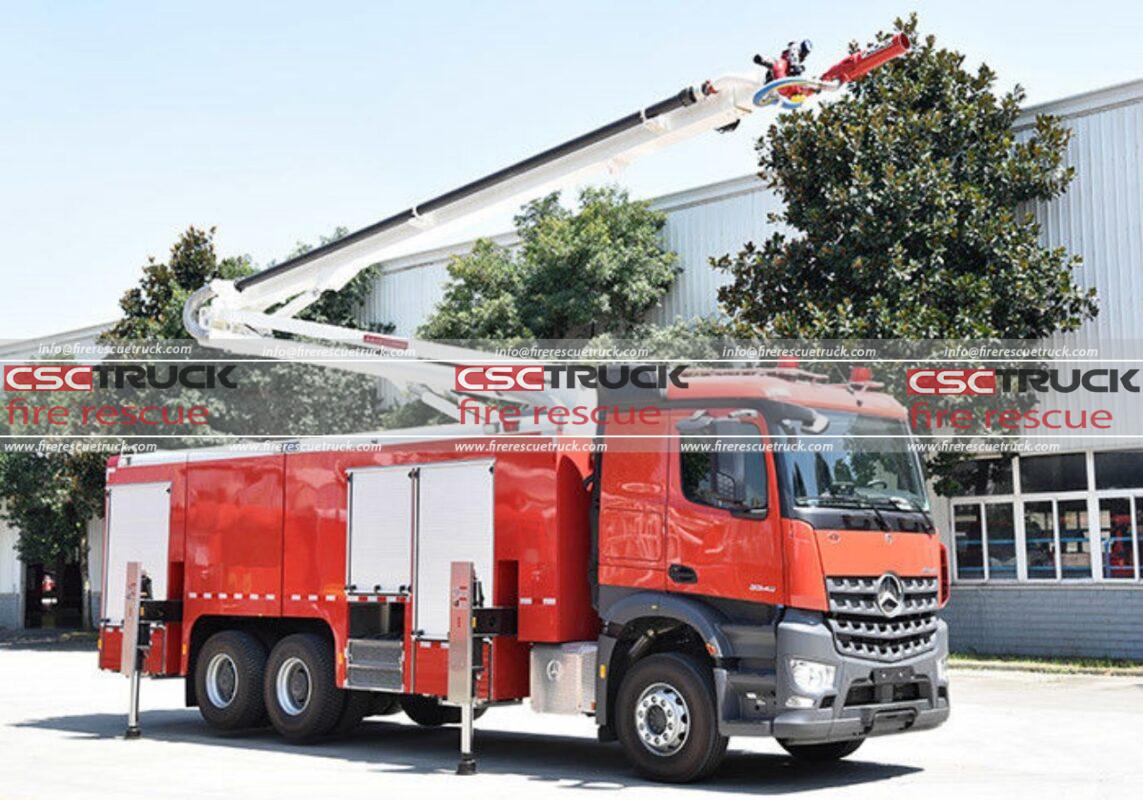
A tower fire truck is a specialized firefighting vehicle equipped with a hydraulically operated aerial tower that supports a large, articulated platform or basket at its tip. This tower can extend both vertically and horizontally, providing firefighters with elevated access to upper floors, rooftops, or hard-to-reach areas during fire suppression or rescue missions. Unlike conventional ladder trucks, tower fire trucks are fitted with platforms rather than open ladders, allowing for safer and more stable operation at height.
These trucks are built on heavy-duty chassis, featuring advanced stabilization systems, high-capacity pumps, and sophisticated control mechanisms. Their versatility makes them indispensable for urban fire brigades, airports, chemical plants, refineries, and industrial complexes where both elevation and high water flow are essential.
2. Advanced Design and Construction
The design of a tower fire truck emphasizes strength, stability, and operational safety. The vehicle is typically mounted on a robust chassis—often from manufacturers such as MAN, Mercedes-Benz, Scania, or HOWO—to ensure durability and smooth handling.
The aerial tower is constructed using high-strength steel or aluminum alloy, ensuring both lightweight maneuverability and structural rigidity. Telescopic and articulated sections enable the tower to reach heights of 30 to 70 meters, depending on the model. Advanced versions also feature dual or triple-section booms with integrated waterway systems that deliver water or foam directly to the fire scene.
Hydraulic outriggers stabilize the truck during operation, automatically adjusting to uneven ground to maintain balance and ensure safe elevation of the tower. Furthermore, modern tower fire trucks are equipped with computer-assisted control systems, allowing operators to monitor boom position, load status, and wind conditions in real-time.
3. Elevated Firefighting Capabilities
The core strength of the tower fire truck lies in its elevated firefighting capability. The aerial tower is fitted with a monitor (water cannon) or foam nozzle at the platform, capable of discharging water or foam at high pressures over long distances.
The flow rate typically ranges from 60 to 100 liters per second, depending on the truck’s configuration and pump capacity. This allows firefighters to effectively suppress fires in skyscrapers, warehouses, aircraft hangars, and oil depots from above or from angles inaccessible to ground units.
Additionally, the platform can accommodate 2 to 4 firefighters with their equipment, enabling direct application of extinguishing agents or performing rescues at elevated locations. With advanced remote controls, operators can precisely adjust spray patterns, pressure, and direction, maximizing efficiency while minimizing water waste.
4. Rescue Operations and Safety Features
Beyond firefighting, the tower fire truck serves as a vital rescue apparatus. Its stable, spacious platform allows firefighters to evacuate people trapped in high-rise buildings during fires, gas leaks, or other emergencies. The basket is often designed to support up to 400 kilograms, making it suitable for carrying multiple occupants at once, including injured or disabled individuals.
To enhance safety, the platform is equipped with non-slip flooring, safety rails, lighting systems, and communication intercoms. Some advanced models also include oxygen supply lines and fireproof curtains to protect occupants during rescue operations in dense smoke or high heat conditions.
For added versatility, many tower trucks integrate crane hooks or winches, enabling lifting operations for debris removal or vehicle recovery during disaster response missions.
5. Pumping and Foam System
At the heart of every tower fire truck is a powerful water pump system. Typically, these pumps are rated between 3,000 and 10,000 liters per minute, depending on the configuration and intended use. The truck draws water from external sources such as hydrants, tanks, or reservoirs and delivers it through the aerial waterway to the tower nozzle.
Some models come equipped with combined water and foam systems, enabling both water-based and chemical-based extinguishing depending on the fire class. The foam proportioning system automatically mixes foam concentrate with water at precise ratios, producing an effective fire-suppressing agent ideal for oil, fuel, and chemical fires.
6. Intelligent Control and Operation Systems
Modern tower fire trucks integrate advanced control systems that enhance operational precision and safety. The electro-hydraulic control system allows smooth and responsive boom movement, while the digital monitoring panel displays critical data such as boom angle, pressure levels, and elevation height.
Some models feature automatic leveling systems, anti-collision sensors, and load moment indicators to prevent overextension or imbalance. Remote operation panels enable the tower to be controlled from both the cab and the platform, offering flexibility and situational awareness.
In addition, onboard communication systems and video monitoring cameras improve coordination between the ground crew and aerial operators, ensuring efficient and safe task execution even in low-visibility conditions.
7. Applications and Operational Scenarios
The versatility of the tower fire truck makes it suitable for a wide range of scenarios:
High-Rise Building Fires: Rapid access to upper floors for extinguishing and rescue operations.
Industrial Complexes: Effective for handling large fires in factories, oil refineries, and chemical plants.
Airport Firefighting: Essential for tackling fires in hangars and aircraft fuselages.
Urban Disasters: Rescue and evacuation during building collapses or floods.
Large Public Events: Provides aerial surveillance and quick response capability in densely populated areas.
Its combination of height, reach, and water flow capacity ensures that no location is beyond the firefighter’s reach, making it an invaluable asset in modern emergency response fleets.
8. Maintenance and Reliability
Due to the complex hydraulic, electrical, and mechanical systems involved, tower fire trucks undergo rigorous maintenance schedules. Regular inspections include checking hydraulic oil levels, boom joints, pumps, valves, and electronic sensors to ensure consistent performance.
Manufacturers often provide comprehensive service programs that include operator training, spare parts supply, and system calibration. Proper maintenance not only extends the vehicle’s lifespan but also guarantees safety and reliability during critical missions.
9. Environmental and Technological Advancements
Modern tower fire trucks are increasingly being developed with eco-friendly and energy-efficient technologies. New-generation diesel engines meet EURO VI emission standards, reducing environmental impact. Some manufacturers are even exploring hybrid or fully electric drive systems to enhance sustainability.
Technological advancements such as AI-based diagnostics, GPS tracking, and integrated fire management software are also being incorporated, allowing better coordination and faster response times during emergencies.
10. Conclusion
The tower fire truck stands as a symbol of technological excellence and firefighting innovation. Combining height, power, and precision, it delivers unmatched performance in high-rise firefighting and rescue operations. Its elevated firefighting capability, integrated safety systems, and versatile functionality make it an essential component of any modern fire service fleet.
As cities continue to grow vertically and industries expand in complexity, the need for advanced tower fire trucks will only increase. Their ability to reach towering structures, deliver immense water power, and conduct safe rescues in hazardous conditions ensures they remain at the forefront of emergency response technology — protecting lives, property, and the future of urban safety.