
Airports are among the most safety‑critical environments on the planet. When disaster strikes — a crash, a fire on the tarmac, a fuel‑spill ignition — response time, equipment reliability, and the ability to suppress large, fuel‑fed blazes can make the difference between catastrophe and controlled emergency. That’s why specialized airport fire trucks — often called Aircraft Rescue and Firefighting (ARFF) vehicles or “crash tenders” — are in a class of their own. Across the world, manufacturers and airport operators continue to refine these machines, tailoring them for speed, power, versatility, and local operational demands. In this article, we explore the key design innovations in modern airport fire trucks and examine how their roles and configurations vary by country and airport context.

What Makes an Airport Fire Truck Special
Purpose-built for aviation emergencies
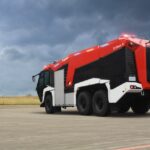
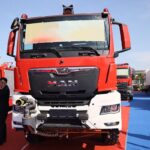
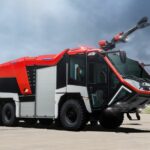
Unlike municipal fire engines or structural fire trucks, ARFF vehicles are engineered specifically to confront aircraft fires, which often involve large quantities of jet fuel, rapid fire spread, risk of explosions, and the need for immediate suppression.
Typical ARFF trucks are sized far beyond regular fire engines: They carry massive tanks of water and foam, operate on all‑terrain surfaces, and feature high‑performance pumps and remote-controlled turrets to project extinguishing agents over long distances.
Core design requirements: speed, reach, capacity, versatility
Some of the defining traits of ARFF trucks include:
- Large water and foam capacity — to suppress large fuel‑fed fires and provide enough agent to sustain firefighting until help arrives.
- High-performance pumps & discharge systems — capable of delivering thousands of liters per minute via roof-mounted turrets, bumper monitors, or under‑truck nozzles.
- All-terrain mobility — ARFF vehicles must accelerate quickly across varied airport terrain: Paved runways, taxiways, open fields, or even off‑runway ground. That often means all‑wheel drive (4×4, 6×6, or 8×8), rugged suspension, and large off‑road tires.
- Extinguishing versatility — besides water and foam, many are outfitted with dry‑chemical or clean‑agent systems to tackle fuel (Class B) fires or electrical (Class C) hazards.
- Rapid response and ergonomic design — cabins often feature large panoramic windshields, ergonomic controls, simplified interfaces, and remote‑operable turret controls. These help crews respond quickly without leaving the safety of the vehicle.
Because airports can be sprawling and hazards unpredictable — runway fires, fuel spills, crashing aircraft, collisions — these trucks must be ready to deliver maximum suppression and rescue capacity at a moment’s notice.
Innovations in Modern ARFF Design
As aviation volumes grow and aircraft become larger, ARFF manufacturers have introduced many innovations over the past decades to improve performance, safety, and environmental impact.
Enhanced suppression technology
- High-flow pumps and advanced foam systems — some modern ARFF vehicles now deliver well over 9,000–10,000 liters per minute, enabling rapid inundation of a fire site.
- Multi-agent systems — simultaneous deployment of water, foam, dry chemical, or clean agents (e.g., Halotron or fluorine‑free foam) to tackle complex fuel + fire + heat/hot‑surface scenarios.
- High‑Reach Extendable Turrets (HRET) — turrets mounted on extendable booms (e.g., 50–65 ft / 15–20 m) allow firefighters to deliver agents from a distance or even puncture aircraft fuselages to fight internal fires.
- “Pump-and-roll” capability — the ability to discharge foam/water while the vehicle is moving, which is critical during dynamic crash responses when positioning may still be in progress.
Operator-focused safety, ergonomics, and situational awareness
- Ergonomic cabins and advanced controls — modern ARFF vehicles prioritize driver comfort and operator efficiency: ergonomic control layouts, color-coded switches (water/foam / dry chemical / clean agents), raised visibility, large glass areas, and camera systems.
- Advanced sensors and cameras — many are equipped with infrared/thermal imaging, 360° camera arrays, and optional “bird’s-eye view” (overhead) cameras to help navigate thick smoke, poor visibility, or complex terrain.
- Stability and chassis innovations — for example, suspension systems like independent all-wheel suspension to improve handling on rough terrain, electronic stability control (ESC) to prevent rollover or skidding, and rear-axle steer to permit tighter turning radii on large vehicles.
- Health & safety for firefighters — some manufacturers include “clean‑cab” options to reduce exposure to carcinogens (e.g., easy‑clean surfaces, washable floors, dedicated compartments for breathing apparatus, boot‑wash stations).
Environmental and operational efficiency trends
With growing emphasis on sustainability and lower environmental impact, there are early signs of innovation in that direction as well: hybrid or more fuel‑efficient engines, foam‑proportioning systems that reduce waste, and telematics for maintenance and resource management.
Some manufacturers market their ARFF trucks as “tailored to the respective airport’s requirements,” allowing customization of tank size, agents carried, turret type, suspension, and chassis, depending on runway length, aircraft types served, climate, and terrain.
Leading ARFF Trucks — Examples of Design Excellence
Two of the most widely deployed modern ARFF trucks exemplify the above innovations:
Rosenbauer Panther
- The Panther series has become something of a global benchmark for ARFF vehicles: Rosenbauer states that the entire vehicle — from chassis to superstructure to firefighting tech — is developed in-house, assuring integration and reliability.
- The Panther combines powerful extinguishing capabilities with high acceleration: with a performance package of about 750 hp and an 8‑speed transmission, it can sprint to the scene at high speed.
- The truck’s cabin is designed with human factors in mind: optimized controls, good visibility (aided by modern windshield and camera systems), and ergonomic layout.
- On the suppression side, Panther units can be equipped with HRET booms, combined agent systems (foam, dry chemical, clean agents), and advanced pumps — making them capable of tackling major aviation fires.
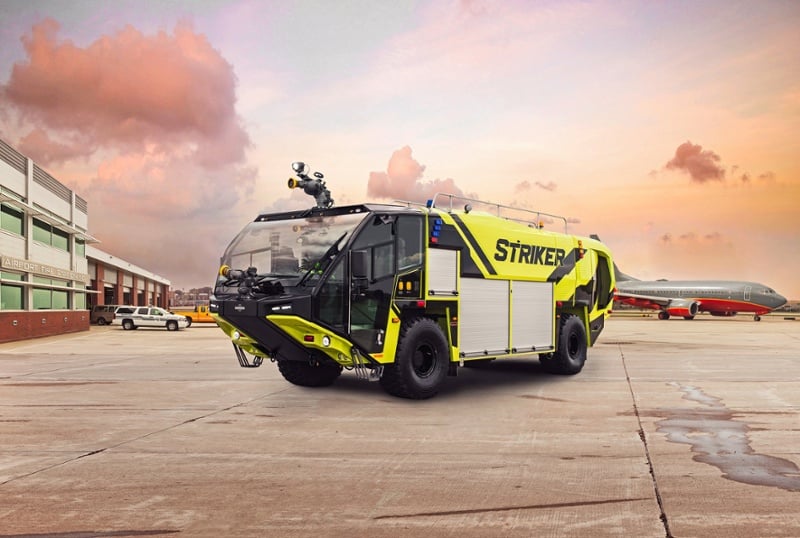
Oshkosh Striker
- The Striker series (available in 4×4, 6×6, and 8×8 platforms) is among the most popular ARFF families globally.
- Its third‑generation models deliver top-tier suppression power: standard 1,950 gpm (≈ 7,381 lpm) pumps, with optional upgrade to 2,650 gpm (≈ 10,000 lpm) — sufficient for high-intensity fires.
- For flexible response, Striker trucks often feature a high-reach extendable turret (Snozzle® HRET) — sometimes with 50 or 65 ft reach — and optional high-pressure or compressed air foam (CAF) systems.
- On the crew side, the Striker’s cab is built for comfort, visibility, and safety: large glass area, center-steer configuration for 254° horizontal view, 360° cameras, clean-cab options to reduce carcinogen exposure, simplified maintenance access, etc.
- The chassis and suspension are optimized for airport terrain: independent suspension (TAK-4), optional rear-axle steer, stability control — all important when maneuvering heavy, water‑laden vehicles under time pressure.
These 2 models (and others in their class) illustrate how far airport fire‑truck design has come — they are not simply oversized fire engines but highly specialized machines engineered for speed, power, precision, and safety.
Country‑Specific & Operational Variations in ARFF Deployment
While the technology behind ARFF vehicles is broadly similar worldwide, actual deployment, configuration, and operational roles differ significantly depending on the country, the size and traffic of the airport, regulatory frameworks, and the mix of aircraft served. Several factors drive these differences:
Regulatory and certification standards
International standards — for example, those developed by the International Civil Aviation Organization (ICAO) — typically define the minimum ARFF requirements (response time, agent discharge capacity, runway coverage, etc.) depending on airport size, aircraft types, and traffic volume.
However, countries often adapt these to local needs. For instance, what counts as “adequate ARFF response” at a major international hub may be overkill for a small regional airport. Thus, some airports operate only “Rapid Intervention Vehicles (RIVs)” or smaller foam tenders; others maintain full‑blown heavy tenders for wide‑body aircraft emergencies.
Airport size, traffic, and aircraft types
At large international airports that handle wide-body aircraft — long‑haul jets with massive fuel loads — heavy ARFF tenders with large water/foam tanks, high-flow pumps, and HRET capabilities are common. On the other hand, small regional airports or airports with only light aircraft may rely on more compact vehicles or fewer resources.
For example, some ARFF vehicle product lines (like the modular vehicles offered by certain manufacturers) allow customizing tank volume, chassis, and agent loadout based on the airport’s runway size, aircraft category, and the volume of traffic.
Local terrain, climate, and infrastructure constraints
Airports in cold climates might specify winterization features (heated tanks, cab insulation, de-icing systems), whereas those in hot, arid, or remote regions might prioritize dust-resistant air intake, powerful cooling, high reliability, and suspension systems to tackle unpaved service roads. The modular and configurable nature of many ARFF designs supports such tailoring. The same manufacturer might deliver different versions to different countries based on the local climate and operational demands.
Operational doctrine and dual roles
In many airports — especially those in the U.S. and other countries — ARFF crews handle more than just aircraft fire emergencies. For instance, under certain regulatory frameworks (e.g., in the U.S. under Federal Aviation Administration (FAA) regulations for Part 139 airports), ARFF-capable airports must maintain fire and rescue services whenever scheduled air carrier flights operate. This means that ARFF vehicles may get dispatched not only to runway emergencies but also to medical calls, fuel spills, structural fires, or even mutual aid for nearby incidents.
In some countries, ARFF vehicles may be provided or supplemented by municipal or regional fire services — especially at smaller airports — blending roles between structural firefighting and airplane rescue.
Variation in technology adoption rates
Not all airports upgrade to the latest generation of ARFF vehicles immediately. Budget constraints, regulatory class, and airport traffic — all influence when and how upgrades happen. As a result, some airports may still operate older first‑ or second‑generation trucks, while others deploy the newest models with HRET, high-pressure systems, and electronic foam proportioning. This variation results in a global patchwork of ARFF capabilities.
Challenges & the Road Ahead: What Next for ARFF?
Despite impressive technical and engineering advances, airport fire‑fighting remains a daunting challenge. The combination of volatile jet fuel, complex aircraft structures, potential occupant rescue, and crash dynamics means ARFF vehicles must always balance power, speed, and safety.
Key areas likely to shape the next generation of ARFF design:
- Sustainability and environmental impact — as airports and governments push for greener operations, ARFF vehicles may increasingly feature hybrid or even fully electric drivetrains, water/foam recycling, fluorine‑free foams, and optimized agent use. Early market signals point toward this direction.
- Smart technology and automation — advanced sensor suites (thermal imaging, LiDAR, environmental sensors), AI‑assisted targeting and agent proportioning, real-time diagnostics, predictive maintenance — all could improve response effectiveness and reliability under stress.
- Customization for diverse airport environments — modular ARFF platforms that can be configured per airport: from small regional airfields to mega‑hubs, from desert climates to arctic conditions. The ability to adapt to local context will remain essential.
- Training, human factors, and crew safety — even the best truck is only as effective as the team operating it. Future designs will likely continue to emphasize ergonomics, cabin safety, decontamination features, and intuitive control systems to reduce firefighter exposure to hazards and long-term health risks.
Conclusion: Guardians of the Skies — More Than Just Fire Engines
Airport fire trucks — ARFF vehicles — are among the most specialized, high‑stakes firefighting machines on Earth. Designed to counter the unique dangers posed by aircraft fires — massive fuel loads, rapid fire spread, structural complexity, and high occupant density — they blend brute power with technological sophistication, ergonomic design, and strategic flexibility.
From heavyweights like the Rosenbauer Panther to versatile workhorses like the Oshkosh Striker, these vehicles embody decades of technological evolution and operational learning. Yet the landscape is not uniform: Country-specific regulations, airport size and traffic, climate, and infrastructure — all shape how, where, and with what configuration ARFF vehicles are deployed.
As aviation continues to expand globally, and as environmental and safety standards tighten, the next generation of ARFF trucks is likely to push the envelope further: Cleaner, smarter, more adaptable, and ever more capable. In the realm of aviation safety, these unsung machines — often parked in quiet airport fire stations — stand ready to defend flights, passengers, and crew at a moment’s notice.