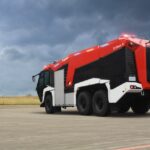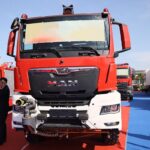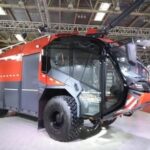

What are Airport Fire Trucks (ARFF vehicles)?
Airport fire trucks — also called airport crash tenders — are specialized firefighting and rescue vehicles designed to respond rapidly to aircraft accidents, fuel fires, runway incidents, and related emergencies at airports. Compared to municipal fire engines, ARFF vehicles are optimized for:
- Large capacity of extinguishing agents (water, foam, dry chemicals) carried onboard — essential for jet‑fuel (aviation fuel) fires.
- Powerful high‑capacity pumps and remote‑controlled turrets (on the roof and bumper) that can discharge water or foam at high flow rates over long distances — enabling suppression even before firefighters reach close to the fire.
- All‑terrain or off‑runway mobility (4×4, 6×6, 8×8 chassis), enabling them to traverse uneven ground, grass, gravel, or soft soil near runways or overrun areas.
- “Pump‑and‑roll” capability: many ARFF trucks can spray foam or water while moving, which helps cover a large crash area quickly — a capability seldom available in municipal fire engines.
Because of these features, ARFF vehicles are functionally different from normal municipal fire trucks: they carry far more extinguishing agents, are heavier and larger, yet need to accelerate quickly and reach remote areas of the airfield.
Typical Types of Airport Fire Trucks (Global / U.S. Standard)
Before comparing China vs. the U.S., it helps to outline typical ARFF vehicle types used internationally (and commonly in the U.S.):
- Major foam tenders/crash tenders — large ARFF trucks carrying water + foam + sometimes dry‑chemical agents, with powerful pumps and turrets for large-scale aviation fuel fires.
- High‑Reach Extendable Turret (HRET) vehicles — equipped with an extendable boom (turret) with a piercing nozzle that can penetrate an aircraft fuselage and inject foam/water directly inside the cabin or cargo hold. This is vital when access is blocked or the fire is inside the aircraft.
- Water tenders/support vehicles — carry large volumes of water/foam to supplement main crash tenders, or assist in sustained firefighting if hydrants are unavailable.
- Rapid Intervention Vehicles (RIVs) or smaller ARFF units — for smaller airports or as first-response backup to larger tenders; carry less water/foam but are more maneuverable and quicker to respond.
Airports choose their fleet composition according to the size and type of aircraft they serve. For instance, airports handling large wide-body jets (e.g., A380, B747) generally require multiple large crash tenders. Smaller airports with only private jets or small aircraft may get by with one small ARFF unit.
In the U.S., the classification and required ARFF equipment are regulated by the Federal Aviation Administration (FAA), under 14 CFR §139.317, which mandates minimum water + foam capacity, turret discharge rates, and agent discharge rates depending on the “Index” of the airport (which depends on aircraft size and traffic).
For example, airports serving very large aircraft (Index E) often require at least three ARFF vehicles and foam‑water discharge turrets that meet specific flow rates.
Well-known U.S. / Western ARFF models include vehicles such as Oshkosh Striker (4×4, 6×6, or 8×8) — widely used at major airports.

China’s Airport Fire Trucks: Designs and Features
China, through domestic manufacturers and also imports from Western companies, operates a variety of ARFF vehicles. Some typical characteristics of Chinese ARFF trucks:
- A common configuration is a 6×6 truck (six‑wheel drive), often built on a chassis from global manufacturers (e.g., German Mercedes‑Benz or European chassis providers).
- Example: a 6×6 ARFF crash tender with 10,000 L water tank + 1,000 L foam tank, capable of water/foam pumping at 100 L/s under 10 bar pressure; with turret shoot range about 90 m.
- More advanced Chinese ARFF vehicles can have larger tanks: e.g., 12,000 L water, 1,500 L foam, plus 250 kg dry‑chemical powder — giving dual‑agent capacity (foam + dry chemical) for greater fire suppression flexibility.
- Chassis and superstructure are typically aluminum alloy welded; tank materials often use PP (polypropylene) composite, which is corrosion-resistant and “never rusts.”
- Pump systems: for instance, a water pump flow rate of 100 L/s @ 10 bar is common; roof- or front‑mounted monitors deliver foam/water. Some Chinese trucks are built to operate even in harsh environmental conditions (for instance, cold or high humidity), highlighting durability in diverse Chinese climates.
Because of these features, Chinese ARFF trucks are functionally quite similar to their U.S./Western counterparts — they carry large water/foam loads, have powerful pumps and turrets, and can operate over rough terrain.
In some cases, Chinese airports also directly use Western ARFF models. For example, several units of Oshkosh Striker 8×8 have been delivered to major Chinese airports (e.g., Beijing Daxing International Airport) to meet high safety standards.
Comparison: China vs U.S. Airport Fire Trucks — Differences, Similarities & Context
✅ Similarities
- Core requirements: Both Chinese and U.S. ARFF vehicles share basic functional requirements: large onboard water/foam capacity, powerful pumps, remote‑controlled turrets, and all‑wheel drive chassis. This is because the nature of aviation fires is similar worldwide: jet fuel fires demand foam-based suppression, rapid response, reach (via turrets), and mobility across large airfields.
- Mixed fleet approach: Airports often maintain more than one ARFF vehicle — a combination of major foam tenders, HRET-capable trucks, possibly water tenders or support vehicles, and sometimes smaller rapid‑intervention units depending on airport size. This is common globally and applies in both China and the U.S.
- Use of international designs/imports: Chinese airports sometimes acquire Western ARFF models such as the Oshkosh Striker 8×8, especially for large new airports, aligning with global standards and benefiting from proven designs.
⚠️ Differences & Contextual Factors
- Regulatory framework: In the U.S., deployment and minimum ARFF vehicle/agent capacity are regulated by the FAA (14 CFR § 139.317). This means U.S. airports must maintain at least a certain total water + foam capacity distributed across vehicles, and meet minimum turret/agent discharge rates. China’s regulatory framework for ARFF is more decentralized and may vary by airport size, region, and local civil aviation authorities; many ARFF trucks in China appear built to export standards (e.g., EU, NFPA, EN) when designed by manufacturers.
- Variation in fleet modernization: Some Chinese airports rely on domestically produced ARFF vehicles (e.g., 6×6 trucks with modest or moderate water/foam capacity). Meanwhile, some U.S. (or Western) airports — especially large international hubs — may deploy heavy 8×8 crash tenders or state-of-the-art HRET‑equipped vehicles. However, with economic growth and investment in civil aviation, many Chinese airports are gradually upgrading their ARFF fleet, sometimes using imported high‑end vehicles.
- Local environmental adaptation: Chinese domestic ARFF trucks sometimes emphasize environmental adaptation — for example, design tolerances for high humidity, saline (coastal) conditions, wide temperature ranges, corrosion resistance (using PP composite tanks), which may reflect varied climates across China. While U.S. ARFF vehicles also need to handle diverse conditions, the regulation-driven standardization may lead to more uniform specs across different airports.
- Use of dual‑ or multi‑agent systems: Some Chinese ARFF trucks list configurations with water, foam, and dry powder (dry chemical) onboard — for example, 12,000 L water + 1,500 L foam + 250 kg dry powder. In the U.S. context, ARFF vehicles are required to carry AFFF (foam) and often dry chemical or clean agent as complementary systems. The multi‑agent approach helps tackle different classes of fires (jet fuel fires, structural/chemical, cargo, etc.).

Applications at Airports: How ARFF Vehicles Are Deployed in China and the U.S.
The use of ARFF vehicles depends heavily on the type and size of the airport, the types of aircraft served, and local regulations or practices.
In the United States
- Airports certified under part 139 (commercial service airports) are required to maintain ARFF coverage during operations.
- For larger airports (serving wide-body jets, heavy traffic), multiple ARFF vehicles are deployed — often a combination of crash tenders, water/foam tenders, and possibly a rapid‑intervention vehicle. These ensure that any point of the runway can be reached within a critical response window (often 3 minutes or less).
- ARFF trucks may also be used outside airport boundaries for mutual aid or specialized incidents (hazmat, fuel‑storage fires, large industrial fires), thanks to their large foam capacity and powerful pumps. This is often done when local fire departments lack foam‑capable tenders. Indeed, some Reddit firefighters say ARFF rigs are “basically a rolling water/foam cannon.”
In China
- As commercial aviation has rapidly expanded in China over recent decades, many airports (especially major new ones) have upgraded their ARFF fleets. For instance, the 8×8 units from overseas providers like Oshkosh have been delivered to several large airports.
- For smaller regional airports or older facilities, domestically-built 6×6 ARFF vehicles with moderate water/foam tanks remain common — offering an affordable solution while meeting basic firefighting needs.
- The use of dual‑agent systems (water + foam + dry chemical) provides flexibility: foam for jet-fuel fires, dry chemical for cargo fires or fuel‑spill-related fires, structural incidents, or fires involving other hazardous materials.
- Some Chinese ARFF manufacturers emphasize build quality and environmental durability (e.g., corrosion‑resistant tanks), which may reflect a focus on long-term maintenance under varied climate conditions across China.
Strengths, Limitations, and Trade‑offs
Strengths
- Large onboard capacity & self‑sufficiency: Whether in China or the U.S., ARFF trucks are designed to fight fuel or jet fires effectively with onboard foam and water — without relying on nearby hydrants or external water supply. This is crucial at remote parts of airfields or in airports without extensive hydrant networks.
- Rapid response & mobility: The 6×6, 8×8 (or 4×4) chassis, combined with powerful engines and off-road capability, allow ARFF vehicles to reach remote areas of airports quickly and traverse rough terrain if needed. This mobility is critical if an aircraft accident happens off paved areas (runway overrun, grass, soft ground).
- Multi-agent firefighting flexibility: The combination of water, AFFF foam, and dry chemical (or other agents) — along with remote‑controlled turrets and sometimes piercing HRET nozzles — provides flexibility to respond to different fire types: jet-fuel fires, cargo fires, structural fires in hangars or buildings, leak/spill fires, etc.
- Customizable fleet configuration: Airports can tailor their ARFF fleet size and type based on their operations — small airports may deploy a single small ARFF unit; large international hubs may operate multiple crash tenders, water tenders, and rapid‑intervention vehicles.
Limitations & Trade-offs
- Cost: Large ARFF vehicles (especially imported 8×8 or highly equipped units) are expensive — cost of acquisition + maintenance + specialized training. This can be challenging for smaller/regional airports. In China, this explains why some airports rely on domestically produced 6×6 trucks with simpler specs.
- Maintenance and resource consumption: Tanks, pumps, foam systems, and turrets require regular maintenance. Foam agents (especially traditional AFFF) have environmental and health drawbacks, prompting some airports to consider alternatives — which may not always deliver the same suppression performance. The complexity of dual-agent systems also demands more training and careful operation.
- Weight and maneuverability trade-off: While large tank capacities are beneficial, heavy trucks have limitations (turning radius, braking distance, ground pressure). In some cases, smaller/tactical rapid‑intervention vehicles may struggle against large fuel fires; conversely, large crash tenders may have difficulty maneuvering in tight airport areas or in mixed-use airports.
- Regulatory and standardization differences: In the U.S., regulation (FAA) ensures a baseline standard across airports. In other countries (including China), practices may vary significantly depending on airport size, budgets, and the chosen ARFF supplier. This can lead to inconsistent levels of readiness across airports.

What the Comparison Suggests — and What Airport Managers Should Consider
From the above comparison, several insights emerge for airports (whether in China, the U.S., or elsewhere) when designing or upgrading their ARFF capabilities:
- Understand Aircraft & Traffic Mix: The size and number of aircraft, traffic volume, and types of operations should drive ARFF fleet design. A large international hub will need multiple, high-capacity crash tenders; a small regional airport may do well with a modest 6×6 ARFF unit.
- Balance Cost vs. Capability: High-end ARFF units (large tanks, dual‑agent, HRET, imported chassis) deliver top performance — but they are expensive. Airports with tight budgets may opt for simpler, domestically built 6×6 vehicles that still meet basic firefighting needs.
- Flexibility & Redundancy: It is prudent to maintain a mixed fleet — combining major foam tenders, water/foam backup tenders, and rapid‑response vehicles. This ensures redundancy and coverage for multiple simultaneous incidents or different fire types.
- Training & Maintenance: Complex firefighting systems (foam + dry chemical + remote turrets/booms) require regular maintenance, crew training, and drills. Fire departments should keep up with servicing and agent replenishment, and ensure crews maintain proficiency in operating nozzles, pump‑and‑roll, HRET, etc.
- Environmental & Regulatory Compliance: Use of foam (especially traditional AFFF agents) raises environmental concerns. Airports should evaluate newer, less harmful foam agents or clean‑agent alternatives where possible — but balance this against suppression effectiveness, as required under safety regulations (e.g., for large aircraft). In regulated environments like the U.S., compliance with FAA (or national aviation authority) requirements should guide the choice.
- Local Environmental Adaptation: In regions with harsh climates (extreme heat, cold, high humidity, coastal salt‑air), ARFF vehicles should be designed with corrosion-resistant materials, environmental sealing, and robust chassis/tank designs. This is especially relevant for airports in diverse climates — a factor evident in some Chinese ARFF vehicle specifications.
Conclusion
Comparing airport fire trucks in China and the United States reveals that — while there are differences driven by regulatory environment, budget constraints, and local practices — the foundational principles of ARFF vehicles remain the same globally: Rapid response, large onboard fire‑suppression capacity, all‑terrain mobility, and specialized foam/agent delivery systems.
Chinese airports increasingly adopt internationally compatible designs — ranging from domestically manufactured 6×6 ARFF trucks to imported 8×8 crash tenders — often mirroring the capabilities of U.S. and European airport fire fleets. These vehicles, with water, foam, and sometimes dry‑chemical agents, with remote‑controlled turrets and durable chassis, provide the core tools needed to fight jet-fuel fires and handle aircraft emergencies.
For airport authorities, the key lies in choosing a fleet configuration that matches the airport’s size, aircraft mix, and risk profile — while balancing cost, maintenance, regulatory compliance, and environmental considerations. As global civil aviation grows, continuous assessment and modernization of ARFF fleets will remain essential to ensure aviation safety on the ground.