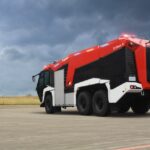

High-performance airport fire trucks—also known as Aircraft Rescue and Firefighting (ARFF) vehicles—play a vital role in ensuring rapid and effective emergency response during aircraft incidents. Designed for speed, resilience, and powerful firefighting capability, these specialized vehicles must comply with ICAO, FAA, and NFPA standards while meeting the unique operational needs of civil, cargo, and military airports. Their advanced pump systems, wide range of extinguishing agents, and integrated rescue features collectively enable airport fire departments to tackle complex fire scenarios, save lives, and protect critical infrastructure.
This article explores the essential components that define high-performance airport fire trucks, focusing on pump systems, extinguishing agents, and rescue functions.
1. Pump Systems: Engineering for Maximum Firefighting Power
The pump system is at the heart of every airport fire truck. It determines how quickly and effectively extinguishing agents can be delivered to suppress fires in high-risk airfield environments.
1.1 High-Capacity Pumps for Rapid Flow Rates
Aircraft fires can escalate within seconds due to highly flammable aviation fuel. Therefore, ARFF vehicles must deliver exceptionally high flow rates. Modern high-performance airport fire trucks typically feature:
- Pumps rated between 6,000 to 10,000 liters per minute (L/min)
- Pressure capabilities of 10–14 bar, with some trucks supporting dual-pressure systems
- Precision electronic control systems for stable and efficient pump operations
These pumps are often driven directly by the vehicle’s engine (power-take-off systems) or through dedicated auxiliary engines—ensuring continuous and uninterrupted firefighting performance.
1.2 Advanced Proportioning Systems
Extinguishing agent proportioning accuracy is crucial, especially when mixing water with foam concentrates. High-performance airport fire trucks use:
- Automatic foam proportioning systems (0.3% to 6%)
- Digitally controlled injection pumps
- Real-time monitoring sensors
These systems ensure the correct foam concentration regardless of flow rate, pressure, or nozzle configuration. They significantly reduce operator workload and increase the reliability of foam discharge during emergencies.
1.3 Multiple Discharge Points and Turret Integration
To fight fires effectively from safe distances, modern ARFF pump systems integrate multiple discharge outlets:
- Roof turrets (flow: 3,000–7,000 L/min; reach: 60–80 meters)
- Front bumper turrets for close-range firefighting
- Side and rear discharges for handheld lines
These outlets are controlled electronically through joysticks or cabin-integrated screens, enabling firefighters to deliver extinguishing agents precisely where needed—even while the truck is in motion.

2. Extinguishing Agents: Versatility Against Complex Aviation Fires
Airport fire trucks must carry a variety of extinguishing agents to address different fire classes and scenarios commonly encountered in aviation environments, including fuel spills, cabin fires, engine fires, and composite-material combustion.
2.1 Water: The Primary Extinguishing Medium
Water remains the base agent for most firefighting operations. Its cooling properties help control high-temperature aviation fuel fires. ARFF vehicles typically carry 6,000–12,000 liters of water, depending on the airport category and truck size. High-performance trucks focus on stable pump capacity to achieve rapid fire knockdown.
2.2 Foam Concentrates: Essential for Fuel Fire Suppression
Foam is indispensable in airport firefighting. High-performance airport fire trucks use Aqueous Film Forming Foam (AFFF) or the newer fluorine-free foams (F3) required by many environmental regulations. Foam provides:
- Vapor suppression
- Fuel surface coverage
- Rapid fire control
Foam tanks typically store 300–1,000 liters of concentrate. With advanced proportioning systems, firefighters can deliver the optimal foam mix quickly, preventing reignition.
2.3 Dry Chemical Agents: Instant Knockdown Capability
Dry chemical agents such as Purple-K (PKP) are widely used for engine fires, electrical fires, and flammable liquid incidents. High-performance ARFF vehicles often carry:
- 225–450 kg of dry chemical powder
- High-pressure discharge systems with flow rates up to 4.5–9 kg/s
Dry chemicals offer instant suppression and are especially effective in fighting fires under and around aircraft fuselages or engines, where foam may not reach efficiently.
2.4 Clean Agents (Halotron or Alternatives)
Some modern airport fire trucks include clean agent systems for fighting fires in sensitive areas like avionics compartments. Although the capacity is smaller than foam or water tanks, these agents are useful for:
- Minimal residue
- High extinguishing efficiency
- Non-corrosive properties
These systems allow firefighters to access and extinguish fires inside cockpits or cargo bays without damaging essential aircraft components.
3. Rescue Functions: Integrated Support for Life-Saving Operations
High-performance airport fire trucks are not just firefighting machines—they are also rescue platforms. In large airport emergencies, the first ARFF unit must arrive within minutes and begin both firefighting and rescue simultaneously.
3.1 Rapid Intervention and Crew Safety Features
Airport fire trucks are engineered to move quickly, with typical acceleration requirements such as:
- 0–80 km/h in under 25 seconds
- Top speeds of 110 km/h or more
Cabins include ergonomic layouts, thermal imaging cameras, breathing air systems, and communication devices that allow crews to perform efficiently even in extreme conditions.
3.2 Rescue Tools and Extrication Equipment
Many high-performance ARFF vehicles are equipped with rescue tools that aid in accessing aircraft and removing victims:
- Hydraulic spreaders and cutters
- Pneumatic lifting bags
- Portable ladders
- Fire-resistant blankets
These tools support rapid extrication, especially in incidents involving structural deformation or obstructed aircraft doors.
3.3 Piercing and Penetration Nozzles
One of the unique rescue features of certain airport fire trucks is the high-reach extendable turret (HRET) equipped with a skin-penetrating nozzle. This allows firefighters to:
- Pierce aircraft fuselages
- Inject water, foam, or dry chemicals directly into cabins or cargo compartments
- Cool the interior rapidly
- Create access points for rescue teams
HRETs significantly reduce the time needed to control interior fires and improve passenger survival chances.
3.4 Medical Support and Onboard First Aid
Although not ambulances, airport fire trucks often carry essential medical equipment for immediate lifesaving care:
- Automated external defibrillators (AEDs)
- Trauma kits
- Burn dressings
- Oxygen supplies
These enable firefighters to provide first-response medical intervention before emergency medical teams arrive.

4. The Role of Technology in Modern ARFF Vehicles
Today’s high-performance airport fire trucks integrate digital systems that enhance coordination and firefighting success:
- Thermal imaging and infrared cameras for pinpointing hotspots
- Real-time vehicle diagnostics
- GPS-based routing to runway incidents
- Cabin monitors for agent usage and equipment status
These technologies support faster decision-making, reduce operational risk, and enable seamless integration with airport emergency response networks.
Conclusion
High-performance airport fire trucks are indispensable assets for aviation safety. Their advanced pump systems, versatile extinguishing agents, and integrated rescue functions enable them to meet the demanding challenges of aircraft firefighting. Whether responding to fuel fires, cabin incidents, or complex crash scenarios, ARFF vehicles provide the power, precision, and reliability needed to protect lives and maintain safe airport operations.
Modern airports continue to expand, aircraft are becoming larger and more technologically advanced, and safety standards are evolving. Consequently, high-performance airport fire trucks must keep pace—becoming faster, stronger, and more versatile. By understanding pump systems, extinguishing agents, and rescue functions, airport authorities and fire departments can make informed decisions that enhance emergency response capabilities and ensure preparedness for any aviation emergency.