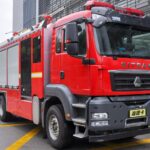
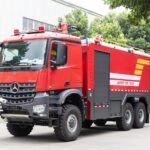
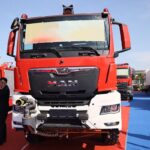
In the modern era of increasingly complex fire risks—high-rise buildings, industrial plants, remote wildlands, and critical infrastructure—the need for flexible, high-capacity water-delivery systems has never been greater. The hytrans fire system truck answers that call. Combining proven hydraulics, modular design, and smart logistics, a Hytrans-equipped vehicle turns any water source into a long-range, high-flow firefighting network. This article explores what makes the Hytrans Fire System truck an innovative tool in today’s firefighting arsenal, how it’s used in the field, and why departments and industrial operators are adopting it for extended-reach suppression and emergency water supply.
What is the Hytrans Fire System?
At its core, the Hytrans Fire System is a portable, high-capacity water relay and distribution system designed to move large volumes of water across long distances with minimal friction loss and logistical overhead. Typically mounted on a purpose-built truck or integrated into a trailer package, Hytrans blends high-flow pumps, engineered hoses or pipe segments, quick-connect fittings, and manifold control stations. The result: A mobile pipeline that can be laid quickly between a water source (river, lake, hydrant, pond, tanker fill point) and the incident scene, supplying engines, monitors, and foam systems with uninterrupted water or foam concentrate.
Why “extended reach” matters
Traditional fire suppression depends on proximity—hydrants, engines, and ladder pipes must be close to the seat of the fire to deliver meaningful flow. In many real-world emergencies, that proximity doesn’t exist: Urban hydrant gaps, rural wildland fires, remote industrial installations, and coastal incidents all pose water-access problems. The Hytrans Fire System Truck addresses this by creating a temporary, high-capacity supply line that can reach well beyond standard hose lays. This extended reach preserves firefighting effectiveness when conventional options fail, enabling sustained high-flow attacks, remote monitoring, and even long-distance foam delivery.
Key components and capabilities
A Hytrans-equipped truck typically features several integrated subsystems that work together to maximize speed and reliability:
High-capacity supply pumps: Designed to move thousands of liters per minute, these pumps form the heart of the system. They’re optimized for continuous operation and often include redundant configurations for resilience during long incidents.
Engineered hose/pipeline: Rather than relying solely on standard rubber hose lines, Hytrans systems use large-diameter, low-friction hose or collapsible pipe segments that reduce head loss and allow water to travel farther with less pump power.
Quick-connect manifolds and valves: Modular manifold stations let crews split, meter, and control flows to multiple attack points—fire engines, turret monitors, or portable deluge systems—without time-consuming reconfiguration.
Foam integration: Many Hytrans trucks include foam proportioning systems, enabling remote foam delivery for fuel and chemical fires while maintaining accurate mix ratios across the extended pipeline.
Telemetry and monitoring: Modern Hytrans trucks support basic digital monitoring—pressure, flow, pump status—so incident commanders can manage the supply chain from the command post and make data-driven decisions as conditions evolve.
How it’s used in the field
Operationally, a Hytrans Fire System Truck is deployed where water logistics are a limiting factor. Common scenarios include:
Wildland-urban interface fires: When natural water sources are distant from critical structures, Hytrans creates a bridge that supports repeated, high-flow attacks and structure protection lines.
Large industrial fires: Refineries, chemical plants, and storage terminals often lack adequate on-site water. Hytrans enables long-duration foam and water supply to protect assets and cooling exposures.
Airport and coastal incidents: For incidents near runways or shorelines where hydrant access is limited, Hytrans supplies monitors and foam systems used in Aircraft Rescue and Firefighting (ARFF) operations.
Mutual aid and multi-agency response: Because Hytrans is modular, it integrates well into regional response, like supplying multiple engines across a broad incident scene or bridging water gaps between jurisdictions.
Advantages over traditional hose lays and tanker shuttles
Hytrans isn’t a replacement for engines, ladders, or tankers—it’s a force multiplier. Its main advantages are:
Sustained high flow: Large-diameter lines and powerful pumps keep flow consistent for hours, eliminating the stop-start inefficiencies of shuttle operations.
Reduced pump fatigue: Lower head loss means engines and portable pumps operate more efficiently and with less wear, lowering maintenance demands.
Scalability: Hytrans can be scaled to match incident size—single-line setups for smaller incidents or multi-line systems for major operations.
Faster setup in difficult terrain: Engineered hoses and quick-connect systems reduce labor and time when compared to extensive relay pumping with many smaller hoses.
Training and logistics
Maximizing Hytrans’ value requires training and planning. Crews need to practice rapid deployment, hose handling, manifold configuration, and pump synchronization. Incident commanders should pre-plan supply points and staging areas (where the truck, auxiliary pumps, and spare hose segments will be kept). Logistically, operators should consider fuel for pumps, spare fittings, and foam concentrate inventory when Hytrans will be used for extended incidents.
Maintenance and reliability
Reliability is essential for any system expected to perform under stress. The Hytrans Fire System Truck emphasizes durability: Ruggedized pumps, corrosion-resistant fittings, and reinforced hose materials that resist abrasion and UV when deployed for long durations. Routine maintenance—pump servicing, pressure testing of hoses, and verification of valves and seals—keeps the truck ready. Many operators also keep an inventory of replacement parts to avoid downtime in the middle of an incident.
Real-world impact and case examples
Fire departments and industrial responders that have integrated Hytrans-style systems report meaningful operational gains: Shorter time-to-flow, fewer apparatus dedicated to shuttle duty, and the ability to attack fires that would otherwise require costly or dangerous workarounds. In one illustrative scenario, a suburban complex threatened by a fast-moving brush fire was protected by a single Hytrans truck that bridged a nearby lake and supplied 3 engine companies and a master stream for hours—allowing firefighters to maintain continuous suppression while exposure-protection lines were built.
Future trends and integration
As the demands on emergency services grow, Hytrans systems are evolving too. Integration with digital incident-management platforms, automated pump control algorithms, lighter composite hoses, and hybrid-electric pump drives are examples of innovations that could reduce logistical burden and improve environmental sustainability. The Hytrans Fire System Truck’s modular nature makes it a prime candidate for upgrades: New telemetry modules, foam-compatible attachments, or alternative energy sources can be added without redesigning the entire system.
Conclusion
The Hytrans Fire System Truck represents a pragmatic and powerful answer to one of modern firefighting’s most persistent problems: How to deliver reliable, sustained water and foam to fires that lie beyond convenient access. By marrying high-capacity pumping, low-friction distribution, and modular controls in a mobile package, Hytrans enables firefighters to extend their reach without sacrificing flow or control. For departments and operators facing complex water logistics—whether in wildland-urban edges, industrial sites, or coastal zones—Hytrans is more than a tool: It’s a strategic capability that expands options, reduces risk, and keeps communities and critical infrastructure safer.