Introduction: CSCTRUCK Fire Rescue Truck and Extreme Terrain Capability
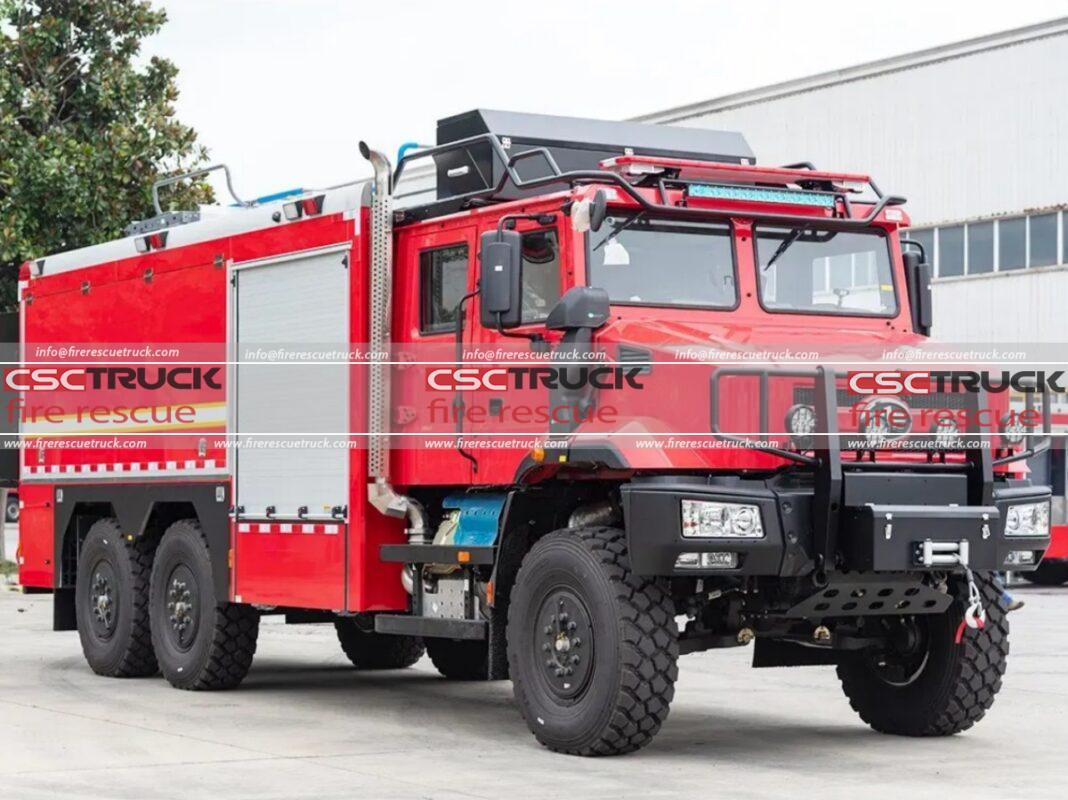
Modern emergency response increasingly depends on vehicles that can operate far beyond paved roads. The CSCTRUCK Fire Rescue Truck 6×6 fire rescue trucks are specifically engineered for these demanding conditions, combining heavy-duty firefighting systems with military-grade off-road mobility.
Designed for wildland firefighting, mining zones, deserts, flood regions, and disaster relief operations, these vehicles are built to reach places where standard fire engines would simply become stuck or fail to operate. Among all challenging terrains, mud is one of the most demanding environments—so can a 6×6 fire truck really handle it? The short answer is yes, but the real explanation lies in how these machines are engineered.
Understanding Why Mud Is So Challenging
Mud is one of the most difficult terrains for any heavy vehicle because it reduces tire grip, increases rolling resistance, and can quickly trap wheels in deep ruts. For emergency vehicles, this creates serious risks:
- Loss of traction
- Wheel spinning and sinking
- Engine strain due to resistance
- Reduced steering control
- Potential immobilization
Standard urban fire trucks are not designed for such conditions. However, 6×6 fire trucks are built specifically to overcome these obstacles.

Why a 6×6 Fire Truck Performs Well in Mud
A 6×6 fire truck is fundamentally different from a standard 4×2 or 4×4 fire engine. The additional driven axle gives it a major advantage in off-road environments.
1. Full-Time All-Wheel Drive System
Most 6×6 fire trucks use permanent or selectable all-wheel drive systems that distribute power across all 3 axles. This means:
- More wheels actively pushing the vehicle forward
- Reduced risk of single-wheel slip
- Better energy distribution in soft terrain
With more contact points, the truck is far less likely to get stuck in mud compared to conventional vehicles.
2. Superior Traction and Ground Contact
Mud reduces friction, so increasing the number of driven wheels improves stability. A 6×6 configuration ensures:
- Greater tire-to-ground engagement
- Reduced ground pressure per wheel
- Improved forward momentum even in soft soil
This is especially important for heavy rescue vehicles carrying water, foam, and equipment.
3. High-Torque Heavy-Duty Engines
6×6 fire trucks are powered by high-output diesel engines designed for torque rather than speed. This allows them to:
- Push through resistance-heavy terrain
- Maintain movement even when wheels slip slightly
- Recover quickly from low-traction situations
This torque advantage is essential when driving through thick, sticky mud.
4. Differential Locks for Maximum Control
One of the most important systems in off-road fire trucks is the differential lock. When engaged, it ensures both wheels on an axle rotate together, preventing power loss in slippery conditions.
In mud, this means:
- No single wheel spins freely
- Continuous power delivery to all wheels
- Improved escape capability from soft ground
5. Off-Road Tires and High Ground Clearance
6×6 fire trucks are equipped with:
- Deep-tread off-road tires designed to “bite” into mud
- Reinforced sidewalls to resist punctures
- High ground clearance to prevent chassis drag
These features prevent the vehicle from sinking and help maintain forward movement.
Real-World Performance in Muddy Environments
In practical emergency operations, 6×6 fire trucks are commonly deployed in:
- Flooded disaster zones
- Monsoon-affected rural regions
- Oil fields and mining sites with clay-rich soil
- Forest firefighting operations after heavy rain
Reports from off-road fire apparatus manufacturers show that 6×6 platforms can maintain mobility even in deep mud conditions where standard 4×2 vehicles fail.
The combination of traction systems, drivetrain design, and weight distribution allows these trucks to continue moving through terrain that would immobilize conventional fire engines.

Limitations: When Mud Still Becomes a Challenge
While 6×6 fire trucks are highly capable, they are not invincible. Certain conditions can still cause difficulty:
- Extremely deep or waterlogged mud
- Lack of forward momentum at the entry point
- Steep muddy slopes without traction
- Improper tire pressure or maintenance issues
In extreme cases, even 6×6 vehicles may require winching or recovery assistance. However, compared to standard fire trucks, their operational threshold is significantly higher.
How Fire Departments Use 6×6 Trucks in Mud-Prone Areas
Fire and rescue agencies deploy 6×6 fire trucks strategically in environments where mud is expected:
- Wildland fire zones during rainy seasons
- Rural and agricultural regions
- Temporary disaster relief routes
- Construction or industrial emergency sites
Their ability to reach isolated locations ensures that firefighting and rescue operations are not delayed by terrain conditions.

Key Advantages Summary
In muddy conditions, a 6×6 fire truck provides:
- Stronger traction from three driven axles
- Improved stability and weight distribution
- High-torque engine performance
- Advanced differential lock systems
- Specialized off-road tires
- Higher ground clearance
These combined features make it one of the most capable emergency vehicles for soft and unstable terrain.
Conclusion
Yes, a 6×6 fire truck can drive in mud—and it is specifically designed to do exactly that. While mud remains one of the toughest terrains for any vehicle, the engineering behind 6×6 fire rescue platforms gives them a clear advantage in traction, stability, and endurance.
With manufacturers like CSCTRUCK Fire Rescue Truck developing increasingly advanced all-terrain firefighting systems, these vehicles play a crucial role in ensuring emergency response teams can operate effectively in even the most extreme environmental conditions.
In short, when the road disappears and turns into mud, a 6×6 fire truck is built to keep going.