
1. What Is a Heavy-Duty Multipurpose Fire Engine?
A heavy-duty multipurpose fire engine is a specialized firefighting vehicle that integrates several emergency response functions into 1 platform. Unlike conventional fire engines designed primarily for water-based firefighting, multipurpose models can be configured to perform multiple tasks, including water spraying, foam suppression, fire monitoring, emergency rescue, and auxiliary firefighting operations.
Depending on the application, the vehicle can be equipped with a water tank, foam tank, high-pressure fire pump, firefighting monitor, hose reels, ladders, rescue equipment, and other specialized accessories. Some configurations also support dry chemical powder systems or additional firefighting agents to improve suppression capabilities in industrial environments.
The main advantage of this integrated design is that emergency response teams can use one vehicle to perform several operations, reducing the need to deploy multiple specialized vehicles at the same incident.
2. Heavy-Duty Chassis and Powerful Engine Performance
The chassis is one of the most important components of a heavy-duty multipurpose fire engine. Since the vehicle must carry substantial quantities of water, foam concentrate, firefighting equipment, and rescue tools, it requires a robust chassis with sufficient load-bearing capacity and structural strength.
Depending on operational requirements, manufacturers can provide 4×2, 4×4, 6×4, 6×6, or 8×4 chassis configurations. 4-wheel-drive models are particularly suitable for rural areas, construction sites, mountainous regions, and industrial facilities with challenging road conditions. Larger 6×4 and 8×4 configurations offer increased carrying capacity for high-volume firefighting operations.
Powerful diesel engines provide the torque and horsepower necessary to transport heavy loads while maintaining reliable performance over long distances. Advanced transmission systems, reinforced suspension, and dependable braking systems further improve vehicle stability and driving safety.
For customers operating in demanding environments, optional configurations may include off-road tires, differential locks, reinforced bumpers, and additional chassis protection.

3. Integrated Fire Suppression Systems
The firefighting system determines the vehicle’s ability to control different types of fires. A heavy-duty multipurpose fire engine can integrate several suppression technologies according to the intended application.
Water firefighting system: A large-capacity water tank supplies water to the fire pump, hose outlets, and firefighting monitor. High-flow water delivery is suitable for structural fires, outdoor fires, warehouses, and general emergency response.
Foam firefighting system: A foam proportioning system mixes foam concentrate with water to produce firefighting foam. This solution is particularly useful for flammable liquid fires involving petroleum products, fuel storage facilities, chemical plants, and industrial equipment.
Dry chemical powder system: For specialized configurations, a dry powder extinguishing system can be installed to address certain flammable liquid and gas fires. Powder systems can complement water and foam equipment in environments with multiple fire hazards.
High-pressure firefighting system: High-pressure pumps and specialized spray equipment provide flexible water delivery for targeted firefighting operations. Depending on the configuration, the system can improve water efficiency and support firefighting in areas that are difficult to access.
By integrating different suppression technologies, the vehicle can provide more comprehensive emergency response capabilities than a conventional water-only fire engine.
4. High-Performance Fire Pump and Monitor
The fire pump is the central component of the vehicle’s water and foam delivery system. A heavy-duty multipurpose fire engine can be equipped with a high-performance centrifugal fire pump designed to provide stable pressure and sufficient flow for different firefighting tasks.
Depending on the vehicle configuration, the pump can support front, side, and rear water outlets, hose connections, and roof-mounted firefighting monitors.
A roof-mounted fire monitor allows operators to discharge large volumes of water or foam over considerable distances. It is particularly useful when fighting fires in large industrial buildings, storage yards, fuel depots, and open areas.
Some models can also be equipped with remote-controlled monitors, allowing firefighters to adjust the water flow and spraying direction from a safer operating position.
The combination of a reliable fire pump, efficient piping system, and adjustable monitor improves firefighting efficiency while reducing the physical workload of emergency personnel.
5. Multifunctional Rescue Equipment
In addition to firefighting, a multipurpose fire engine can carry various rescue tools to support emergency response operations. These accessories can be selected according to local rescue requirements and the intended application.
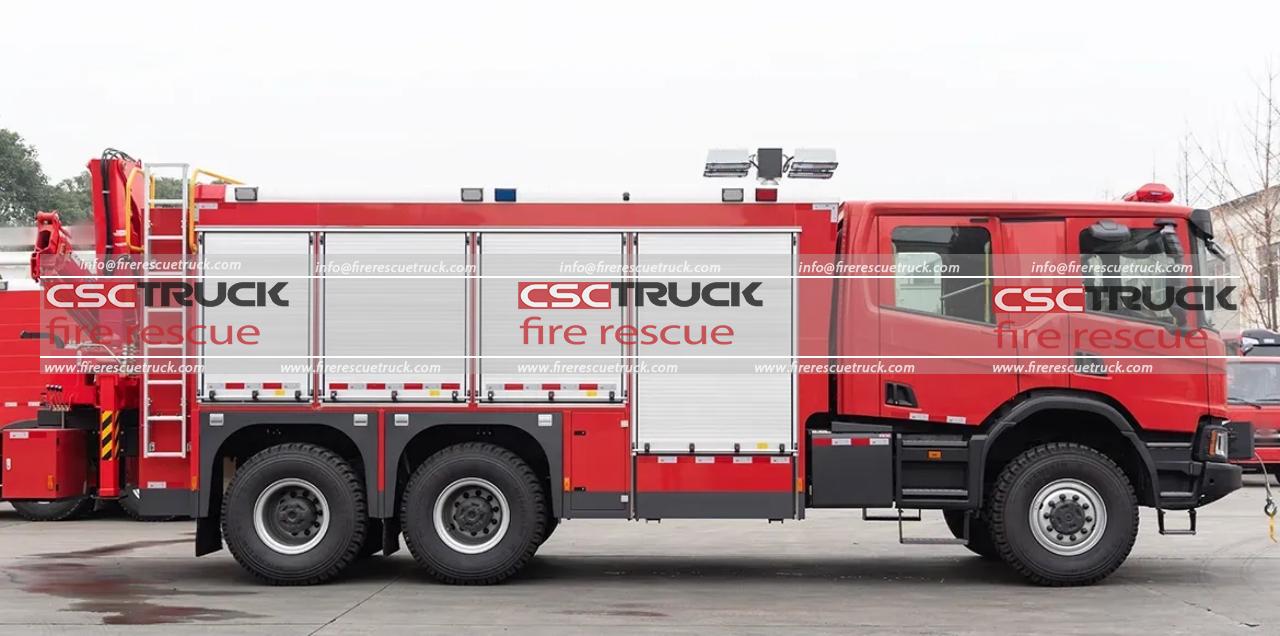
Common equipment includes hydraulic rescue tools, cutting equipment, lifting bags, portable generators, searchlights, safety ropes, ladders, breathing apparatus, first-aid supplies, and protective equipment.
Hydraulic cutting and spreading tools are particularly useful for vehicle accident rescue, allowing firefighters to remove damaged vehicle components and help trapped occupants. Portable lighting systems improve visibility during nighttime operations, while generators provide electricity for rescue equipment and temporary emergency lighting.
The vehicle can also be configured with storage compartments, equipment racks, and dedicated mounting brackets to ensure that rescue tools remain organized, accessible, and securely stored during transportation.
6. Large-Capacity Tanks and Intelligent Equipment Layout
Tank capacity is another important consideration when selecting a heavy-duty multipurpose fire engine. Larger water tanks allow firefighters to operate for longer periods before replenishment, making them valuable for industrial sites, remote areas, and locations without reliable water supplies.
Depending on the chassis and application, the vehicle can be designed with different water and foam tank capacities. Tank materials may include stainless steel, carbon steel, or other suitable corrosion-resistant materials, depending on the firefighting medium and operating conditions.
The internal equipment layout should prioritize safety, accessibility, and maintenance convenience. Separate storage compartments can accommodate hoses, nozzles, rescue tools, protective clothing, and other emergency accessories.
A well-organized vehicle design enables firefighters to locate essential equipment quickly and reduces preparation time during emergency response.
7. Wide Range of Applications
Heavy-duty multipurpose fire engines are suitable for various firefighting and rescue environments.
- Municipal fire departments: Supporting urban firefighting, traffic accident rescue, and general emergency response.
- Industrial facilities: Providing firefighting support for manufacturing plants, warehouses, workshops, and production facilities.
- Petroleum and chemical industries: Combining water and foam systems to address specific flammable liquid fire risks.
- Mining and construction sites: Delivering firefighting equipment and rescue tools to challenging working environments.
- Airports and transportation facilities: Supporting emergency response operations where rapid deployment and multifunctional equipment are important.
- Remote communities: Providing integrated firefighting capabilities in areas with limited access to specialized emergency vehicles.
Its versatility makes the heavy-duty multipurpose fire engine a practical investment for organizations that need flexible emergency response capabilities.
8. Why Choose CSCTRUCK Fire Rescue Truck?
CSCTRUCK Fire Rescue Truck is a professional Chinese manufacturer and supplier of specialized fire rescue vehicles, offering a broad range of firefighting trucks and customized emergency response solutions.
With experience in the special-purpose vehicle industry, CSCTRUCK Fire Rescue Truck provides different types of fire engines designed for municipal firefighting, industrial fire protection, high-rise rescue, and specialized emergency applications. Its product portfolio includes water tank fire trucks, water foam fire trucks, dry powder fire trucks, CAFS fire trucks, aerial platform fire trucks, aerial ladder fire trucks, and multipurpose fire engines.
One of the key advantages of CSCTRUCK Fire Rescue Truck is its ability to provide customized vehicle configurations based on customers’ operational requirements. Buyers can select suitable chassis brands, engine specifications, tank capacities, fire pump models, firefighting monitors, and auxiliary rescue equipment.
CSCTRUCK Fire Rescue Truck also supports OEM and ODM requirements, helping customers develop vehicles that meet specific working conditions and local market demands. Its engineering team can assist with technical configuration, equipment selection, and vehicle customization. Export and international order support are also available to help overseas customers with procurement and delivery arrangements.
For fire departments, industrial operators, distributors, and government procurement organizations, CSCTRUCK Fire Rescue Truck offers a practical source for exploring heavy-duty multipurpose fire engines and other specialized firefighting vehicles.

9. How to Select the Right Heavy-Duty Multipurpose Fire Engine
Before purchasing a heavy-duty multipurpose fire engine, buyers should evaluate several important technical and operational factors.
First, determine the primary firefighting applications. Municipal fire departments may prioritize water capacity and general rescue equipment, while petroleum and chemical facilities may require larger foam systems or dry chemical powder equipment.
Second, select a chassis with sufficient load capacity, engine power, and appropriate drivetrain performance. Road conditions, terrain, vehicle dimensions, and local regulations should all be considered.
Third, evaluate the fire pump’s rated flow and pressure, firefighting monitor performance, tank capacity, and hose connections. These specifications directly influence the vehicle’s firefighting capabilities.
Finally, consider equipment accessibility, maintenance requirements, operator training, spare parts availability, and after-sales technical support. A suitable fire engine should not only meet initial procurement requirements but also provide dependable performance throughout its service life.
Conclusion
A Heavy-Duty Multipurpose Fire Engine combines powerful firefighting systems, substantial tank capacity, reliable chassis performance, and versatile rescue equipment into 1 integrated emergency response vehicle. Its ability to handle different fire suppression and rescue tasks makes it an effective solution for municipal fire departments, industrial facilities, petroleum installations, and other demanding environments.
For organizations seeking a customized firefighting vehicle, CSCTRUCK Fire Rescue Truck provides a range of multipurpose fire engines and specialized fire rescue solutions. By selecting the appropriate chassis, firefighting systems, tank configuration, and rescue equipment, customers can obtain a heavy-duty emergency vehicle tailored to their operational needs.