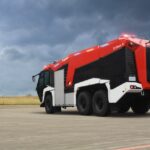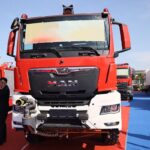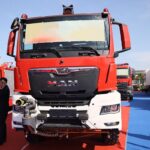

Air travel relies heavily on rigorous safety regimes — and at the heart of airport emergency response are specialized fire trucks known as Airport Rescue and Firefighting (ARFF) vehicles, or “airport crash tenders.” These vehicles differ substantially from municipal fire engines: They are purpose-built for aircraft fires, capable of carrying large volumes of water and foam, deploying specialized extinguishing agents, and traversing airports — and sometimes rough terrain beyond — at high speeds.
In this article, we compare prominent types of airport fire trucks used across different countries, highlight their design and operational features, and examine how regional needs and standards shape their deployment.
What Makes ARFF Trucks Unique
Airport crash tenders are not ordinary fire engines. Their design, extinguishing systems, and capabilities are specifically tailored to the demands of aviation– where fires often involve jet fuel, require rapid suppression, and sometimes demand interior aircraft penetration.
Key distinguishing features include:
- Large‑capacity tanks: ARFF trucks carry far more water and foam than typical structural fire engines — commonly in the range of 1,500 to 4,500 gallons of water, and hundreds of gallons of Aqueous Film Forming Foam (AFFF), critical for suppressing fuel fires.
- Multiple extinguishing agents: In addition to water and foam, they often carry clean agents (e.g., Halotron), dry chemicals, or even dual‑agent systems combining foam and dry chemical to tackle complex fuel-based fires safely.
- High‑performance pumps and delivery systems: ARFF pumps deliver up to 1,000–2,500 gallons per minute (GPM), with remote‑controlled roof‑mounted or bumper nozzles, and sometimes “snozzles” or piercing nozzles — capable of penetrating an aircraft fuselage to inject suppressant inside cabins or cargo holds.
- Mobility and terrain adaptability: Many ARFF trucks are built on 4×4, 6×6, or even 8×8 chassis, enabling them to navigate runways, aprons, unpaved terrain, or even off-airport zones if necessary. Some 8×8 units feature steerable front wheels to improve the turning radius.
These capabilities make ARFF vehicles the backbone of airport firefighting, especially for rapid response, large‑scale fuel fires, and scenarios where traditional fire engines would be ineffective.
Leading ARFF Trucks: Global Examples
Here are a few of the most widely used — and world-renowned — ARFF vehicles, reflecting design philosophies from different regions.
Oshkosh Striker (USA / global)
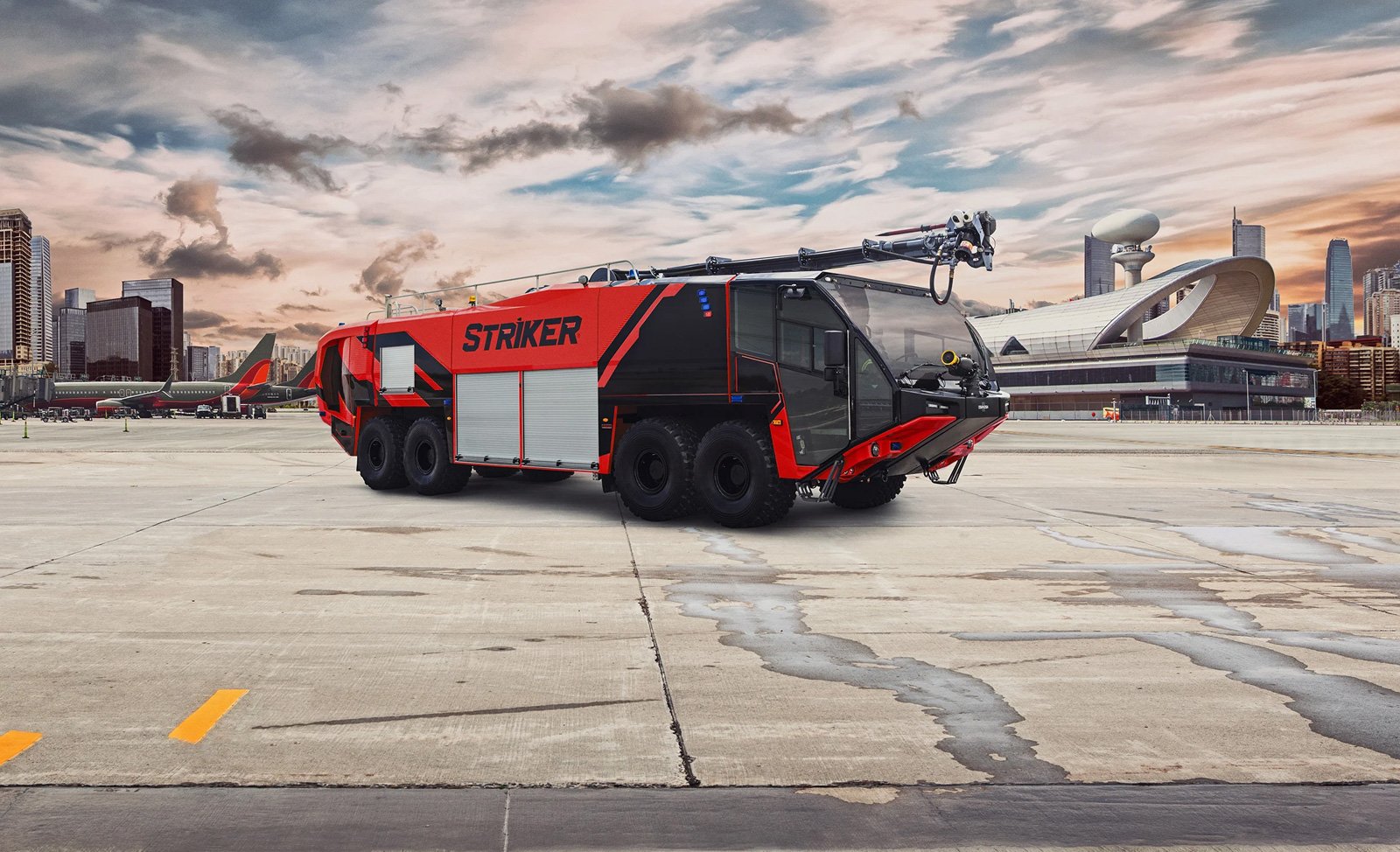


- Produced by Oshkosh Corporation, the Striker is among the most popular ARFF vehicles globally.
- Available in 4×4, 6×6, and 8×8 chassis configurations to match different airport sizes and risk categories.
- For example, the Striker 3000 (6×6) has a 3,000-gallon water tank and significant foam & dry‑agent capacity. The 8×8 model can carry up to 4,500 gallons of water, making it well-suited for major international airports.
- Many units include a “snozzle” — a piercing turret nozzle to deliver extinguishing agent inside aircraft fuselages — vital for interior cabin or cargo fires inside an aircraft.
Because of its flexibility and modularity, the Striker is used in airports worldwide, adapted to local needs and regulations.
Rosenbauer Panther (Europe, Asia, worldwide)

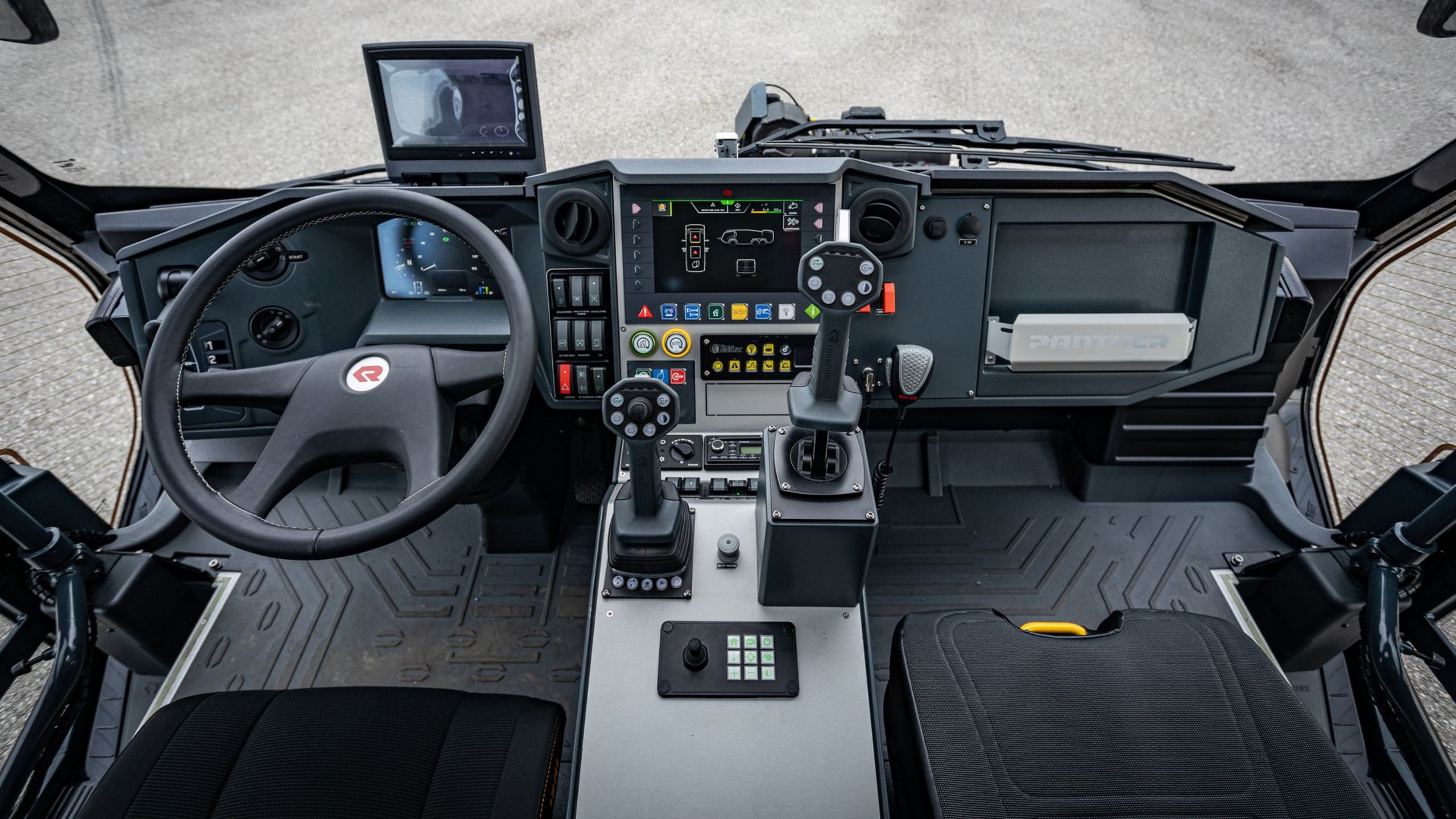

- Manufactured by Rosenbauer (Austria), the Panther line is widely used across Europe, Asia, and other regions.
- Available in 4×4, 6×6, and 8×8 versions. In its 8×8 configuration, it can accommodate large extinguishing agent volumes (for example, many thousands of liters) and is built for high-speed response.
- Rosenbauer emphasizes modularity: depending on needs, the “MT Airport” concept allows for adjustable compartment layouts, variable tank sizes, and tailored firefighting equipment — making Panther trucks adaptable to a wide variety of airports (large, small, paved, unpaved, domestic, international).
- Because they meet relevant international ARFF standards, Panther trucks are often used at airports worldwide.
For many European and non-U.S. airports, Panther trucks provide a balance of power, versatility, and compliance with local aviation fire safety regulations.
Other Notable Types
Depending on regional requirements, you will also find ARFF trucks such as E‑ONE Titan (USA), lighter ARFF trucks suited for smaller airports, or vehicles from other manufacturers like Magirus DRAGON X6 TEP, or even custom-built ARFF units on various chassis for specific environments.
- Some ARFF trucks are designed for “major foam tender” roles: Carrying large volumes of water/foam and delivering them quickly across airport grounds.
- Others focus on High-Reach Extendable Turret (HRET) capability, with “snozzles” that can pierce into aircraft fuselages to fight internal fires.
- For smaller airports or less busy airfields, more compact 4×4 or 6×6 ARFF trucks may suffice.
How Airport Type, Geography, and Regulatory Standards Influence ARFF Choices
Not all airports are equal — the size of aircraft, volume of traffic, regional terrain, and regulatory requirements shape what kind of ARFF trucks are deployed.
Regulatory Framework & Airport Category
Globally, airports often follow guidelines set by regulatory organizations, such as the International Civil Aviation Organization (ICAO) standards. Under such standards — or similar national standards — the required firefighting coverage depends on the size and type of aircraft the airport serves. This means large international hubs housing heavy, wide-body aircraft need ARFF trucks with higher extinguishing agent capacity, stronger pumps, and rapid‑response capabilities.
Conversely, smaller regional airports — serving light aircraft or short‑haul flights — may meet requirements with smaller 4×4 or 6×6 ARFF trucks carrying less water/foam.
Geography, Terrain & Infrastructure
In regions with challenging terrain, unpaved airfields, or remote airstrips — for instance, in developing countries, smaller regional airports or military airbases — ARFF trucks must be robust, off‑road capable, and versatile. This is why some providers build ARFF trucks on rugged chassis or offer modular, customizable designs for flexibility.
For large, modern international airports with paved runways and high aircraft traffic, the priority might be on high-capacity water/foam, high-speed deployment, and advanced suppression systems (HRET, multiple agents, rapid extinguish).
Operational Philosophy & Risk Assessment
Different airports may prioritize different operational philosophies. For example:
- Some airports prefer major foam tenders with large volume capacity to quickly suppress large external fuel fires on runways or aprons.
- Others emphasize HRET-equipped ARFF trucks capable of penetrating aircraft fuselages to fight cabin or cargo fires — essential for wide‑body passenger jets.
- Some may retain a mix — smaller, nimble vehicles for rapid initial response, plus larger “tenders” for sustained firefighting — to offer layered response capability.
Comparative View: ARFF Practices Around the World
| Region / Country / Use-case | Common ARFF Truck Types | Key Design/Operational Features | Why this setup |
|---|---|---|---|
| Large U.S. international airports | Oshkosh Striker (6×6, 8×8), E‑ONE Titan, sometimes 4×4 for smaller airports | High water/foam capacity, multiple agents (foam, dry chemical, clean agents), snozzle/HRET options, high‑speed chassis | Meets strict certification/regulations (e.g., Federal Aviation Administration — FAA), needs capability for big aircraft fires, rapid response |
| European & global hubs | Rosenbauer Panther (4×4/6×6/8×8), custom ARFF by European manufacturers | Modular build, high extinguishing capacity, off‑road capable chassis, multi‑agent, often HRET/nozzle | Variety of airport sizes & regulations, modularity for different airport categories, compliance with local ARFF standards |
| Smaller regional or remote airports | 4×4 / 6×6 ARFF trucks, lighter tenders, sometimes custom-built rugged units | Lower capacity water/foam tanks, simpler pump/nozzle systems, more emphasis on mobility/off‑road | Less traffic, smaller aircraft, limited infrastructure, and cost-effectiveness |
| Mixed-use / Specialized airports (e.g., military, remote airbases) | Off‑road capable ARFF (e.g., backbone‑chassis trucks), custom units | High terrain adaptability, robust suspension/chassis, flexible extinguishing systems | Handling rough terrain, remote operations, dual-use as fire-rescue and structural fire support |
Technological Trends & Future Directions
Over the decades, ARFF design and technology have evolved considerably. Some of the major advances and current trends include:
- Modularity and customization: Manufacturers allow airports to specify tank capacities, body configurations, agent delivery systems, and chassis types — offering tailored solutions depending on the airport’s traffic, aircraft types, and local environment.
- High‑Reach & Penetration Technology: The use of extendable booms and piercing “snozzles” has become standard for many large‑airport crash tenders, enabling internal firefighting inside aircraft fuselages — critical for modern aircraft with large passenger/cargo capacity.
- Multi-agent and dual‑agent firefighting systems: Rather than just water, ARFF trucks now routinely integrate foam, clean agents, and dry chemicals — sometimes simultaneously — to suppress jet-fuel, oil, and electrical fires more effectively.
- Compliance with international standards and interoperability: Especially for airports serving international carriers, ARFF trucks are designed to meet global standards (for example, ICAO‑aligned requirements), enabling consistent safety regardless of geography or operator.
- Mixed terrain/off‑road capability: For airports in remote or rugged areas — or those where runway safety zones may not be paved — ARFF trucks are built on off-road-ready chassis with strong suspension, high ground clearance, and durable build quality.
Looking ahead, we may see – especially in developing regions or newly built airports — even more customized ARFF configurations, increased use of modular, scalable designs, and possibly integration with other rescue systems (drones, remote‑controlled suppression robots, advanced sensors) to complement traditional crash tenders.
Challenges and Considerations
While ARFF trucks are indispensable, there are several challenges and trade-offs:
- Cost vs. Necessity: High-capacity 8×8 ARFF trucks are expensive to purchase, maintain, and operate. For smaller airports, investing in such heavy apparatus may not be cost-effective. That’s why many airports opt for smaller 4×4 or 6×6 units or as-needed modular solutions.
- Training and standardization: Effective use of ARFF vehicles — especially those with HRET, multiple agents, or complex pumping systems — requires well-trained crews. Compliance with international or national regulations (response times, agent volumes, crew readiness) adds complexity.
- Logistics and maintenance: Large ARFF vehicles, with powerful engines, complex nozzles, and multiple extinguishing systems, demand rigorous maintenance regimes. In some regions, especially with limited infrastructure, keeping them operational may be challenging.
- Adaptability to local needs: Airports vary widely, from major international hubs to small remote airstrips. A one-size-fits-all ARFF approach rarely works; choosing the right truck requires balancing risk, traffic, aircraft type, terrain, and budget.
Conclusion: No Universal “Best” — But Context Matters
There is no single “best” airport fire truck — rather, there are solutions optimized for different contexts. The ideal ARFF fleet for a mega international hub housing wide-body jets will look very different from that of a small regional airfield handling propeller aircraft or light jets.
Global leaders such as Oshkosh Striker and Rosenbauer Panther exemplify the peak of ARFF design — powerful, modular, high-capacity, globally deployable. At the same time, smaller or custom-built ARFF trucks serve vital roles at smaller airports, remote runways, or specialized airbases, where agility, off-road capability, and cost-effectiveness matter more than sheer capacity.
Ultimately, the “comparative study” of airport fire trucks underscores one thing: Airport safety is deeply contextual. The combination of runway size, aircraft type, flight volume, geography, and regulatory environment dictates what kind of crash tender a given airport should — and will — deploy.
In that sense, ARFF trucks around the world reflect not just engineering excellence, but also a tailored approach to safety — a critical factor in ensuring that, no matter where you fly, there are capable guardians ready to respond.