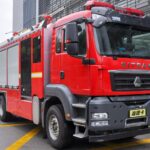
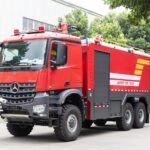
A 6×6 fire truck is built for demanding emergency operations where mobility, traction, and firefighting capability are more important than fuel economy alone. With 3 driven axles and a heavy-duty chassis, this type of fire truck can travel across mud, gravel, steep terrain, and other difficult surfaces. However, one common question from fire departments and fleet managers is: What is the fuel consumption of a 6×6 fire truck?
The short answer is that a typical 6×6 fire truck may consume approximately 30–60 liters of diesel per 100 kilometers (L/100 km) under normal road and operational conditions. In severe off-road conditions, during heavy acceleration, or while carrying a large firefighting payload, consumption can be considerably higher. The exact figure depends on the chassis, engine, vehicle weight, terrain, and driving conditions.
Introduction to CSCTRUCK Fire Rescue Truck
As a professional manufacturer of fire and rescue vehicles, CSCTRUCK Fire Rescue Truck provides a wide range of emergency vehicles, including custom 4WD and 6WD fire trucks for demanding global operations. Its 6×6 fire truck solutions are designed for applications such as airport rescue and firefighting, petrochemical facilities, military bases, mining areas, and large industrial sites. CSCTRUCK Fire Rescue Truck also supports customized vehicle configurations based on different chassis, payload, terrain, and firefighting requirements.
Typical Fuel Consumption of a 6×6 Fire Truck
In practical terms, 30–60 L/100 km is a reasonable general estimate for a heavy 6×6 fire truck. However, this should not be treated as a fixed specification for every model.
For example, a relatively lightweight 6×6 fire truck with a modern diesel engine and efficient transmission may achieve fuel consumption closer to the lower end of this range during highway driving. A large airport rescue fire truck with a high-power engine, a full water and foam load, and specialized firefighting equipment may use considerably more fuel.
In some extreme operating situations, fuel consumption may exceed 60 L/100 km. This is particularly possible when the truck operates continuously in low gear, travels on steep slopes, or drives over soft and uneven ground.
The most important point is that 6×6 fire truck fuel consumption should be evaluated according to the vehicle’s mission rather than compared directly with an ordinary road truck.
Why Does a 6×6 Fire Truck Use More Fuel?
There are several important reasons why a 6×6 fire truck generally consumes more fuel than a standard 4×2 or 6×4 truck.
1. 3 Driven Axles
The biggest difference is the 6×6 drivetrain. All 6 wheels are powered, which significantly improves traction on difficult terrain. However, powering three axles also creates additional mechanical resistance and requires more energy from the engine.
When the truck is driving on a normal paved road, this additional capability may not always be needed. But when the vehicle enters mud, sand, forest trails, or steep terrain, the 6×6 system becomes extremely valuable.
2. Heavy Vehicle Weight
A fire truck carries much more than a standard truck. Depending on the design, it may carry a large water tank, foam tank, pump, hoses, firefighting equipment, rescue tools, and crew.
For example, heavy-duty 6WD firefighting configurations can be equipped with water capacities up to 13,500 liters and foam capacities up to 1,700 liters.
Water is particularly important when calculating fuel consumption. One liter of water weighs approximately one kilogram. Therefore, a large water tank can add many tons to the operating weight of the vehicle. The heavier the fire truck, the more fuel the engine needs to accelerate and climb hills.
3. High-Power Diesel Engine
Many 6×6 fire trucks use powerful diesel engines because they need high torque and rapid acceleration. This is especially important for airport rescue and firefighting vehicles or trucks operating in remote industrial areas.
A high-power engine can provide excellent performance, but fuel consumption is usually higher than that of a smaller engine. The engine must also be capable of moving a fully loaded vehicle quickly in emergency conditions.
4. Off-Road Driving
Terrain has a major impact on fuel consumption. On a flat highway, a 6×6 fire truck may operate at a relatively stable speed. However, off-road driving is very different.
Mud, sand, rocks, steep slopes, and frequent speed changes all increase fuel use. In some situations, the truck may need to operate in low-range gears or maintain high engine speed to preserve traction. As a result, fuel consumption can rise significantly.
Does Operating the Fire Pump Increase Fuel Consumption?
Yes, operating the fire pump can increase fuel consumption, although the exact effect depends on the fire truck’s design.
Some fire trucks use a power take-off system to drive the fire pump. When the pump is operating, the engine must provide additional power. A high-pressure pump working continuously at a high output can therefore increase the engine’s fuel demand.
However, the fuel used by the pump is normally much less important than the fuel consumed while driving a heavy 6×6 truck over difficult terrain. In other words, the vehicle’s total operating fuel consumption depends on both driving time and firefighting system operation.
For this reason, fleet managers should consider fuel consumption on an hourly basis as well as a per-100-kilometer basis.
How Can Fuel Consumption Be Reduced?
Although a 6×6 fire truck is designed for emergency performance, several measures can help reduce fuel consumption.
First, correct tire pressure is important. Underinflated tires create greater rolling resistance and can increase fuel use. For vehicles operating on different surfaces, tire pressure should follow the manufacturer’s recommended operating requirements.
Second, unnecessary idling should be avoided whenever operationally safe. Fire trucks may spend considerable time waiting at a scene, and extended engine idling can consume fuel without moving the vehicle.
Third, regular maintenance is essential. Clean air filters, properly serviced fuel systems, correct engine oil, and a well-maintained transmission all contribute to efficient operation.
Finally, driver training can make a significant difference. Smooth acceleration, avoiding unnecessary high engine speeds, and selecting the correct drivetrain mode for the terrain can help reduce fuel consumption.
Conclusion
So, what is the fuel consumption of a 6×6 fire truck? In general, a heavy 6×6 fire truck may consume approximately 30–60 L/100 km, while difficult terrain, heavy payloads, and severe emergency operations can push fuel consumption even higher.
Nevertheless, fuel economy is only one part of the vehicle’s overall performance. A 6×6 fire truck is designed to provide reliable access and firefighting capability in locations where ordinary vehicles may not be able to operate. With its 6WD drivetrain, high ground mobility, large firefighting capacity, and powerful engine, it offers essential performance for demanding emergency missions.
CSCTRUCK Fire Rescue Truck focuses on customized fire and rescue vehicle solutions for different operational environments. By selecting the appropriate chassis, engine, tank capacity, and firefighting system, customers can balance mobility, firefighting performance, and operating efficiency according to their specific requirements.