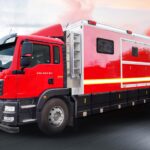
In the complex landscape of modern disaster response and crisis management, mobility, adaptability, and rapid deployment are key to saving lives and maintaining operational effectiveness. The emergency combat support caravan stands as a highly specialized mobile unit designed to deliver immediate logistical, medical, and operational support during emergency and disaster relief missions. Developed to function in both civilian disaster zones and combat-like emergency environments, this mobile caravan integrates advanced communication, power generation, and field logistics technologies, making it an indispensable asset for emergency response teams, humanitarian organizations, and military support operations.
1. Concept and Purpose
The emergency combat support caravan is essentially a mobile command and support center that brings critical infrastructure and services directly to the field. It is designed to operate autonomously in remote or devastated areas where traditional facilities and utilities may be unavailable. The caravan serves as a rapid-response base, capable of housing communication systems, first-aid facilities, logistics coordination tools, and even temporary accommodation for field personnel.
Its core purpose is to bridge the gap between the disaster site and central command, enabling real-time coordination, immediate relief distribution, and sustained field operations. Whether deployed in earthquake-hit regions, post-flood environments, wildfire recovery zones, or large-scale humanitarian crises, this caravan ensures that essential support functions can continue without interruption.
2. Structural Design and Build
The emergency combat support caravan is typically constructed using heavy-duty, all-terrain mobile platforms such as reinforced truck chassis or semi-trailer bases. The exterior shell is made from high-strength steel or aluminum alloy panels, providing durability and resistance to environmental stresses like debris impact, heat, and corrosion. Some variants feature armored protection, especially in conflict-affected or unstable areas where security risks are elevated.
Inside, the caravan is modular and highly customizable. It can be divided into sections such as:
Command and control area – Equipped with multi-screen displays, satellite communication systems, and digital mapping tools.
Logistics compartment – For storing food, medical supplies, repair tools, and personal protective equipment (PPE).
Medical bay – Outfitted with first-aid kits, stretchers, defibrillators, and other emergency medical gear.
Power and water systems area – Containing generators, battery packs, and water filtration units.
Crew rest and operation quarters – With basic amenities for long-duration missions.
Each compartment is designed for quick transformation depending on mission needs—making the caravan a versatile and multifunctional field asset.
3. Mobility and Deployment Capabilities
Mobility is at the heart of the caravan’s design. It features high ground clearance, 4×4 or 6×6 drive systems, and heavy-duty suspension, allowing it to traverse rough terrains, mud, or rubble-strewn disaster areas. The unit can be deployed within hours of activation, often accompanied by auxiliary vehicles such as fuel trucks, water carriers, or UAV transporters.
Once on-site, the caravan can set up operational readiness in less than 30 minutes. Hydraulic leveling systems stabilize the vehicle, while retractable awnings and fold-out modules extend its functional workspace. Solar panels and telescopic communication masts can be deployed automatically, ensuring the caravan becomes a fully functional operations base almost instantly after arrival.
4. Power, Communication, and Connectivity
Reliable communication and energy independence are vital for field operations. The Emergency Combat Support Caravan is equipped with:
Diesel or hybrid generators provide steady power output for onboard systems.
Renewable energy integration, such as solar panels and wind turbines, for sustainable operations.
Battery storage units to maintain power continuity during generator downtime.
Satellite communication antennas enable global connectivity where conventional networks are unavailable.
VHF/UHF radios and data terminals for local and regional communications between field units.
Secure data networks, including encrypted Wi-Fi and cloud access for coordination with command centers.
These integrated systems ensure uninterrupted communication with higher authorities, field teams, and other agencies, facilitating efficient coordination in chaotic environments.
5. Operational Roles in Disaster Relief
The caravan plays a central role in diverse emergency scenarios:
a. Command and Coordination Hub
The caravan serves as a mobile headquarters for emergency management leaders, offering real-time information sharing and situational awareness. It can track field teams, coordinate resource deployment, and host meetings through digital conference systems.
b. Medical and Humanitarian Support
With onboard medical equipment and supply storage, the caravan acts as a field treatment station for first responders and victims. It supports triage operations, basic medical care, and coordination of medevac logistics.
c. Logistics and Supply Management
The caravan’s storage and tracking systems help manage food, water, and material distribution. It can also support vehicle maintenance, fuel management, and resupply operations for extended field missions.
d. Communication Relay Node
In areas where disaster has destroyed communication networks, the caravan functions as a temporary network hub, reestablishing connectivity for emergency personnel and even local civilians.
e. Shelter and Rest Base
For field crews working in prolonged missions, the caravan offers safe rest and recovery facilities—including climate control, bunk space, and sanitation systems.
6. Advanced Technologies and Features
Modern Emergency Combat Support Caravans integrate cutting-edge technologies to enhance performance and situational awareness:
AI-driven command software for logistics and task coordination.
Real-time GIS mapping and drone-linked surveillance for field assessments.
Thermal imaging systems for night operations and search efforts.
Water purification systems provide clean drinking water from local sources.
Integrated weather monitoring units for forecasting and safety planning.
Smart storage systems with RFID tagging for inventory control.
Some high-end variants even feature autonomous driving support or remote operation capabilities, allowing the caravan to reposition itself without a driver in hazardous environments.
7. Benefits and Strategic Importance
The emergency combat support caravan provides numerous operational and strategic advantages:
Rapid response to emergencies with self-contained support infrastructure.
Enhanced coordination among diverse response agencies.
Reduced downtime between mobilization and active operation.
Improved safety for responders through secure, climate-controlled facilities.
Long-term sustainability in the field through hybrid power systems and modular design.
Interoperability with military, police, and humanitarian organizations.
In essence, it transforms any remote or chaotic location into a functional, controlled, and connected operational base—significantly improving response effectiveness and reducing the time to deliver aid.
8. Applications Across Sectors
While the caravan is primarily designed for disaster relief and emergency response, it also finds applications in:
Military field operations – For tactical support and logistics coordination.
Peacekeeping and humanitarian missions – Offering mobile administration and health support.
Large-scale event management – As mobile command centers during high-risk public gatherings.
Environmental response – Supporting teams in oil spills, chemical accidents, and wildfire recovery.
Its ability to adapt across missions makes it an essential tool for any organization involved in high-mobility crisis management.
9. Conclusion
The emergency combat support caravan represents a major advancement in mobile disaster response and field operations technology. By combining robust mobility, advanced communications, and versatile functionality, it enables emergency teams to maintain command, provide aid, and coordinate resources in even the most challenging environments. In a world increasingly affected by natural disasters, conflicts, and humanitarian crises, this caravan offers not just mobility—but a lifeline of resilience and operational readiness wherever it’s needed most.
It is not merely a vehicle; it is a mobile command, support, and survival system that brings structure to chaos and hope to crisis zones. With the growing need for swift, coordinated, and technology-driven responses, the Emergency Combat Support Caravan stands as a cornerstone of future-ready disaster management infrastructure.