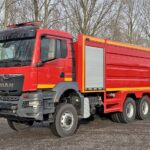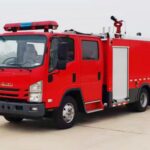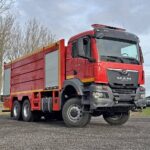
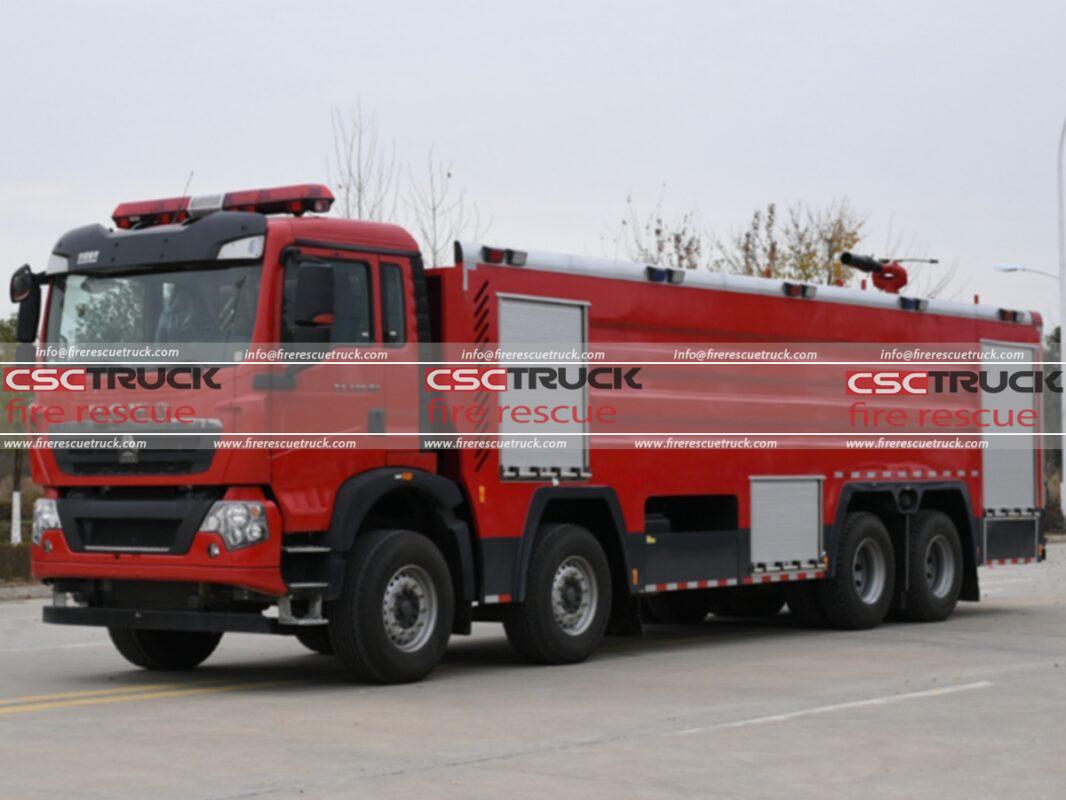
In modern firefighting operations, maintaining a stable and continuous water supply is one of the most critical factors for success, especially in rural, industrial, or disaster-affected areas where hydrant infrastructure may be limited or unavailable. The fireground water shuttle truck for Continuous Water Relay Operations by CSCTRUCK Fire Rescue Truck is specifically engineered to address this challenge by ensuring uninterrupted water delivery through coordinated shuttle and relay systems. This article explores its design, operational role, working principles, and importance in emergency response scenarios.
1. Introduction to Water Shuttle Firefighting Operations
A water shuttle operation is a firefighting strategy used when there is no reliable fixed water supply near the fire scene. Instead of relying on hydrants, a fleet of water tankers transports water from a fill site—such as a hydrant, reservoir, pond, or water station—to the fireground, where it is discharged into portable tanks or directly into pumpers for fire suppression.
According to firefighting operational references, water shuttle systems are essential in rural firefighting because they enable a “continuous movement of apparatus between the fire scene and water source” to maintain fire suppression activities without interruption.
The CSCTRUCK Fire Rescue Truck fireground water shuttle truck is designed precisely for this mission, acting as a mobile water transport unit that ensures constant relay cycles between supply and demand points.
2. Role of the Fireground Water Shuttle Truck
The primary role of the CSCTRUCK Fire Rescue Truck fireground water shuttle truck is to:
- Transport large volumes of water rapidly
- Maintain continuous relay cycles between fill and dump sites
- Support pumpers at the fireground with steady water replenishment
- Bridge gaps where hydrant systems are unavailable or insufficient
In large-scale incidents, multiple shuttle trucks operate in rotation, creating a continuous loop of water movement that ensures firefighting operations never run dry.
This makes the vehicle a critical component in wildfire control, industrial fire suppression, rural structure fire response, and disaster relief operations.

3. Core Design and Engineering Features
The CSCTRUCK Fire Rescue Truck water shuttle truck is built on a heavy-duty chassis and optimized for durability, efficiency, and rapid water transport cycles. Its engineering focuses on maximizing payload capacity while maintaining stability and operational safety.
Key Components:
- High-capacity water tank (typically several thousand liters)
- High-flow centrifugal pump system
- Quick-fill and quick-discharge valves
- Large diameter suction and delivery piping
- Reinforced chassis for off-road and rural terrain
- Operator control panel for precise flow management
The design ensures that water can be loaded and discharged in minimal time, reducing downtime during shuttle cycles.
4. Continuous Water Relay Operations Explained
The concept of continuous water relay operations is central to the effectiveness of shuttle trucks.
Step 1: Fill Site Operations
At the water source (hydrant, pond, or reservoir), the shuttle truck is rapidly filled using a high-capacity pump system. Efficient fill-site operations are critical, as minimizing fill time increases total water delivery efficiency.
Step 2: Transport Phase
The truck travels to the fireground while maintaining safe speed and route optimization. Road conditions, distance, and traffic affect total cycle efficiency.
Step 3: Dump Site Operations
At the fire scene, water is discharged into:
- Portable foldable water tanks (“drop tanks”)
- Direct supply lines feeding fire engines
- Relay pumping systems supporting aerial or ground firefighting units
Step 4: Continuous Cycle Repetition
Once empty, the truck immediately returns to the fill site. Multiple trucks are staggered in operation so that while one is returning, another is delivering water—creating a continuous flow.
This system is widely used in firefighting logistics to ensure uninterrupted suppression capability, especially when hydrants are unavailable.
5. Integration with Fireground Relay Systems
In many large incidents, shuttle trucks do not operate alone. They are part of a broader fireground water relay system, which may include:
- Engine pumpers
- Relay pump units
- Portable water tanks
- Additional tanker trucks
Relay systems may also include pump-to-pump water transfer lines or staged pumping stations when terrain or distance makes direct shuttle inefficient.
The CSCTRUCK Fire Rescue Truck shuttle truck integrates seamlessly into these systems, acting as the backbone of water transportation between supply points and operational fire zones.

6. Advantages of CSCTRUCK Fire Rescue Truck Water Shuttle Trucks
1. Reliable Water Supply in Remote Areas
Ideal for rural and wildland environments where hydrants are absent.
2. High Operational Efficiency
Fast fill and dump systems reduce turnaround time, increasing water delivery rate.
3. Scalable Deployment
Multiple trucks can operate simultaneously to increase total water supply capacity.
4. Versatile Use Cases
Suitable for:
- Wildfires
- Industrial fires
- Highway accidents involving fire
- Construction site emergencies
5. Enhanced Fireground Sustainability
Ensures firefighting operations can continue for extended periods without water interruption.
7. Importance in Modern Firefighting Strategy
Water shuttle trucks have become a cornerstone of modern firefighting logistics. In many regions, especially those without dense hydrant networks, the success or failure of fire suppression depends on the efficiency of shuttle operations.
Experts emphasize that tanker shuttle systems can determine operational outcomes in limited-water environments, making them a critical part of emergency preparedness planning.
The CSCTRUCK Fire Rescue Truck fireground water shuttle truck enhances this capability by providing a reliable, high-capacity, and continuously operable water transport solution.
8. Operational Challenges and Solutions
Challenge 1: Distance Between Fill and Fire Sites
Long distances can slow cycle times.
Solution: Deploy multiple shuttle trucks and establish multiple fill points.
Challenge 2: Traffic and Terrain Constraints
Rough or congested routes can delay operations.
Solution: Use off-road capable CSCTRUCK Fire Rescue Truck chassis designs.
Challenge 3: Coordination Complexity
Multiple trucks require precise timing and communication.
Solution: Incident command systems assign water supply officers to manage shuttle rotations.

9. Future Development Trends
Modern water shuttle trucks are evolving with new technologies:
- GPS-based fleet coordination
- Automated pump controls
- Improved lightweight tank materials
- Real-time telemetry for water level monitoring
- Hybrid and fuel-efficient drivetrains
CSCTRUCK Fire Rescue Truck continues to develop advanced fire rescue platforms that improve efficiency and reduce response time in critical emergencies.
Conclusion
The fireground water shuttle truck for continuous water relay operations by CSCTRUCK Fire Rescue Truck plays an essential role in ensuring an uninterrupted water supply during firefighting missions. By combining high-capacity water transport, rapid loading and unloading systems, and seamless integration into relay operations, it supports firefighters in tackling large-scale emergencies effectively.
In environments where water infrastructure is limited or nonexistent, this type of vehicle becomes not just useful—but vital. Through continuous shuttle cycles and coordinated relay systems, CSCTRUCK Fire Rescue Truck’s design ensures that every drop of water reaches where it is needed most, helping protect lives, property, and critical infrastructure.