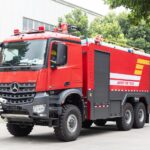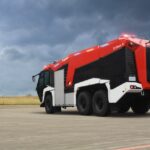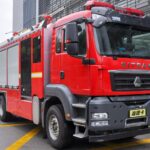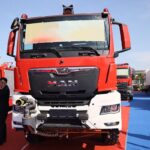

Aircraft rescue and firefighting (ARFF) vehicles are purpose-built machines that look like fire engines on steroids — but beneath the dramatic silhouette, they are highly specialized tools, designed to meet rules, threat profiles, and operating conditions that vary between countries and airports. This article compares ARFF design standards, core functions, and real-world performance drivers, showing why an airport in Singapore buys a different truck from one at Denver or Frankfurt — and how international norms help keep expectations consistent.
Why ARFF vehicles are different from municipal fire trucks
ARFF vehicles are optimized for the unique challenges of aircraft incidents: High fuel loads, rapid fire spread, complex aircraft geometry, hard-paved and off-pavement access, and the critical need for fast rescue of many occupants. To meet these needs, ARFF apparatus typically combine large foam and water capacities, powerful propulsion and off-road mobility, front-mounted or extendible turrets (for “high-reach” attack), bumper turrets, and integrated rescue tools — features that municipal engines rarely require. Manufacturers also prioritize crashworthiness and operator protection because ARFF crews may need to approach burning aircraft under extreme conditions.

Global design standards: ICAO, national rules, and industry norms
Although airports and national regulators set operational requirements, much of the baseline expectation for ARFF capability is framed by ICAO’s Annex 14 and its supporting Airport Services Manual (Doc 9137). Annex 14 defines Rescue and Fire Fighting (RFF) categories for aerodromes based on the size and frequency of aircraft operations and links each category to minimum numbers of vehicles, foam-production capability, and response-time expectations. Doc 9137 provides further technical guidance on vehicle siting, extinguishing agents, and equipment. These ICAO documents create a common language so airports and suppliers can align on protection levels.
Beyond ICAO, regional and national standards influence design details. In the United States, NFPA’s standard for aircraft rescue and firefighting vehicles — historically NFPA 414 and now consolidated into NFPA 1900 series updates — establishes minimum design and performance criteria, prototype testing, and equipment requirements that many U.S. airports and procurement specs reference. European customers often require compliance with EN/ISO and national firefighting vehicle standards (for example, EN standards for vehicle construction and subsystem performance), while individual civil aviation authorities add local rules and testing protocols. The result is a blend of global guidance and local rules that shapes final vehicle specifications.
Key design differences by region and role
- Vehicle chassis and mobility. ARFF vehicles must reach crash sites fast across aprons, perimeter roads, and potentially soft shoulders. Heavy airports in the U.S. and Australia often choose 6×6 or 8×8 chassis with high horsepower and heavy-duty suspensions for off-pavement traction, while smaller airports may accept 4×4 or 4×2 units. European designs sometimes prioritize maneuverability in constrained ramp environments and tighter urban airports.
- Extinguishing agent capacity and delivery systems. Foam capability (AFFF, high-expansion agents, fluorine-free foams today) is a central spec. Large international hubs opt for trucks with thousands of gallons of water and hundreds of gallons of foam concentrate plus dry chemical or powder systems for fuel fires. The presence of multiple turrets (roof, bumper, extendable HRET) and remote-control nozzle operation varies by need and budget. Regulatory foam-production testing is often required to demonstrate proportioner performance and foam output.
- High Reach Extendable Turrets (HRET). HRETs (sometimes marketed as “boom” or “snozzle” systems) allow crews to reach upper parts of an airliner — useful for widebodies and elevated rescue — and are standard on major-airport vehicles in North America, Europe, and parts of Asia. HRETs change tactics: High-angle application, piercing and direct agent application into cabins or cargo holds, and a safer distance for the crew. Their mechanical complexity and cost make them less common in small regional fields.
- Cabin ergonomics and crew protection. Integrated crew shelters, positive-pressure cabs, ballistic-grade windows in some designs, and thermal insulation are more prevalent where agencies anticipate an aggressive approach to burning airframes. NFPA and manufacturer guidance influence cabin layout, SCBA storage, and egress.

Functions and tactics: Matching capability to mission
ARFF vehicles perform three interrelated functions: Rescue (rapid access, occupant extraction), fire suppression (knockdown of fuel-fed fires), and hazard mitigation (foam management, spill containment, and coordination with mutual aid). The distribution of these functions explains fleet mixes: A major airport will field multiple specialized units (e.g., a fast-response lighter vehicle for initial attack, heavy foam carriers for sustained suppression, HRET-equipped units for elevated reach), while smaller airports often rely on multi-purpose trucks that balance capacity and agility. ICAO RFF category drives the minimum fleet composition and response times, influencing procurement decisions.
Performance drivers: What actually matters in an incident
- Response time and positioning. The fastest truck is often the best asset. Airport layout, vehicle top speed, routing, and station locations determine whether the mandated—often within 3–4 minutes—response time can be met. ICAO and national rules emphasize response-time performance as a core safety metric.
- Agent application effectiveness. Foam proportioning reliability, nozzle reach, and the ability to apply correct agent types quickly determine whether a fire is suppressed or transitions to a protracted event. Performance tests and annual foam production tests (required by some regulators) validate this capability.
- Crew training and integration. Even the most advanced truck is ineffective without trained crews, practiced tactics, and coordination across emergency services. Many standards, therefore, pair vehicle specs with operational guidance and expected crew proficiencies.
- Maintenance and lifecycle support. Global fleets differ in their spare-parts ecosystems and in-country manufacturer support. Airports with local manufacturer presence (for example, certain U.S. and European makers) enjoy shorter downtimes and easier upgrades than those relying on imports with limited regional servicing.

Trends shaping the next generation of ARFF
Recent editions of standards and industry roadmaps emphasize environmental considerations (fluorine-free foams), enhanced sensors (infrared cameras, thermal mapping), telematics for predictive maintenance, and modular designs that allow mixed-agent payloads. Manufacturers continue to innovate on mobility (lighter composite tanks, advanced suspension) and on safety features for crews. Standards bodies are updating prototype testing and equipment requirements to reflect those technological shifts.
Conclusion
Comparing airport fire trucks worldwide reveals both clear commonalities — shared mission, ICAO baseline guidance, and the centrality of foam and rapid response — and important regional differences driven by airport size, aircraft types, operating environment, and regulatory regimes. Whether a fleet emphasizes brute-force capacity (large water/foam payloads and 8×8 chassis) or nimble initial attack (smaller fast vehicles with advanced turrets), the best procurement choices marry validated vehicle performance with well-practiced tactics, robust maintenance, and training. In short: the truck matters, but it’s only one piece of a system whose goal is always the same — get people out and get the fire out, as fast and reliably as possible.