
Airport fire trucks — often called crash tenders or ARFF (Aircraft Rescue and Firefighting) vehicles — are a specialized class of emergency apparatus engineered to meet the extreme demands of aviation incidents. Unlike municipal fire engines, ARFF vehicles combine immense capacity, high-speed response, and advanced delivery systems for extinguishing agents so they can control jet-fuel fires, rescue passengers, and protect critical airport infrastructure. This article explores the core technologies, principal vehicle types, and how different countries and airport environments shape ARFF design and deployment.
Core technologies that define modern ARFF vehicles
Modern ARFF trucks pack a suite of technologies tuned to rapid intervention and aggressive fire suppression:
- High-capacity water/foam systems. ARFF vehicles carry large volumes of water and foam concentrate. Proportioning systems mix foam at precise ratios to create film-forming foams capable of sealing burning jet fuel and preventing reignition. Tanks and pump designs prioritize both capacity and flow rate — measured in liters (or gallons) per minute — to sustain large turbulent fires.
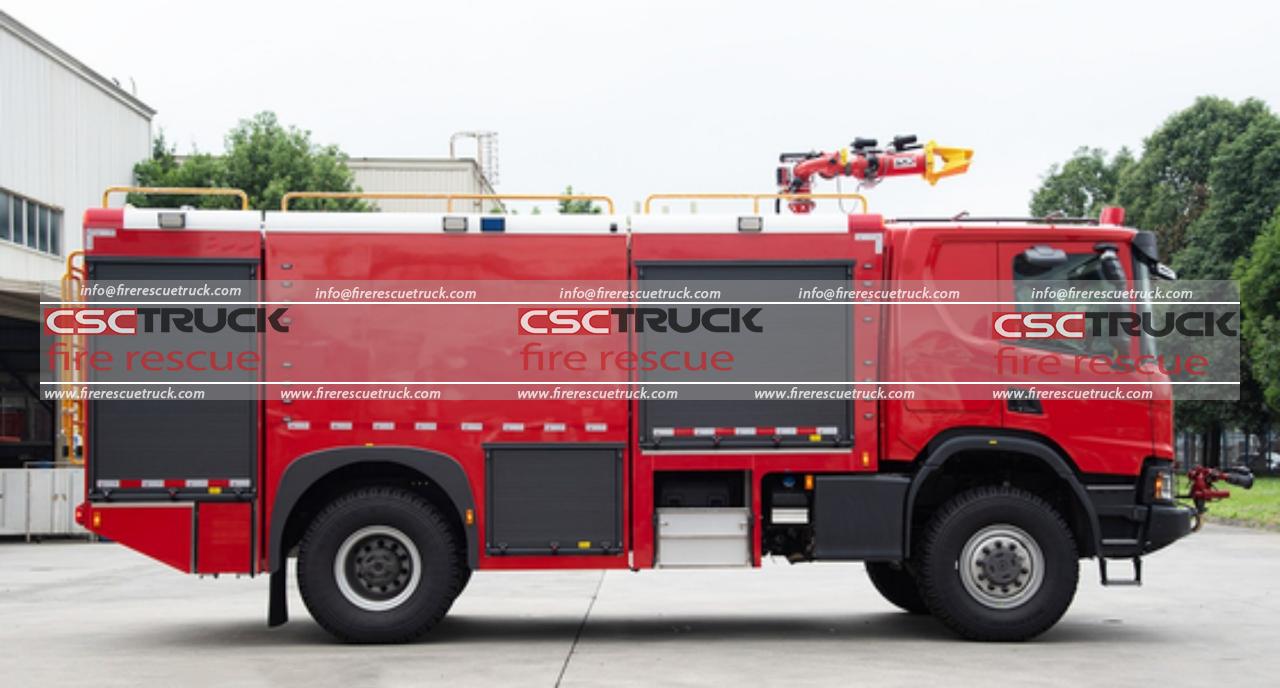
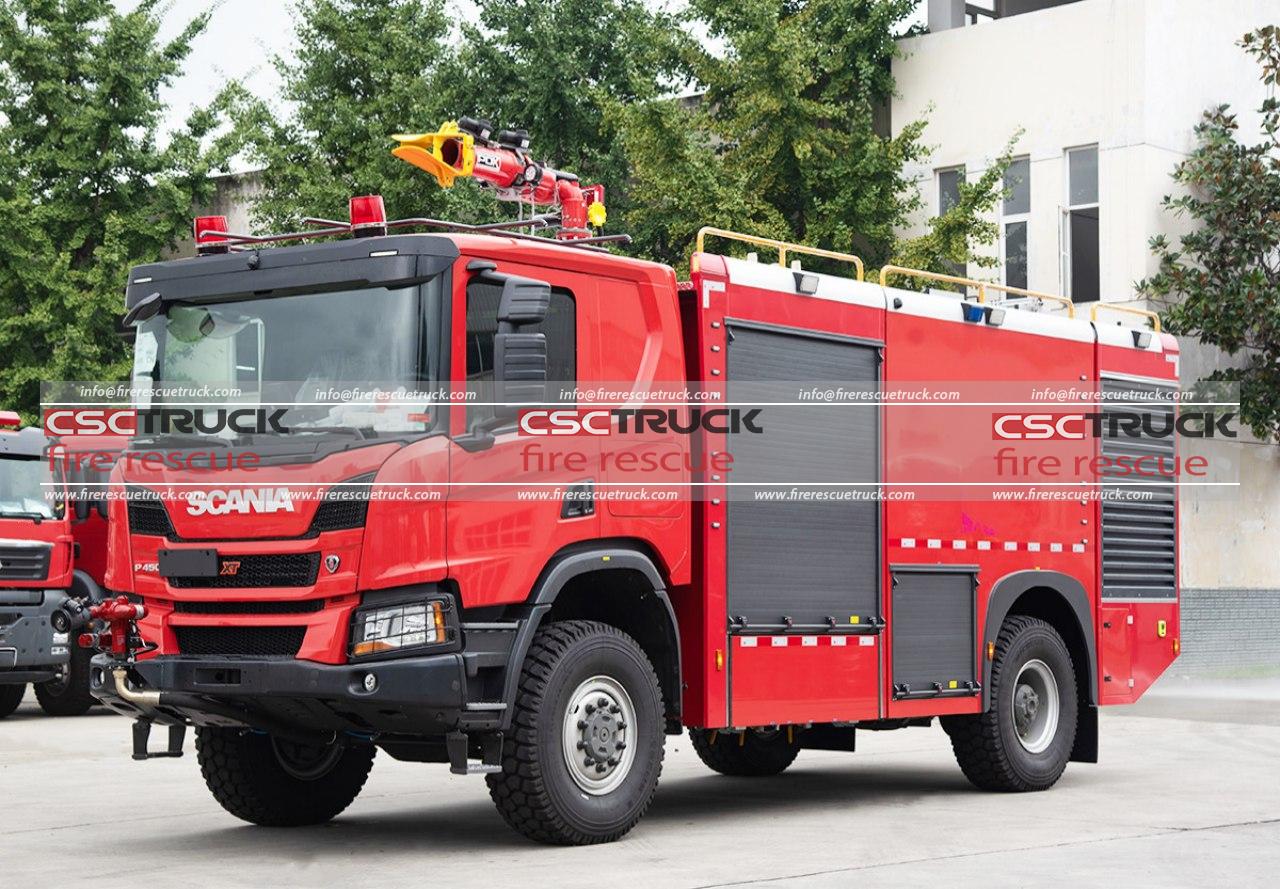
- High-reach extendable turrets (HRET). Also called boom-mounted monitors, HRETs allow crews to apply water, foam, or other agents directly into aircraft openings and up fuselages or wings from a safe distance. The booms often include nozzles for piercing fuselages and delivering agents into enclosed spaces.
- Compressed-air foam systems (CAFS). CAFS improves foam penetration and adhesion, producing a drier, longer-lasting foam blanket while reducing agent volumes required. These systems provide tactical advantages in airport environments with complex geometry.
- Dry chemical and dual-agent systems. For hydrocarbon-based fires, dry chemical agents (e.g., Purple-K) disable flame propagation quickly. Dual-agent systems deploy a dry chemical shot followed by foam to achieve rapid knockdown and cooling.
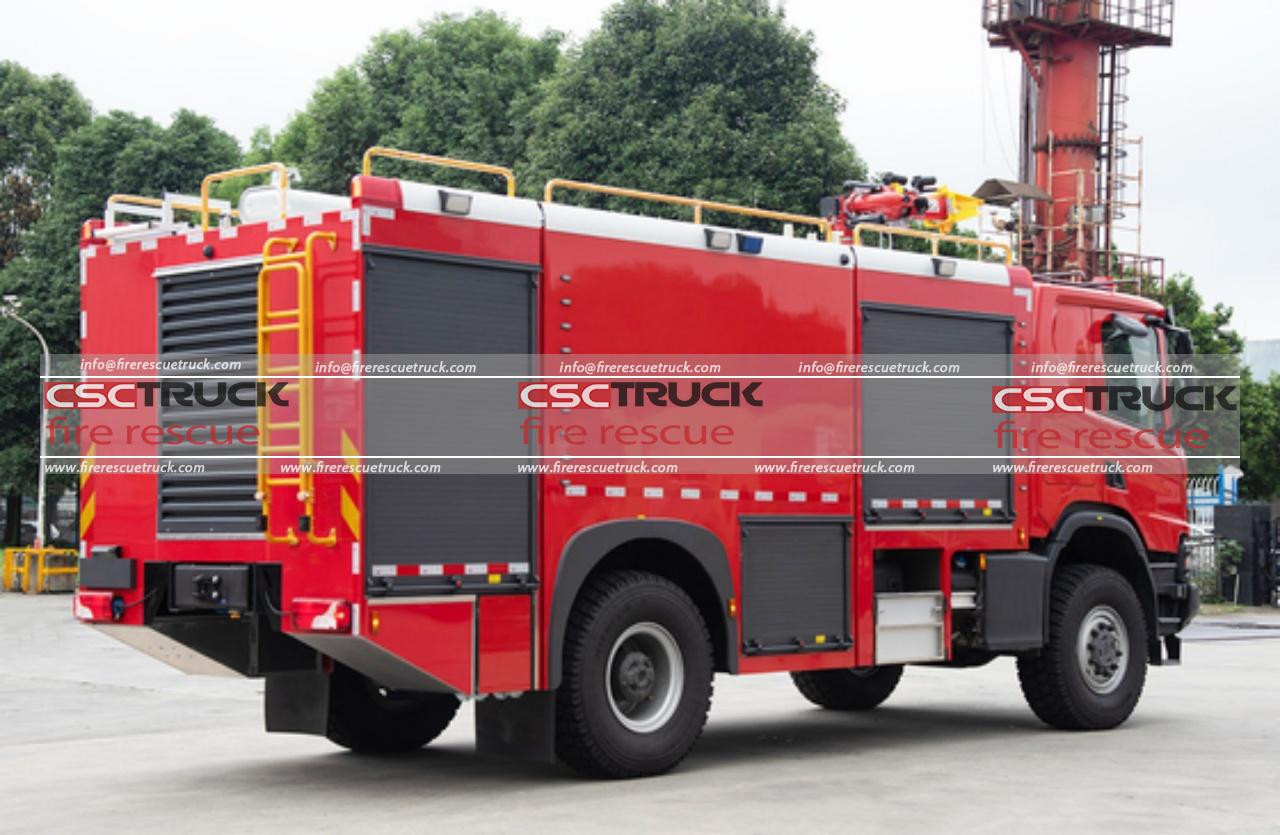
- Advanced pumps and drivetrains. ARFF vehicles are performance-oriented: Powerful engines, reinforced chassis, and off-road capable suspensions ensure they reach remote parts of an airfield fast. Pumps are rated to sustain extremely high flows at pressure.
- Integrated command and detection systems. Modern tenders may include onboard thermal imaging, infrared cameras, vehicle telematics, and remote-control turret operation to augment crew safety and situational awareness.
Principal ARFF vehicle types
Although design varies widely, ARFF vehicles typically fall into several categories based on function and capability:
- Full-size crash tenders (heavy ARFF). These are the largest ARFF apparatus, built to carry maximum water, foam, and chemical payloads, with powerful turrets and HRETs. They’re intended for major airports serving large commercial jets and are often four-axle or multi-axle rigs.
- Rapid Intervention Vehicles (RIVs) / Response vehicles. Smaller and faster than heavy tenders, RIVs are optimized for high-speed runway access, rapid assessment, and initial attack. They carry fewer agents but get on scene quickly to begin life-saving operations.
- High-reach Extendable Turret trucks (HRET-centric). Some vehicles are specifically built around large booms for rescue and targeted suppression on tall fuselages and large aircraft. These are essential for incidents where crew access is restricted.
- Rescue and service trucks. Configured for personnel extrication, medical response, and equipment carriage, these complement suppression-focused vehicles with extrication tools, stretchers, and lighting.
- Multi-role and off-road-capable tenders. Airports with rough terrain (e.g., remote military bases, island runways) often use specially-modified chassis and tires to traverse unpaved surfaces and carry firefighting loads over difficult ground.
Country- and region-specific applications
ARFF equipment and operational practices are shaped by regulatory frameworks, traffic types, climate, and available budgets. Below are some country-specific characteristics and typical adaptations.
- United States (FAA-regulated environments). U.S. airports generally follow the FAA ARFF Indexing (based on aircraft length and movement volume) that dictates minimum equipment and response times. Many U.S. airports invest in large, multi-axle tenders with dual-agent capability and CAFS. Given varied climates, vehicles are also designed for winter readiness (anti-freeze systems, heated agent lines).
- Europe (ICAO and EASA influence). European standards lean heavily on ICAO Annex 14 and EASA guidance for certification and operations. Airports in Europe often balance historical infrastructure constraints with modern performance requirements, leading to a diverse fleet mix: Compact rapid-response vehicles for constrained airfields, and heavy tenders for international hubs.
- Middle East and Asia (large aircraft and extreme heat). Rapid passenger growth and the presence of wide-body long-haul fleets have driven airports in the Middle East and parts of Asia to invest in very large crash tenders with oversized tanks and HRETs. Heat and sand exposure also shift material choices and maintenance practices — filtration, corrosion protection, and cooling systems receive particular attention.
- Small island and remote airports. In regions with limited resources or small aircraft operations, ARFF fleets tend to be leaner. Vehicles emphasize mobility and reliability over huge agent volumes. Alternative strategies like staged mutual aid, boat-based suppression for coastal strips, or modular suppression units may be used.
- Developing nations and budget constraints. Where budgets are constrained, airports prioritize meeting minimum regulatory indices, often relying on retrofit solutions, used-vehicle markets, and modular agent systems. Training and maintenance programs become as important as the hardware itself to ensure operational readiness.
- Military airfields. Military ARFF vehicles may be purpose-built for high-threat environments, with enhanced armor, NBC (nuclear/biological/chemical) protections, and special rescue toolkits. Military operations also tend to drive innovation in rapid extraction and fuel-fire extinguishment techniques.
Operational considerations and trends
Beyond vehicle hardware, several operational trends shape ARFF effectiveness globally:
- Training and interoperability. Sophisticated vehicles are only as good as the crews that operate them. Regular live-fire training, airport-specific drills, and interoperability between airport authorities, local fire services, and mutual aid partners are essential.
- Sustainability and agent alternatives. Environmental concerns are prompting research into foam alternatives, biodegradable agents, and closed-loop cleanup systems to mitigate the ecological impact of firefighting runoff.
- Data-driven maintenance and telematics. Fleet health monitoring, predictive maintenance, and data analytics reduce downtime and prolong vehicle life, which matters for high-cost ARFF assets.
- Modular and scalable response. Airports increasingly adopt mixed fleets (heavy tenders + RIVs + rescue units) to tailor responses to incident scale and to optimize life-cycle costs.
Conclusion
Airport fire trucks occupy a unique niche where automotive engineering, fire science, and regulatory policy intersect. From the enormous multi-axle crash tenders of major international hubs to the nimble rapid-response units of smaller airfields, ARFF fleets reflect a balance between speed, suppression capability, crew safety, and operational context. Country-specific factors — regulatory regimes, climate, traffic mix, and budgets — decisively shape procurement and deployment choices. As aviation evolves, trends toward cleaner agents, smarter vehicle telematics, and more specialized boom technologies will continue to redefine what airports need from their firefighting fleets. Ultimately, the objective remains constant: Rapid, effective intervention to save lives and protect one of aviation’s most critical infrastructures.