
Air travel brings tremendous convenience — but also the risk of high-stakes emergencies. In aviation accidents, a quick, powerful firefighting response is critical. That’s where specialized vehicles, collectively known as airport rescue and firefighting (ARFF) trucks or “airport fire trucks,” come in. From massive foam‑laden tenders to agile rapid‑intervention units, these vehicles are tailored specifically for the unique challenges of aircraft fires. In this article, we explore their key functional aspects: Speed and mobility, extinguishing agent capacity, and technological systems — and how these translate into firefighting effectiveness worldwide.

🔥 Why Airport Fire Trucks Are Different
Unlike municipal or structural fire engines, ARFF trucks are purpose-built for the hazards of aviation: Large fuel loads, high‑intensity fires, wreckage, and the need for almost-instant response on vast airfields. As one Reddit firefighter described:
“They’re meant for off road operations because planes don’t always crash in convenient places.”
Because of these demands, ARFF trucks stand out in appearance and capability — with wide‑angle cabs for visibility, large tires and suspension for off‑road or rough‑terrain access, and heavy‑duty tanks and pumps to suppress fuel‑fed infernos quickly.
Speed & Mobility: Reaching the Incident in Minutes
A foundational requirement for ARFF trucks is rapid response. The standard set by the International Civil Aviation Organization (ICAO) — echoed by the Federal Aviation Administration (FAA) and other regulators — is that an ARFF vehicle must be able to reach any point on the airfield within three minutes of an alarm.
To meet that benchmark, ARFF trucks are engineered with:
- High‑power engines — often in the 500 to 1,000+ horsepower range.
- High speed and acceleration — many models can exceed 70 mph (≈ 110–120 km/h) and accelerate from 0 to 80 km/h (≈ 50 mph) in under 25 to 30 seconds, even when heavily loaded.
- All‑terrain capability — all‑wheel drive (AWD), specialized suspension, and large off‑road tires give them the ability to traverse runways, grass, gravel, or uneven airport terrain.
One widely used example is the Rosenbauer Panther. Depending on the variant (4×4, 6×6, 8×8), it can hit top speeds around 115 km/h, with some newer versions even reaching ~120 km/h.
This speed and mobility are not just for show — in aviation emergencies, mere seconds can mean the difference between containment and catastrophe.
Capacity: Water, Foam, and Agent Volumes to Tame Jet-Fuel Fires
Aircraft fires typically involve large amounts of jet fuel — a volatile, high‑energy fire source. To combat that, ARFF trucks carry substantial volumes of extinguishing agents onboard, so firefighters are not dependent on external water or hydrants. Key capacities include:
- Water tanks: Many ARFF vehicles carry between 3,000 to 12,000 liters (about 800 to 3,170 gallons) of water.
- Foam concentrate tanks: Because fuel fires are often involved, foam — typically AFFF (aqueous film-forming foam) — is essential. Foam system capacities in ARFF trucks may range from several hundred to over a thousand liters, depending on the model.
- Dry chemical or clean‑agent capacities: Some ARFF trucks carry additional agents like dry chemical or Halotron to deal with fuel, electrical, or other special fire hazards.
Furthermore, these trucks are equipped with high‑flow pumps and advanced discharge systems. Typical output ranges from 1,000 to 2,500 gallons per minute (GPM) — sometimes more, depending on the configuration. Roof‑mounted turrets, bumper monitors, and sometimes under‑truck nozzles allow for flexible deployment depending on the fire scenario.
Large-capacity firefighting not only allows quick suppression of external fires but also enables sustained suppression if the fire is protracted, which is often the case in aircraft incidents with fuel involved.
Firefighting Technology: Turrets, Foam, and Specialized Systems
ARFF trucks incorporate sophisticated systems tailored for aircraft emergencies — where fire may be under wings, inside fuselage, or near fuel tanks. Key technologies include:
• Roof and Bumper Turrets + High-Reach Extendable Turrets (HRET)
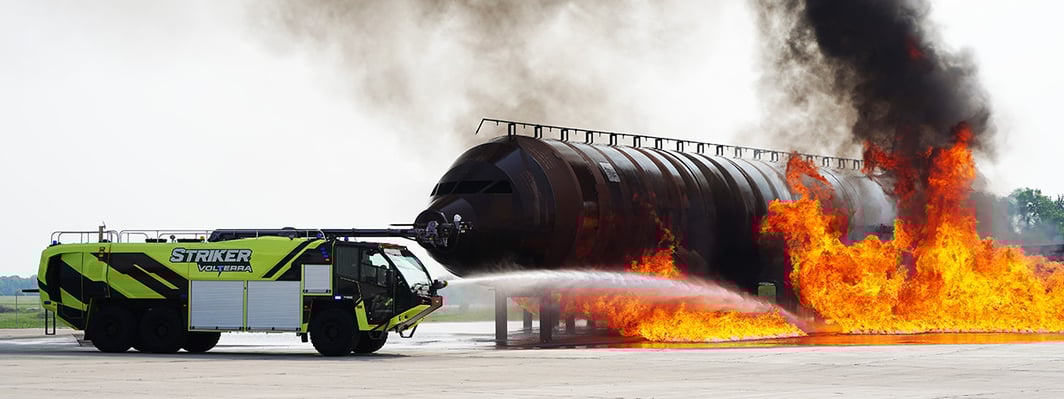
Many ARFF units feature remote‑controlled turrets mounted on the roof or bumper. Some also have a High-Reach Extendable Turret (HRET) — a telescopic arm designed to reach high parts of an aircraft (wings, tail, cargo compartments) or penetrate fuselages to inject foam internally.
This lets firefighters apply suppression agents quickly and at a distance, even before they exit the cab — greatly reducing exposure to heat, smoke, or explosions.
• Dual-Agent Systems: Water + Foam (and more)
Because jet fuel fires behave very differently from ordinary structural fires, water alone is often insufficient or even dangerous. ARFF trucks typically use water mixed with foam (AFFF) to smother fuel fires and suppress re-ignition. In many trucks, foam is proportioned automatically. Dry chemical agents or clean agents (e.g., Halotron) provide additional suppression for fuel, oil, or electrical fires.
• Pump-and-Roll / Under-vehicle Nozzles
Some models support “pump-and-roll,” meaning they can spray while on the move — useful for enveloping a moving fire or following a burning path (e.g., fuel spill). Under‑truck nozzles can spray extinguishing agents beneath the vehicle, protecting against fires under or around the fuselage and preventing ground‑level fuel fires from spreading.
• Cab Safety & Visibility, All‑Terrain Design
Given the harsh conditions — smoke, debris, uneven terrain — ARFF vehicles are built with robust safety features. Their cabs often have panoramic windshields for wide visibility, rugged suspension and off‑road tires, and reinforced chassis to handle heavy loads plus rough terrain.
These design choices make the trucks reliable first responders even under the most challenging and chaotic circumstances.
Global Examples: Models at the Forefront
Several manufacturers and models stand out globally because they combine all the above features effectively.
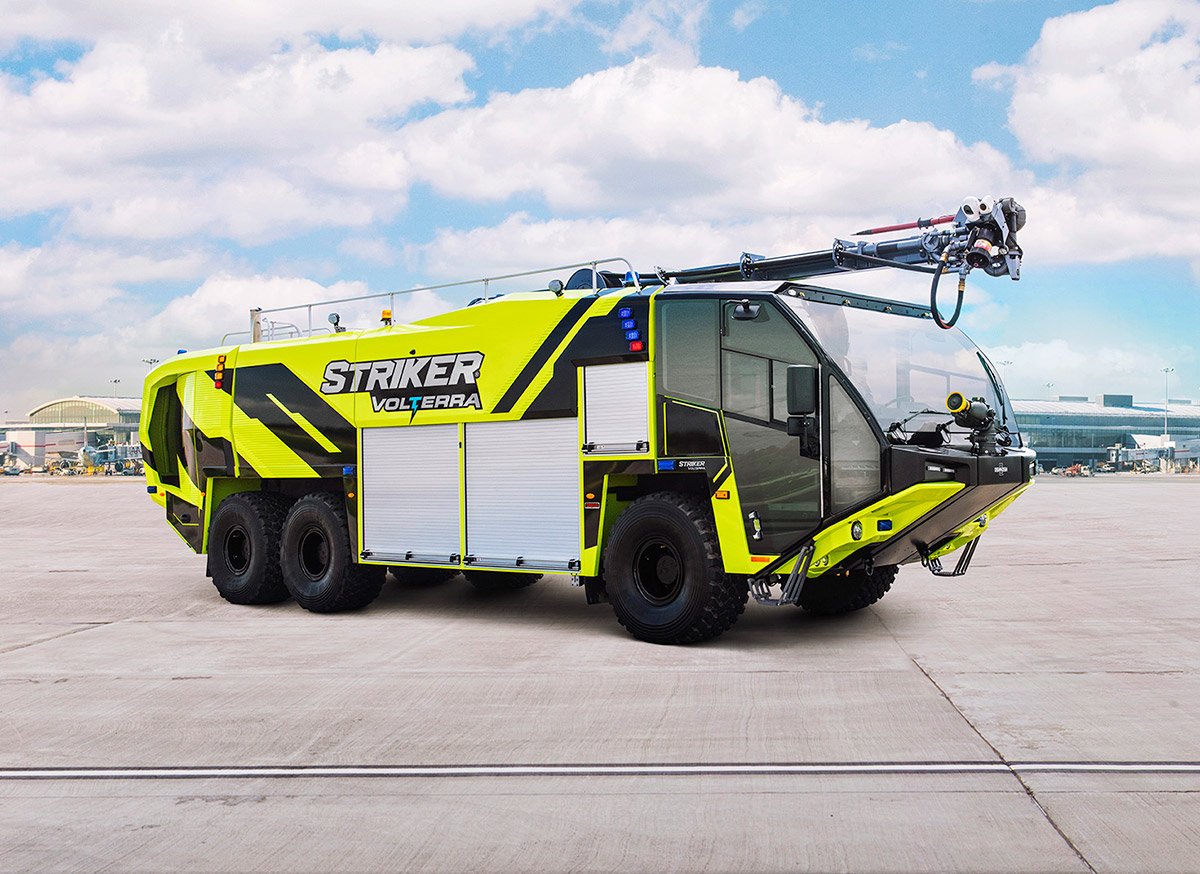
Oshkosh Striker
Built by the U.S. manufacturer, the Striker series is a well-known ARFF line used in many airports worldwide. It comes in multiple configurations (4×4, 6×6, 8×8) and is often equipped with a “snozzle” — a piercing nozzle capable of injecting extinguishing agents directly into aircraft cabins or cargo areas.
These features make the Striker suitable not just for external fires, but also for interior aircraft fires — where rapid containment is essential.
Rosenbauer Panther
The Panther series from Austria builds on decades of ARFF design refinement. It is available in 4×4, 6×6, and 8×8 variants. The 6-wheel and 8-wheel variants often carry between 9,000 to 14,000 liters of extinguishing agents (water/foam/powder), depending on configuration.
For instance, a typical 6×6 Panther used at major international airports has about 11,356 L water capacity, ~1,598 L foam agent capacity, and also carries Halotron for specialized suppression. Pump output on such a vehicle can deliver thousands of liters per minute, making it capable of producing a massive foam or water blanket rapidly.
Such heavy-duty ARFF units are often deployed at major international airports handling wide‑body jets, where fire risk is correspondingly high.
Challenges and Trade‑offs
While ARFF trucks bring powerful capabilities, their design represents a set of trade‑offs — balancing speed, capacity, and versatility with cost, complexity, and practicality. Some of the challenges:
- Weight and size: Fully loaded ARFF trucks can weigh dozens of tons, making maneuvering, braking, and cornering more difficult. Their large size can also make access to tight spaces or congested ramp areas challenging.
- Operational cost and maintenance: High‑power engines, dual-agent systems, turrets, and heavy-duty pumps require regular maintenance and specialized staff. Large tanks and foam systems also need care to avoid deterioration.
- Specialization vs. versatility: ARFF trucks are optimized for airport incidents — jet‑fuel fires, aircraft structure, etc. They are less useful (and sometimes impractical) for wildland fires, urban structural fires, or settings with narrow roads. Indeed, many firefighters note that ARFF rigs are “a lot bigger than regular engines” and carry much more water/foam than typical municipal engines — but lack certain structural‑fire tools or extrication gear.
- Foam environmental concerns: The use of AFFF (aqueous film‑forming foam) — critical for suppressing jet-fuel fires — has come under scrutiny in many places because of environmental and health concerns associated with per- and polyfluoroalkyl substances (PFAS). This is prompting airports and manufacturers to explore alternative foams or suppression agents (though such alternatives must still match AFFF’s rapid spread and suppression performance).
Emerging Trends & Innovations
The landscape of ARFF trucks continues to evolve as technology advances:
- Electric/hybrid ARFF vehicles: Manufacturers are developing electric-powered ARFF trucks that can deliver comparable firefighting performance while reducing emissions, noise, and dependence on diesel.
- More precise and automated discharge systems: High‑reach turrets, nozzle targeting, adjustable flow rates, and proportioning systems optimize the use of firefighting agents — conserving water/foam while maximizing suppression effectiveness.
- Improved safety and situational awareness: Panoramic cabs, advanced lighting/LED systems, thermal imaging, and remote/nozzle‑control help crews operate safely under smoke, low visibility, or dangerous conditions.
- Modular & dual‑purpose designs: Some ARFF models are equipped to handle both aircraft fires and structural or hazardous‑materials incidents, increasing their utility for airports and allowing better return on investment.
As air travel continues to expand, and as aircraft get larger or more complex, ARFF technology must also keep pace — ensuring that emergency response can remain effective, fast, and safe.
Conclusion
Airport fire trucks — ARFF vehicles — are among the most specialized firefighting apparatus in existence: Designed with unique demands in mind, from the need to respond within minutes across vast airfields to the requirement to suppress high‑energy jet‑fuel fires with large amounts of water, foam, and chemical agents. Their heavy engine power, all‑terrain mobility, large-capacity tanks, advanced turrets, and dual‑agent suppression systems make them indispensable for aviation safety worldwide. As manufacturers push the boundaries with electric powertrains, smarter hydraulics, and more efficient suppression systems, the next generation of ARFF trucks promises even greater readiness — a critical necessity whenever lives, aircraft, and fire meet on the runway.