
Introduction: CSCTRUCK Fire Rescue Truck and Heavy-Duty Firefighting Solutions
Modern firefighting operations increasingly require vehicles that can operate in extreme environments, including mountains, deserts, forests, industrial zones, airports, and disaster areas. Traditional fire engines designed for urban roads may struggle when faced with mud, steep terrain, limited access roads, or large-scale emergencies. This is where heavy-duty off-road fire trucks, such as 6×6 and 8×8 fire trucks, become essential.
CSCTRUCK Fire Rescue Truck specializes in manufacturing advanced firefighting vehicles, including 4×4, 6×6, airport rescue fire trucks, water foam fire trucks, and specialized rescue vehicles. With powerful chassis platforms, high-capacity firefighting systems, and excellent off-road mobility, CSCTRUCK Fire Rescue Truck fire trucks are designed to support emergency response teams in some of the world’s most challenging environments.
Among heavy-duty firefighting vehicles, the 6×6 fire truck and 8×8 fire truck are 2 of the most capable configurations. Although both provide excellent traction and mobility, they are designed for different mission requirements. Understanding the differences between these 2 platforms helps fire departments, airports, industrial facilities, and government agencies select the right vehicle for their operational needs.
1. Understanding 6×6 and 8×8 Fire Truck Configurations
The terms 6×6 and 8×8 describe the vehicle’s drivetrain and wheel arrangement.
A 6×6 fire truck has:
- Three axles
- Six wheels
- All six wheels are powered by the drivetrain
An 8×8 fire truck has:
- Four axles
- Eight wheels
- All eight wheels are powered
Both systems provide full-time or selectable all-wheel drive capability, allowing them to maintain traction on difficult surfaces such as sand, mud, snow, gravel, and uneven terrain. However, the additional axle and wheels of an 8×8 platform provide increased load capacity and stability.

2. Difference in Size and Payload Capacity
One of the biggest differences between 6×6 and 8×8 fire trucks is their size and carrying capability.
A 6×6 fire truck offers an excellent balance between mobility and payload. It can carry:
- Large water tanks
- Foam tanks
- Rescue equipment
- Pumps
- Hydraulic tools
- Lighting systems
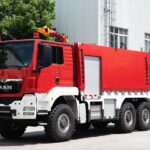
Many 6×6 rescue fire trucks are designed as multi-purpose emergency vehicles capable of transporting large amounts of equipment while maintaining good maneuverability. For example, CSCTRUCK Fire Rescue Truck’s 6×6 combination rescue fire truck features a heavy-duty chassis, high payload capability, and a maximum gradeability designed for challenging rescue environments.
An 8×8 fire truck, however, provides even greater carrying capacity because the vehicle’s weight is distributed across four axles instead of three. This allows manufacturers to install:
- Larger water tanks
- Higher-capacity foam systems
- Bigger pumps
- More rescue equipment
- Additional specialized firefighting modules
For airports, oil refineries, military bases, and large industrial sites, where massive firefighting capacity is required, 8×8 platforms are often preferred.
3. Off-Road Mobility Comparison
Both 6×6 and 8×8 fire trucks are designed for extreme terrain, but their performance characteristics differ.
6×6 Fire Truck Advantages
A 6×6 fire truck is often considered the ideal balance between:
- Mobility
- Size
- Operating cost
- Payload
Its shorter wheelbase compared with an 8×8 vehicle gives it better maneuverability in:
- Forest roads
- Mountain areas
- Mining sites
- Construction zones
- Rural emergency locations
The three-axle design allows excellent traction because six driven wheels maintain contact with the ground. High ground clearance, differential locks, reinforced suspension, and specialized off-road tires further improve performance.
8×8 Fire Truck Advantages
An 8×8 fire truck provides superior stability and traction in extremely demanding environments.
The additional axle offers:
- Better weight distribution
- Higher payload capacity
- Improved stability under heavy loads
- Reduced ground pressure
This makes 8×8 trucks especially suitable for:
- Airport rescue firefighting (ARFF)
- Military applications
- Large industrial facilities
- Extreme disaster response
However, the larger dimensions can make an 8×8 truck less agile in narrow areas compared with a 6×6 vehicle.

4. Firefighting Capacity Differences
The firefighting systems installed on these trucks are another major difference.
6×6 Fire Truck Equipment
Typical 6×6 fire trucks may include:
- 8,000–15,000 liter water tanks
- Foam tanks
- High-pressure pumps
- Roof monitors
- Front monitors
- Rescue equipment compartments
They are commonly used for:
- Wildland firefighting
- Industrial firefighting
- Emergency rescue
- Remote-area operations
8×8 Fire Truck Equipment
Because of its larger chassis, an 8×8 fire truck can support much larger firefighting systems:
- 15,000–30,000+ liter water capacity
- High-flow pumps
- Multiple monitors
- Advanced foam systems
- Large rescue modules
For example, airport firefighting vehicles require extremely high water and foam delivery rates because aircraft emergencies demand rapid fire suppression over large areas.
5. Driving Performance and Maneuverability
When comparing daily operation, the 6×6 fire truck has some advantages.
6×6 Benefits:
- Smaller turning radius
- Easier operation on narrow roads
- Lower fuel consumption
- Lower maintenance costs
- Faster deployment in mixed terrain
This makes it suitable for municipalities, forestry departments, and industrial emergency teams.
8×8 Benefits:
- Greater stability
- More powerful carrying capability
- Better performance under maximum load
However, an 8×8 truck generally requires more:
- Fuel
- Maintenance
- Driver training
- Infrastructure space
Its larger size can be challenging in urban environments or confined areas.

6. Cost and Maintenance Considerations
A 6×6 fire truck usually has lower acquisition and operating costs compared with an 8×8 vehicle.
Maintenance advantages include:
- Fewer axles
- Less complex suspension systems
- Lower tire costs
- Easier servicing
For many fire departments, a 6×6 truck provides sufficient capability without the additional expense of an 8×8 platform.
An 8×8 fire truck represents a higher investment but delivers unmatched performance for specialized missions where maximum firefighting power is required.
7. Which Fire Truck Should You Choose?
The choice between a 6×6 and an 8×8 fire truck depends on the application.
Choose a 6×6 Fire Truck If You Need:
- Strong off-road capability
- Good maneuverability
- Medium-to-heavy firefighting capacity
- Lower operating costs
- Flexible emergency response
Typical applications:
- Wildfire response
- Mining operations
- Forestry firefighting
- Disaster rescue
- Industrial emergency response
Choose an 8×8 Fire Truck If You Need:
- Maximum water and foam capacity
- Extreme stability
- Heavy equipment transport
- Airport firefighting capability
- Large-scale industrial protection
Typical applications:
- International airports
- Military airfields
- Oil and gas facilities
- Chemical plants
- Large industrial complexes

Conclusion
The difference between a 6×6 fire truck and an 8×8 fire truck mainly comes down to capacity, size, mobility, and mission requirements.
A 6×6 fire truck provides an excellent combination of off-road performance, maneuverability, and firefighting capability. It is a versatile solution for many emergencies, especially in remote and challenging environments.
An 8×8 fire truck represents the next level of heavy-duty firefighting capability. With greater payload capacity, larger firefighting systems, and superior stability, it is designed for the most demanding missions where maximum performance is required.
For organizations looking for a reliable balance between mobility and firefighting power, a 6×6 fire truck is often the practical choice. For extreme firefighting scenarios requiring the largest possible capacity, an 8×8 fire truck provides unmatched capability.
With advanced engineering and customized firefighting solutions, CSCTRUCK Fire Rescue Truck continues to provide professional fire vehicles designed to meet the diverse needs of global emergency response teams.