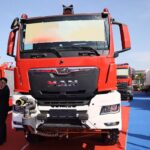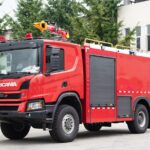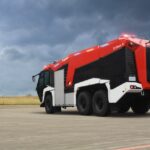

Airports are unique environments where emergencies can escalate quickly and affect hundreds of lives. To meet this challenge, airports use specialized firefighting apparatus often called Airport Rescue and Firefighting (ARFF) vehicles — commonly referred to as airport fire trucks. These machines are engineered for extreme response speed, powerful extinguishing capability, and rugged off-runway mobility. This article explains the key features of airport fire trucks, their roles during incidents, and how they are deployed around the world.
What makes an airport fire truck different?
Unlike municipal fire engines, airport fire trucks are purpose-built for aircraft incidents and large-scale fuel fires. Core differences include:
- High discharge rates and large agent capacity: ARFF vehicles carry specialized extinguishing agents — large volumes of water, compressed or liquid foam concentrates, dry chemical, and sometimes clean agents — and deliver them at very high flow rates to rapidly knock down jet-fuel fires.
- High-speed response: Airports require fire vehicles that accelerate quickly and travel at higher sustained speeds across long, open airfield pavements so they can reach aircraft incidents in minimal time.
- Rugged off-road mobility: Many incidents occur on grass, gravel, or unpaved areas beside runways. ARFF trucks therefore have heavy-duty chassis, large tires, all-wheel or all-axle drive, and high ground clearance.
- Remote turrets and roof monitors: Onboard monitors (fixed or remote-controlled “turrets”) enable crews to apply agent from a distance with precision and safety.
- Specialized crew layout and ergonomics: Cab designs allow rapid egress of firefighting crews and provide space for communications and incident command equipment.
- Integrated rescue tools: Many units include hydraulic rescue tools, cutters, and ladders suited for aircraft fuselage access.

Key technical features explained.
- Agent systems (water, foam, dry chemical):
- Water and foam are the backbone of ARFF operations. Foam concentrates mixed with water create an aqueous film-forming foam (AFFF) or other foam types that create a film over fuel, suppressing vapors and cooling the surface. ARFF vehicles store several hundred to several thousand liters/gallons of water and a significant foam concentrate supply.
- Dry chemical and wet chemical systems (e.g., Purple-K or specialized powders) are often carried for rapid knockdown of hydrocarbon fires or to protect critical exposures.
- High-capacity pumps and turrets:
Powerful pumps enable sustained high-flow delivery through roof and bumper turrets, providing streams and application patterns impossible for standard engines. Remote-controlled turrets let operators direct large flows from inside the safety of the cab. - Compressed air foam systems (CAFS):
CAFS mixes foam concentrate, water, and compressed air to produce a dense, cohesive foam that sticks to surfaces and penetrates complex geometry — valuable for aircraft fire suppression. - Chassis and mobility features:
Multi-axle chassis (4×4, 6×6, even 8×8) distribute heavy loads while delivering mobility. Central tire inflation systems, heavy-duty suspension, and torque-rich drivetrains improve off-runway traction. - Cab and crew safety:
Cabs are often armored to some degree, with climate control, integrated SCBA storage, and communications gear. Quick-access doors and wide steps speed firefighter deployment. - Auxiliary systems:
Thermal imaging cameras, scene lighting, hydraulic rescue tools, winches, and water/foam recharging gear are common, tailoring each vehicle to the airport’s risk profile.
Roles and operational use
Airport fire trucks are multi-role platforms deployed across several mission types:
- Aircraft rescue & firefighting: Primary role — rapid attack and suppression of aircraft fires following runway incidents or crashes.
- Fuel spill response and perimeter protection: Foam application to spilled fuels and protection of adjacent infrastructure or aircraft.
- Mass-casualty extrication & rescue: Using rescue tools and ingress equipment to remove trapped passengers and crewmembers.
- Medical support & triage: Serving as initial medical response platforms until ambulances arrive.
- Hazardous materials (HazMat) containment: Limited response to fuel and chemical spills in coordination with specialized HazMat teams.
- Mutual aid and structural firefighting (when trained): Some airport ARFF departments support neighboring communities under mutual-aid agreements.
Tactics emphasize speed and aggressive initial knockdown to prevent fire escalation and vapor spread. Crews often apply foam from a safe distance with turrets while rescue teams prepare for entry after knockdown and cooling.

Standards and staffing
Globally, airport firefighting is guided by regulatory frameworks that set minimum equipment, crew, and response-time standards. These frameworks vary by country but share core principles: Required response times to any point on the movement area, minimum agent capacities, and tiered vehicle inventories based on airport size and traffic. Staffing models emphasize trained personnel who can operate specialized systems, perform rescue procedures, and coordinate with air traffic control and incident command.
Global deployment: Adapting to different airports
Airport fire trucks are not one-size-fits-all. Deployment strategies differ by airport type and geography:
- Large international hubs typically maintain multiple, highly capable ARFF vehicles (heavy pump and high agent capacity), sometimes with coordinated vehicles for rescue, rapid intervention, and support.
- Regional and smaller airports use smaller, more economical ARFF units that still meet required response and agent thresholds for their risk category.
- Remote or austere airports may employ modular systems or trailer-mounted foam units when a full-size ARFF apparatus is impractical.
- Harsh environment adaptations: In cold climates, heating systems for water/foam circuits and winterized equipment are essential. In desert climates, dust-resistant air filters and cooling systems extend vehicle reliability.
- Emerging technologies: Adoption of tele-operated turrets, improved telemetry, and advanced foam formulations continues to evolve, although core design priorities — speed, agent capacity, and crew safety — remain constant.

Training, maintenance, and logistics
High readiness requires rigorous training and preventive maintenance. ARFF personnel train in aircraft familiarization, foam application techniques, confined-space rescue, and joint exercises with airport operations and airlines. The vehicles themselves demand intensive maintenance: Pumps and foam systems must be routinely flushed and tested, chassis and drivetrains inspected for off-field operations, and onboard electronics validated. Logistics for foam concentrate and replacement parts must be reliable to maintain uninterrupted readiness.
Challenges and future directions
Key challenges include balancing cost with capability — ARFF vehicles are expensive to procure and operate — and ensuring crews receive ongoing, realistic training. Environmental concerns about foam runoff and certain legacy foam chemistries have prompted shifts to more eco-friendly agents and improved containment practices. Technological trends include improved telematics for remote diagnostics, active safety systems, and foam systems designed to reduce environmental impact while preserving extinguishing performance.

Conclusion
Airport fire trucks are specialized tools at the intersection of speed, power, and rescue capability. Designed to tackle the unique hazards of aircraft incidents and fuel fires, these vehicles combine large-agent capacity, remote turrets, rugged mobility, and rescue equipment to deliver decisive initial interventions. Around the world, their design and deployment reflect local risk profiles, regulatory standards, and evolving technology, but their mission is universal: to protect lives, aircraft, and airport infrastructure by arriving fast and fighting smart.