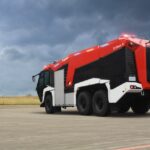

Airport fire trucks—also known as Aircraft Rescue and Firefighting (ARFF) vehicles—are among the most advanced emergency response machines in the world. Designed to respond to aviation incidents within seconds, they combine high-speed mobility, off-road capability, powerful firefighting systems, and specialized rescue tools. As global aviation expands and safety standards rise, understanding these vehicles has become increasingly important for airport planners, fire departments, and regulatory authorities. This guide explores ARFF truck classifications, capabilities, and international use cases across airports of varying sizes.
1. What Are Airport Fire Trucks?
Airport fire trucks are purpose-built emergency vehicles that support rapid response to aircraft fires, fuel spills, runway accidents, and structural emergencies within airport zones. Their design is governed by international aviation standards, primarily from:
- ICAO (International Civil Aviation Organization)
- FAA (Federal Aviation Administration)
- NFPA (National Fire Protection Association)
These guidelines specify vehicle performance requirements such as acceleration, water tank capacity, extinguishing agents, and response times. Most modern ARFF units reach the scene within 2–3 minutes, regardless of runway location.

2. Classification of Airport Fire Trucks
Airport fire trucks are commonly categorized by purpose, size, and regulatory category. Below are the major classifications used worldwide.
A. ICAO Category Vehicles (Cat 1 – Cat 10)
The ICAO classification is based on aircraft size and airport operational needs.
Each category dictates the required:
- Number of ARFF vehicles
- Minimum water and foam capacity
- Minimum discharge rates
- Maximum response times
For example:
- Cat 5–6 airports (medium jets like B737, A320) typically use 4,000–6,000 L ARFF vehicles.
- Cat 9–10 airports (large aircraft like B777, A380) require 8,000–12,000 L units with high-volume turrets.
B. Types of ARFF Trucks by Configuration
1. Rapid Intervention Vehicles (RIV)
- Lightweight, fast response units
- Carry limited water (500–1,500 L)
- Equipped with dry chemical or clean agent systems
- Used for initial attack while larger vehicles arrive
2. Major Foam Vehicles (MFV)
- Most common ARFF category
- Typically carry 6,000–12,000 L of water, 500–1,500 L of foam, and dry powder systems
- Feature roof turrets, bumper turrets, and high-flow pumps
- Designed to suppress large aviation fuel fires quickly
3. Water Tankers / Support Vehicles
- Provide an additional water supply
- Often used in large airports or remote regions
- Not always equipped with firefighting turrets
4. High Reach Extendable Turret (HRET) Trucks
- Feature a boom-mounted turret with a piercing nozzle
- Can penetrate the aircraft fuselage to inject water/foam inside
- Enhance interior firefighting and rescue in large aircraft incidents
C. Chassis Types
- 2×2 RIVs for speed and maneuverability
- 4×4 ARFFs for medium airports
- 6×6 ARFFs for large hubs (common worldwide)
- 8×8 super heavy-duty ARFFs (e.g., Rosenbauer Panther 8×8) for A380-capable airports
3. Core Capabilities of Modern Airport Fire Trucks
Airport fire trucks integrate a suite of advanced firefighting technologies designed for rapid suppression of jet-fuel fires and time-critical rescue operations.
A. High-Speed Mobility
ARFF trucks can accelerate extremely quickly for their size.
Typical specifications:
- 0–80 km/h in under 30 seconds
- Top speed: 110–140 km/h
- Powerful engines: 700–1,400+ hp
Wide tires and all-wheel-drive systems allow fast travel over soft ground, grass, or rough terrain.
B. Large Water, Foam, and Agent Capacity
Typical ARFF agent storage:
- Water: 6,000–12,000 L
- Foam concentrate: 500–1,500 L
- Dry chemical powder: 200–450 kg for fuel fires
- Clean agent systems for sensitive avionics fires
These capacities support sustained, high-flow firefighting operations.
C. Turret and Nozzle Systems
Airport fire trucks use specialized, high-performance delivery systems:
- Roof turret: 3,000–7,000 L/min discharge
- Bumper turret: For low-angle firefighting near the aircraft belly
- Handlines: Manual hoses for close-range fire suppression
- HRET systems: Extendable arms up to 20 m with a piercing nozzle
The combination allows effective handling of both exterior and interior fires.
D. Advanced Pump Technology
High-output pumps ensure continuous, controlled discharge.
- Pump capacity: 6,000–10,000 L/min
- Balanced pressure delivery for foam-water mixtures
- Automatic proportioning for accurate foam concentration
E. Rescue Equipment Integration
ARFF vehicles often carry:
- Thermal imaging cameras
- Aircraft door opening tools
- Rescue saws, lifting bags, and cutting tools
- Spill booms and absorbents
- Medical kits for mass-casualty response
F. Crew Safety and Communication
Modern ARFF cabs feature:
- Pressurized cabins
- Fire-resistant interiors
- Integrated GPS, radio systems, and dispatch connectivity
- 360° cameras for better visibility

4. Global Use Cases of Airport Fire Trucks
ARFF trucks differ in configuration and deployment strategies depending on airport type, country regulations, and operational environment. Here’s how they are used around the world.
A. Major International Airports
Examples: JFK, LAX, Heathrow, Dubai, Singapore Changi, Frankfurt.
These airports handle large aircraft like B777, A350, and A380, requiring:
- 6×6 or 8×8 ARFFs
- Multiple MFVs and HRET-equipped units
- Dedicated RIVs for ultra-fast response
- Large support fleets with extra tankers
Their ARFF fleets are among the most technologically advanced in the world.
B. Regional and Domestic Airports
Examples: Small to mid-size airports in Europe, Africa, Southeast Asia.
These airports typically operate:
- 4×4 ARFFs
- Sometimes supplemented by water tankers
- Limited use of HRET systems due to smaller aircraft
C. Remote and Island Airports
Examples: Pacific island airports, Arctic runways, small African airports.
Unique challenges include:
- Limited infrastructure
- Harsh climate conditions
- Longer response routes
- Small runway capacity
These airports often rely on adapted 4×4 trucks or multi-purpose rescue vehicles.
D. Military Airfields
Military ARFF units differ in capability due to unique risks.
Key characteristics:
- Adapted for fighter jets, heavy transports, and fuel-intensive aircraft
- Use of specialized dry chemical systems for high-energy fuel fires
- Enhanced off-road capabilities for remote airbases
- Rugged designs to withstand battlefield environments
E. Industrial and Private Airports
Including corporate jet centers, mining airstrips, and oilfield aviation bases.
- Often use smaller or mid-size ARFF trucks
- RIVs and 4×4 MFVs are most common
- Cost and maintenance efficiency are top priorities
5. Future Trends in ARFF Truck Development
As aviation evolves, ARFF technology is advancing rapidly.
A. Electric and Hybrid ARFF Vehicles
Manufacturers are testing hybrid powertrains to reduce emissions and improve efficiency.
B. Autonomous Driving and Remote Operation
Future ARFF vehicles may include:
- Semi-autonomous runway navigation
- Remote firefighting via robotic turrets
- AI-assisted fire assessment
C. High-Efficiency Foam Alternatives
As airports phase out PFAS-based foams, new eco-friendly firefighting agents are emerging.
D. Integrated Incident Command Systems
Real-time data streams from drones, trucks, and sensor networks will improve emergency coordination.

Conclusion
Airport fire trucks are essential pillars of aviation safety, combining power, speed, and specialized firefighting technology to protect millions of passengers every day. Their classifications—from RIVs to MFVs and HRET-equipped giants—reflect global operational needs, while their capabilities enable rapid, effective intervention in critical incidents. As airports worldwide continue to evolve, ARFF fleets are adopting greener technologies, smarter systems, and more advanced firefighting tools to meet the challenges of modern aviation.