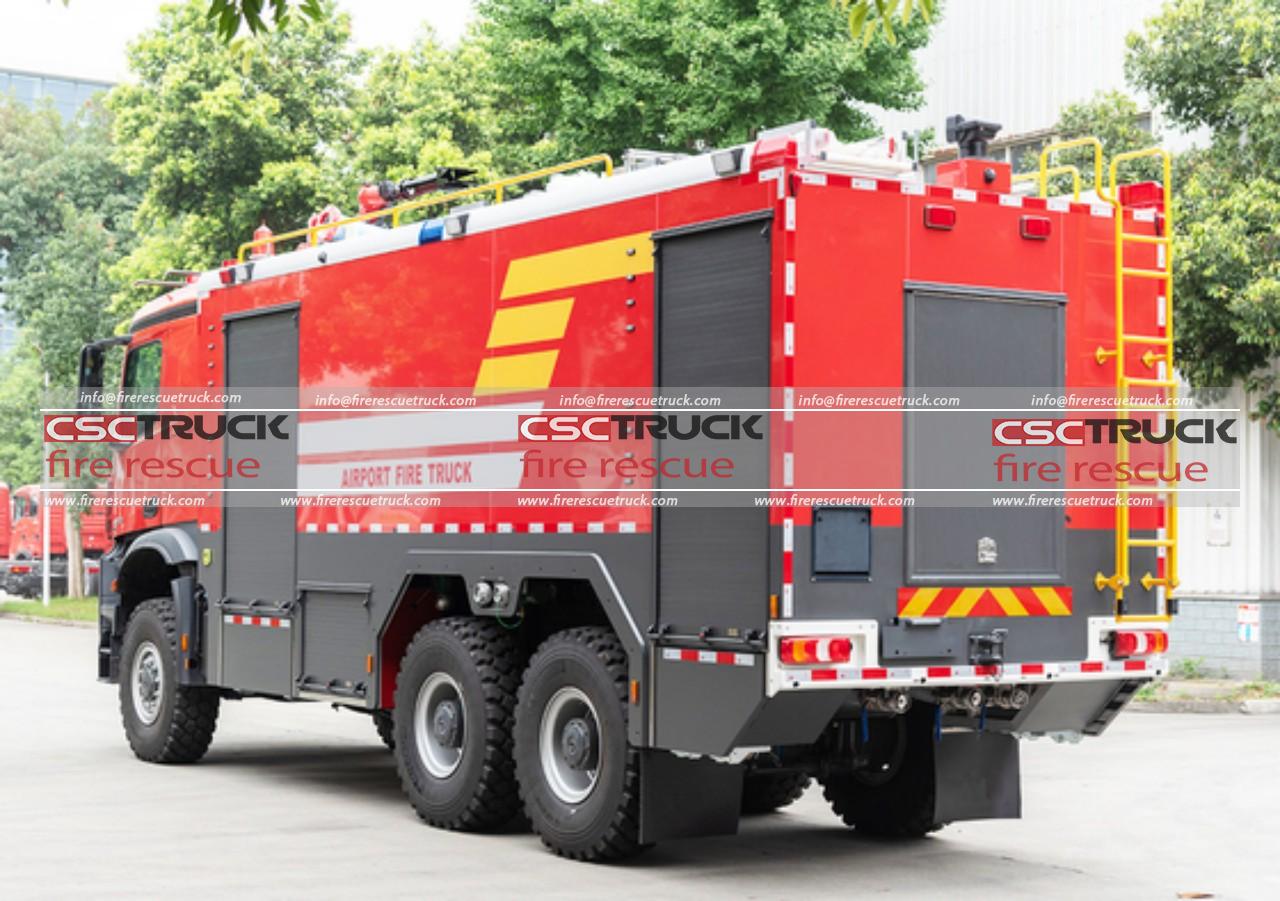
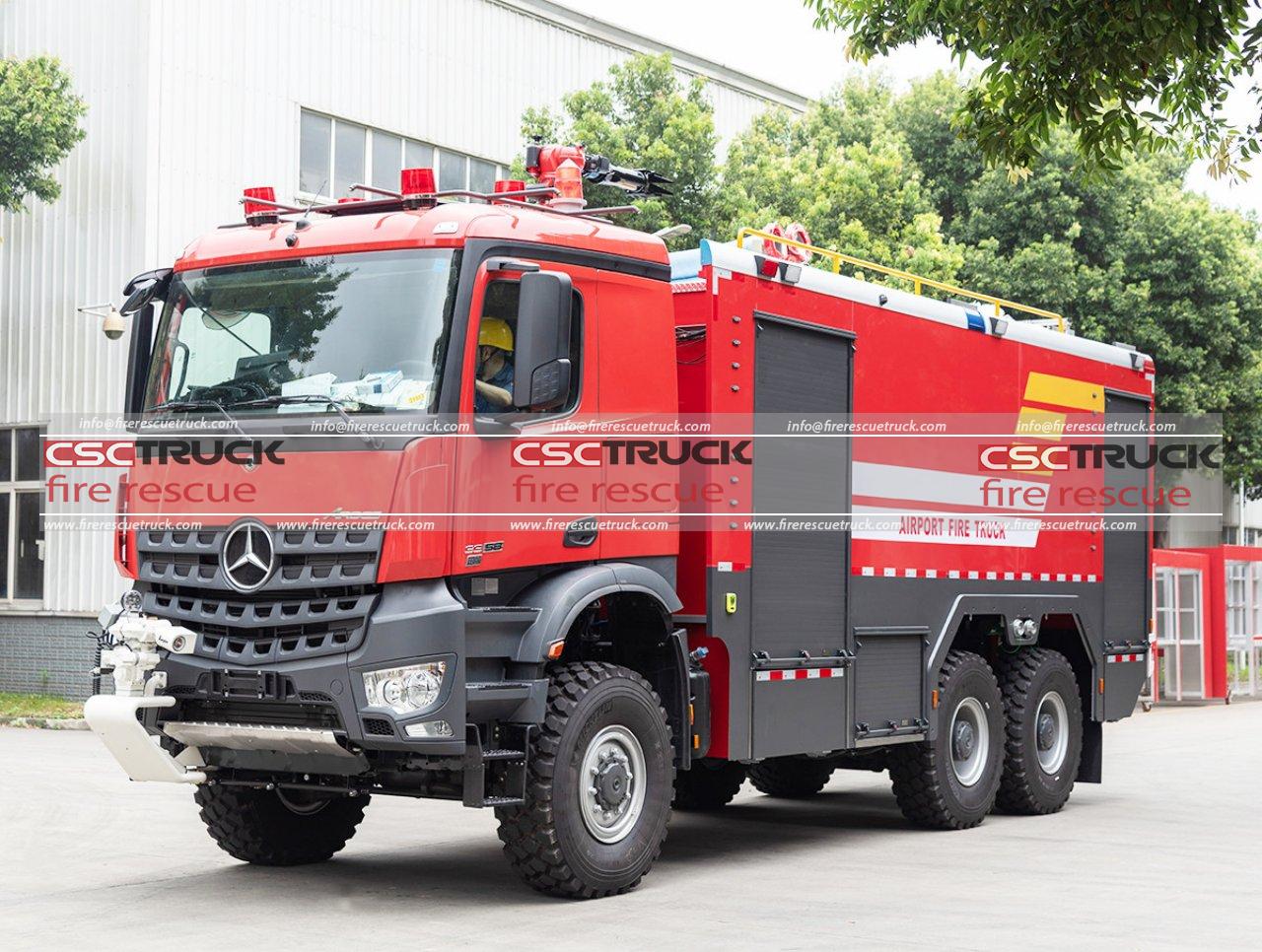
A water/foam crash tender is a specialized airport firefighting vehicle designed to respond rapidly to aircraft emergencies, particularly incidents involving aviation fuel fires. Also known as an airport fire tender, airport crash tender, or ARFF vehicle, it combines high-speed mobility, large water capacity, foam concentrate, powerful pumps, and high-flow monitors to deliver firefighting agents quickly at an airfield.
Unlike conventional municipal fire engines, a water/foam crash tender is specifically designed for the unique risks of aviation emergencies. Aircraft carry large quantities of fuel, and a crash can create extensive fire areas within seconds. For this reason, airport crash tenders must be able to reach runways and aircraft quickly and apply large quantities of extinguishing agents from a safe distance.
What Is a Water/Foam Crash Tender?
A water/foam crash tender is essentially a high-capacity airport fire truck carrying water and foam concentrate as its primary firefighting agents.
The water provides cooling and helps suppress flames, while firefighting foam is particularly important for liquid-fuel fires. When foam is mixed with water at the appropriate concentration and discharged through a suitable nozzle or monitor, it can spread across a fuel surface and help separate the fuel from oxygen and heat.
The vehicle normally consists of several major systems:
Heavy-duty 4×4, 6×6, or 8×8 chassis
High-performance diesel engine
Large-capacity water tank
Foam concentrate tank
High-capacity fire pump
Roof-mounted water/foam monitor
Front bumper monitor or nozzle
Foam proportioning system
Fire hoses and handline equipment
Crew cab and emergency communication equipment
Rescue and emergency-response equipment
The exact configuration depends on the airport’s operational requirements, aircraft types, local regulations, and required firefighting capacity.
Why Do Airports Need Water/Foam Crash Tenders?
Aircraft fires are different from many ordinary structural fires.
A damaged aircraft may contain aviation fuel, hydraulic fluids, electrical systems, composite materials, luggage, and other combustible materials. A fuel spill can also spread fire over a large area around the aircraft.
Therefore, airport firefighting vehicles must accomplish several tasks simultaneously:
Reach the emergency quickly
Apply extinguishing agents immediately
Control or suppress fuel fires
Protect passengers and crew
Support aircraft rescue operations
Create safer conditions for evacuation and rescue personnel
Airport crash tenders are therefore designed around speed, firefighting capacity, maneuverability, and rapid agent application rather than the equipment layout of a conventional city fire engine.
How Does a Water/Foam Crash Tender Work?
The basic firefighting process begins when the vehicle arrives at an aircraft emergency.
1. Rapid Response
The crash tender uses a powerful engine and specialized chassis to travel quickly across airport roads, taxiways, runways, and, where required, areas outside paved surfaces.
Many airport fire trucks use 4×4, 6×6, or 8×8 configurations to improve traction and mobility. Large airport crash tenders can therefore combine substantial firefighting capacity with the ability to move across difficult terrain.
2. Water and Foam Delivery
Once positioned, the crew activates the firefighting system. Water is drawn from the onboard tank and delivered through the pump.
Foam concentrate is introduced through the foam proportioning system. The resulting foam solution can then be discharged through monitors or nozzles.
This allows the operator to attack a fuel fire rapidly without requiring firefighters to approach the aircraft immediately.
3. Monitor Operation
The roof-mounted monitor is one of the most recognizable components of a crash tender.
It is designed to project water or foam over a considerable distance and can usually be aimed toward the fire from the cab or an operator’s position.
Some advanced airport fire trucks also incorporate front monitors, allowing firefighters to attack the fire from different directions.
4. Fire Suppression and Cooling
Foam is primarily used to control flammable-liquid fires, while water can provide cooling and additional fire suppression.
During an aircraft emergency, firefighters may need to protect the fuselage, engines, escape routes, and surrounding areas while simultaneously suppressing burning fuel.
Key Features of a Water/Foam Crash Tender
Large Water Capacity
Water capacity is one of the most important specifications.
Depending on vehicle size and airport requirements, crash tenders can carry several thousand liters of water. Large ARFF vehicles may have capacities exceeding 10,000 liters. Current CSCTRUCK Fire Rescue Truck listings, for example, include airport fire trucks with 7,000 L, 11,000 L, 12,000 L, 14,000 L, 16,000 L, and 17,000 L-class configurations.
Foam System
The foam system is essential for dealing with aviation-fuel fires. The vehicle stores foam concentrate separately and uses a proportioning system to introduce it into the water stream.
Buyers should consider foam tank capacity, proportioning accuracy, compatible foam concentrate, discharge rate, and applicable local requirements when specifying a vehicle.
High-Capacity Pump
The fire pump must deliver sufficient flow and pressure for the vehicle’s monitors and other discharge outlets.
A properly matched pump and monitor system allows the crash tender to attack a fire rapidly while maintaining an appropriate operational distance from the aircraft.
Powerful Chassis
Airport fire trucks require more than a large tank. They also need enough engine power to accelerate quickly despite their substantial gross vehicle weight.
6×6 and 8×8 chassis are common choices for larger airport firefighting vehicles because they provide additional traction and payload capability.
Off-Road Mobility
Aircraft accidents do not necessarily occur in the middle of a paved runway. An incident may happen beside the runway, on grass, near an airport perimeter, or on other uneven surfaces.
For this reason, airport crash tenders generally emphasize all-terrain capability more than conventional municipal fire engines.
Water/Foam Crash Tender vs. Conventional Fire Truck
Although both vehicles fight fires, their designs are different.
Feature
Water/Foam Crash Tender
Conventional Fire Truck
Main application
Aircraft and airport emergencies
Buildings, roads, urban fires
Water capacity
Usually very large
Varies
Foam capability
Major firefighting function
May be optional
Speed
Designed for rapid airfield response
Designed for road response
Chassis
Often 4×4, 6×6, 8×8
Commonly 4×2 or 6×4
Terrain
Runways, grass, airfield areas
Primarily paved roads
Fire monitor
High-flow monitor commonly installed
Configuration varies
Primary fuel-fire role
Very important
Depends on vehicle
In practice, a water/foam crash tender is an airport-specific firefighting platform, optimized to combine rapid response with large-scale fire suppression.
What Should Buyers Consider?
Airports purchasing a water/foam crash tender should evaluate more than water tank capacity.
Important specifications include:
Airport category and regulatory requirements
Aircraft types and maximum aircraft size
Water tank capacity
Foam tank capacity
Fire pump flow and pressure
Monitor flow rate and throwing range
Chassis configuration
Engine power
Acceleration and maximum speed
Crew capacity
Vehicle dimensions
Turning radius
Off-road capability
Rescue equipment
Foam proportioning system
Local certification requirements
Spare parts and after-sales support
The required vehicle should ultimately be matched to the airport’s emergency-response plan and applicable aviation and firefighting standards rather than selected solely according to tank size.
Water/Foam Crash Tenders from CSCTRUCK Fire Rescue Truck
CSCTRUCK Fire Rescue Truck provides a range of airport firefighting vehicles, including 4×4, 6×6, and 8×8 airport fire trucks. Its current product range includes configurations such as a 6×6 14,000 L airfield fire truck, 6×6 16,000 L ARFF truck, 8×8 17,000 L airport fire truck, and other water/foam firefighting vehicles.
CSCTRUCK Fire Rescue Truck also states that it can customize its fire trucks to customer requirements, including chassis, engine, transmission, drive type, tank size, pump capacity, hose configuration, and other equipment.
For international airport projects, customization can be particularly useful because airport infrastructure, aircraft categories, climate, terrain, regulations, and operational procedures vary between countries.
Conclusion
A water/foam crash tender is a specialized airport firefighting vehicle designed to deliver large quantities of water and foam rapidly during aircraft emergencies. Its combination of a powerful chassis, large-capacity tanks, high-performance pump, foam proportioning system, and high-flow monitors makes it fundamentally different from a standard municipal fire engine.
For airports, the right crash tender should balance response speed, firefighting capacity, mobility, foam performance, reliability, and regulatory compliance. Whether configured as a 4×4, 6×6, or 8×8 vehicle, the goal remains the same: reach the aircraft emergency quickly and deliver effective firefighting agents during the critical first moments of an incident.