Aircraft emergencies can involve large fuel loads, intense fires, complex aircraft structures, and difficult access conditions. For major airports handling wide-body passenger aircraft, cargo aircraft, or high-frequency commercial operations, a standard municipal fire engine may not provide the required combination of speed, firefighting capacity, and off-road mobility. This is where a Heavy ARFF vehicle becomes important.
Heavy ARFF vehicles—Aircraft Rescue and Fire Fighting vehicles—are large airport fire trucks engineered to carry substantial quantities of water and foam, deliver extinguishing agents at high flow rates, and reach aircraft incidents rapidly across runways, taxiways, aprons, and surrounding terrain. Current FAA guidance defines several ARFF vehicle classes and procurement requirements, with vehicle selection tied to airport and operational requirements.
What Is a Heavy ARFF Vehicle?
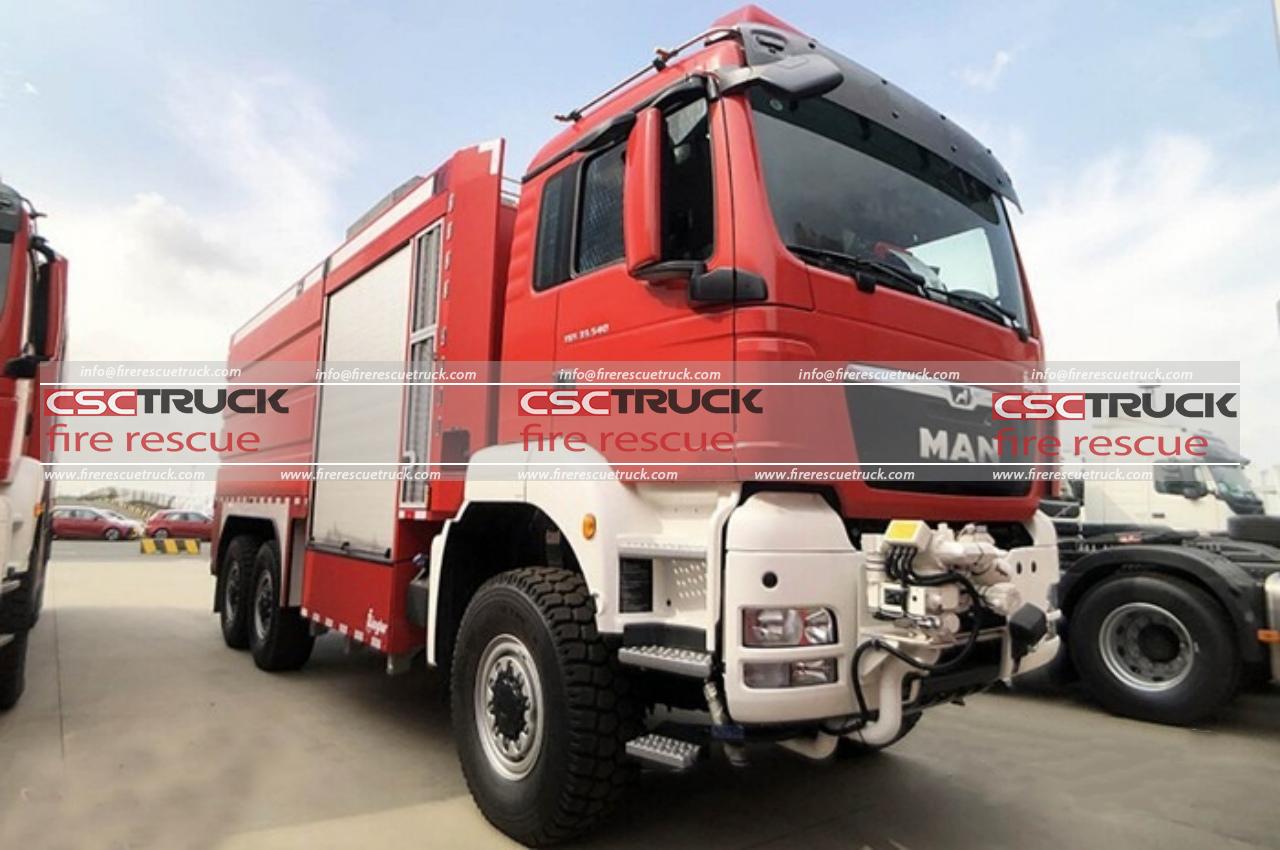
A Heavy ARFF vehicle is a large-capacity airport rescue fire truck designed for demanding aircraft firefighting and rescue operations. Compared with smaller ARFF units, heavy vehicles generally provide greater firefighting-agent capacity, larger chassis and powertrains, higher-output pumps, and more advanced monitors or specialized equipment.
The exact definition of “heavy” can vary by manufacturer, airport procurement specification, and regulatory framework. In practical terms, these vehicles are commonly associated with 6×6 or 8×8 configurations, large water and foam tanks, powerful diesel engines, and high-capacity firefighting systems.
For example, CSCTRUCK Fire Rescue Truck currently presents large ARFF models including a 6×6 16,000-liter ARFF truck, a 6×6 14,000-liter airfield fire truck, and an 8×8 17,000-liter airport fire truck.
Why Do Large Airports Need Heavy ARFF Trucks?
Aircraft fires present several challenges that differ from ordinary structural fires.
First, aircraft can carry significant quantities of aviation fuel. A fuel spill can spread rapidly across an apron or runway, creating a large flammable area. Foam-based systems are therefore an important part of many ARFF configurations.
Second, modern aircraft can be physically enormous. Wide-body aircraft have large fuselages, multiple decks or extensive cabin areas, substantial wings, and complex fuel systems. Firefighters need enough extinguishing agent and discharge capability to establish effective fire suppression quickly.
Third, airport emergency crews may have to travel long distances. A runway can extend for several kilometers, while airport grounds can include grass, gravel, drainage areas, and other surfaces. A heavy ARFF truck therefore needs more than a large tank—it also needs strong acceleration, all-wheel drive, robust suspension, and reliable braking.
Major Components of a Heavy ARFF Vehicle
1. Large Water and Foam Capacity
One of the most visible characteristics of a heavy airport fire truck is its large firefighting-agent capacity.
Depending on the airport’s requirements and vehicle configuration, heavy ARFF vehicles can carry thousands of liters of water together with foam concentrate. CSCTRUCK Fire Rescue Truck‘s current airport fire truck range, for example, includes models with capacities such as 11,000, 12,000, 14,000, 16,000, and 17,000 liters.
The correct capacity should not simply be selected according to the largest available tank. Airport operators need to consider aircraft types, airport category or index, required application rates, response objectives, local regulations, and the airport’s overall emergency plan.
2. High-Capacity Pump
A large tank is only useful if the truck can deliver the agent rapidly.
Heavy ARFF trucks therefore use high-capacity pumps designed to supply roof monitors, bumper monitors, handlines, foam systems, and other outlets. Pump selection should be considered together with monitor flow rate, operating pressure, piping design, foam proportioning, and the intended firefighting strategy.
3. Roof and Bumper Monitors
ARFF vehicles commonly use remotely controlled monitors to project water or foam toward an aircraft fire.
A roof-mounted monitor provides a high-angle and long-range discharge capability, while a bumper-mounted monitor can help firefighters attack a fire from a lower position.
The control system is particularly important because firefighters may need to operate the monitors while remaining inside the protected cab.
4. High-Speed Heavy-Duty Chassis
Heavy ARFF vehicles need considerable engine power because they combine a large chassis, substantial firefighting-agent load, rescue equipment, and crew.
Six-wheel-drive and eight-wheel-drive configurations can provide traction on difficult airfield surfaces. The choice between 4×4, 6×6, and 8×8 depends on airport requirements, vehicle size, terrain, weight distribution, and procurement specifications.
FAA guidance also emphasizes vehicle performance characteristics as part of ARFF procurement rather than treating the vehicle simply as a conventional fire truck.
5. Foam Proportioning System
Foam is particularly relevant to aircraft fuel-fire suppression. A foam proportioning system mixes foam concentrate with water at the required concentration before discharge.
When specifying a heavy ARFF vehicle, airport buyers should examine the foam system as a complete package, including concentrate tank capacity, proportioning technology, compatible foam concentrate, controls, flushing arrangements, and maintenance requirements.
6. High-Reach and Specialized Firefighting Equipment
Some heavy ARFF vehicles can be equipped with advanced systems such as high-reach extendable turrets (HRETs) and aircraft skin-piercing devices.
These systems can allow firefighters to deliver extinguishing agents into areas that are difficult to reach using conventional exterior application. Whether such equipment is necessary depends on the airport’s aircraft fleet, emergency-response philosophy, regulations, and budget.
Heavy ARFF Vehicle vs. Standard Fire Truck
A standard municipal fire engine and a heavy ARFF vehicle serve different operational environments.
Feature
Heavy ARFF Vehicle
Standard Fire Truck
Primary application
Aircraft emergencies
Buildings, vehicles, urban incidents
Firefighting agents
Large water/foam capacity
Usually water and/or foam
Chassis
Often 6×6 or 8×8
Commonly road-oriented
Airport mobility
Designed for airfield operation
Primarily paved-road operation
Speed/acceleration
Designed for rapid airport response
Depends on municipal specification
Monitors
High-capacity roof/bumper monitors
Often hose lines and/or monitor
Fuel-fire capability
Major design consideration
Secondary depending on application
Rescue equipment
Aircraft-specific options available
General rescue equipment
The distinction is not simply vehicle size. Heavy ARFF trucks are purpose-built around aviation emergency response.
Standards and Compliance
Airport authorities should establish applicable standards before purchasing an ARFF vehicle.
In the United States, the FAA‘s AC 150/5220-10F, Guide Specification for Aircraft Rescue and Fire Fighting (ARFF) Vehicles, provides procurement guidance and incorporates relevant NFPA provisions. The FAA document describes different ARFF vehicle classifications and associated equipment and performance requirements.
International airport projects may also need to consider ICAO requirements, national aviation regulations, and applicable fire-apparatus standards. CSCTRUCK Fire Rescue Truck‘s published ARFF information references ICAO, NFPA, and EN requirements as relevant frameworks, while noting that actual certification or compliance depends on the specific model and customer requirements.
Therefore, buyers should provide the manufacturer with the applicable specification rather than assuming that one ARFF configuration automatically satisfies every airport’s requirements.
How to Select a Heavy ARFF Vehicle
Before purchasing a large airport fire truck, evaluate these factors:
Airport category and operational requirements
Largest aircraft regularly served
Required water and foam capacity
Pump and monitor flow rates
Foam proportioning system
4×4, 6×6, or 8×8 drivetrain
Acceleration and maximum speed
Off-road and airfield mobility
Cab protection and firefighter ergonomics
HRET or aircraft-piercing requirements
Rescue and extrication equipment
Applicable FAA, ICAO, NFPA, EN, or national standards
Maintenance and spare-parts support
Customization and long-term operating costs
The objective is to match the vehicle to the airport’s actual emergency-response requirements rather than simply purchasing the largest truck available.
CSCTRUCK Fire Rescue Truck for Heavy ARFF Applications
CSCTRUCK Fire Rescue Truck is a China-based fire and rescue vehicle platform offering airport fire trucks alongside pumper trucks, aerial fire trucks, rescue vehicles, hazmat units, and other specialized emergency vehicles. Its published product range includes 4×4, 6×6, and 8×8 airport fire trucks, with configurations such as 12,000-, 14,000-, 16,000-, and 17,000-liter-class models.
CSCTRUCK Fire Rescue Truck also states that its fire trucks can be customized according to customer requirements, including chassis, engine, drivetrain, tank size, pump capacity, and specialized equipment. This can be useful for airport projects where the ARFF vehicle must be configured around a specific technical specification.
For an RFQ, airport authorities, fire departments, aviation companies, and distributors should provide information such as destination country, required capacity, aircraft types, applicable standards, chassis preference, firefighting-agent requirements, and special equipment. CSCTRUCK Fire Rescue Truck‘s website provides an inquiry process for obtaining a project-specific quotation.
Conclusion
A Heavy ARFF vehicle is a specialized airport firefighting platform designed for situations where rapid response, high extinguishing capacity, mobility, and aircraft-specific equipment are essential.
Large water and foam tanks, high-capacity pumps, powerful monitors, all-wheel-drive chassis, advanced foam systems, and optional HRET or rescue equipment allow these trucks to address demanding aircraft emergencies.
For airport operators, selecting the right heavy ARFF truck should begin with the airport’s aircraft fleet, operational requirements, regulatory framework, response objectives, terrain, and firefighting strategy. A properly specified vehicle can then be configured around the airport’s actual mission rather than relying on a one-size-fits-all design.