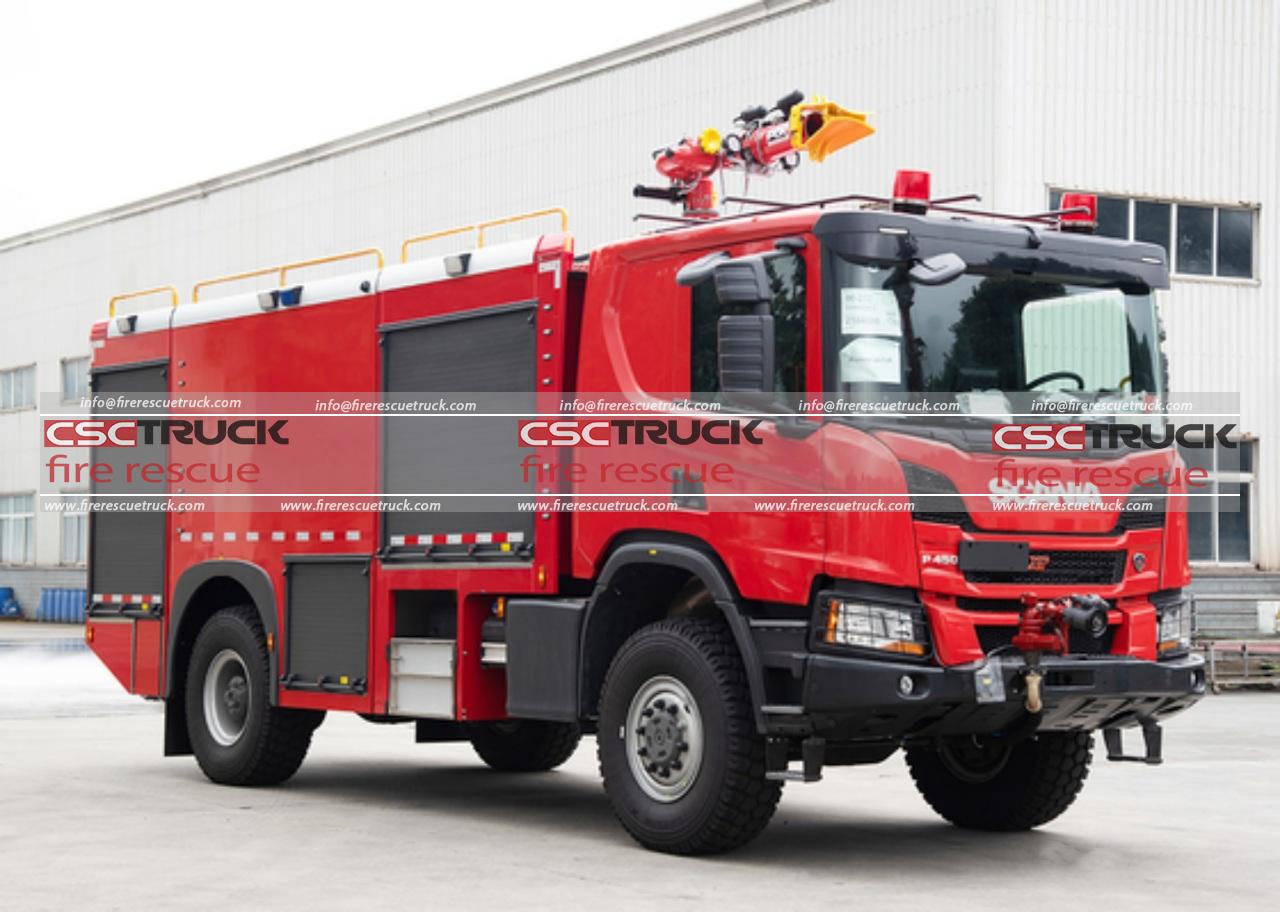
A water/foam crash tender is one of the most important emergency vehicles at an airport. Also known as a water/foam ARFF vehicle, airport fire truck, or airport crash tender, it is specifically designed to respond rapidly to aircraft accidents, aviation fuel fires, runway emergencies, and other airfield incidents.
Unlike conventional municipal fire engines, water/foam crash tenders combine high-speed response, large firefighting-agent capacity, powerful pumps, foam proportioning systems, and roof- or bumper-mounted monitors. The vehicle must also be capable of operating across runways, taxiways, aprons, grass, and other airport surfaces.
For airport operators planning a new purchase or fleet replacement, the challenge is not simply choosing a truck with a large water tank. Airport category, aircraft types, response requirements, foam system, chassis configuration, pump performance, regulatory compliance, maintenance, and total ownership cost all need to be considered.
What Is a Water/Foam Crash Tender?
A water/foam crash tender is an ARFF vehicle that carries water and foam concentrate and delivers the resulting foam solution through high-capacity firefighting systems.
Aircraft accidents can involve aviation fuel, which can spread rapidly across an apron or runway. Foam is therefore an important extinguishing agent because it can cover the fuel surface and help suppress fire and vapor release.
The basic system normally includes:
Water tank
Foam concentrate tank or foam-storage system
Fire pump
Foam proportioning system
Roof-mounted monitor
Front or bumper monitor
Hose reels and handlines
Driver and crew cab
Emergency lighting and communications
Specialized rescue equipment, depending on configuration
Larger ARFF vehicles may also incorporate high-reach extendable turrets, under-truck nozzles, thermal imaging systems, dry-chemical systems, or other specialized equipment.
Why Water and Foam Capacity Matters
One of the first specifications airport buyers examine is agent capacity. However, the required capacity should be determined from the airport’s operational and regulatory requirements rather than simply selecting the largest available tank.
Airport firefighting requirements are linked to factors such as airport category, aircraft characteristics, runway environment, and the required firefighting capability. ICAO Annex 14 provides international guidance, while national aviation authorities may impose additional requirements. In the United States, FAA ARFF procurement specifications incorporate NFPA requirements and establish different vehicle classifications for different airport applications.
As a practical reference, large crash tenders can carry several thousand liters of water. CSCTRUCK Fire Rescue Truck‘s current airport-fire-truck range, for example, includes configurations such as 7,000-liter 4×4, 11,000-liter 6×6, 12,000-liter electric 6×6, 14,000-liter 6×6, 16,000-liter 6×6, and 17,000-liter 8×8 airport fire trucks.
The correct configuration depends on the airport’s requirements rather than tank size alone.
1. Check Airport Category and Aircraft Mix
Before requesting quotations, buyers should establish the operational requirements of the airport.
Consider:
Airport rescue and firefighting category
Largest aircraft regularly using the airport
Passenger and cargo traffic
Runway dimensions and layout
Distance between the fire station and runway
Terrain surrounding the airfield
Required response time
Local aviation authority requirements
A regional airport serving narrow-body aircraft may have very different requirements from a major international airport handling wide-body aircraft.
This information allows the manufacturer to recommend an appropriate chassis, water capacity, foam capacity, pump, monitor, and optional rescue systems.
2. Evaluate the Chassis and Drive System
A crash tender needs more than a powerful firefighting system. It must reach an aircraft incident quickly.
Airport buyers commonly consider 4×4, 6×6, and 8×8 configurations. 4-wheel-drive vehicles can be suitable for smaller airports or applications where maneuverability is important. 6-wheel-drive configurations provide a combination of payload capacity, traction, and mobility, while 8×8 vehicles are generally intended for larger and heavier ARFF configurations.
Off-road capability is especially important because an aircraft incident may occur outside a paved runway or taxiway.
Important chassis specifications include:
Engine power
Acceleration
Maximum speed
Gross vehicle weight
Axle configuration
Ground clearance
Suspension
Tire size
Turning radius
Transmission
Braking system
The vehicle should be evaluated as a complete system rather than according to engine horsepower alone.
3. Pay Attention to Pump and Monitor Performance
Large water capacity is useful only if the truck can deliver the agent effectively.
Airport buyers should examine:
Pump rated flow
Pump pressure
Foam-solution discharge rate
Roof monitor flow rate
Bumper monitor flow rate
Monitor range
Monitor control system
Simultaneous monitor operation
Priming system
Pump controls
The roof monitor is particularly important because it allows firefighters to begin applying extinguishing agent while maintaining distance from the aircraft or fuel fire.
Depending on the airport’s requirements, buyers may also consider remote-controlled monitors or high-reach systems.
4. Understand the Foam System
Not every foam system is identical.
The buyer should confirm the type of foam concentrate intended for the vehicle, the required proportioning ratio, concentrate-storage arrangement, operating temperature range, and compatibility between the foam concentrate and proportioning equipment.
Environmental requirements should also be considered. For example, U.S. FAA guidance specifically notes restrictions concerning certain foam configurations, including the statement that F3 foams cannot be used with a premix system truck.
Therefore, airport procurement teams should specify the approved firefighting agent and system requirements before finalizing the vehicle design.
5. Consider HRET and Specialized Aircraft-Firefighting Equipment
For larger airports, a basic roof monitor may not be sufficient for every operational requirement.
A High-Reach Extendable Turret (HRET) can provide a controlled means of delivering extinguishing agent to difficult-to-access areas of an aircraft.
Depending on the airport and aircraft fleet, optional equipment can include:
HRET
Piercing nozzle
Bumper turret
Under-truck nozzles
Thermal imaging camera
Dry-chemical system
Rescue tools
Breathing-apparatus storage
Scene lighting
Foam proportioning automation
These options increase capability but also affect vehicle price, weight, maintenance, and operator training.
6. Verify Regulatory Compliance
Compliance should be addressed before placing the purchase order.
Potential references include:
ICAO Annex 14
ICAO Airport Services Manual
FAA ARFF specifications
NFPA standards
EN standards
National civil aviation regulations
Local fire-service requirements
The exact requirements depend on the airport’s jurisdiction and procurement specification. A tender should clearly identify the applicable standards and acceptance-testing requirements.
A South African government procurement specification, for example, required an ARFF vehicle to meet airport-category requirements and referenced ICAO and NFPA provisions for agent quantities, discharge rates, and vehicle performance.
7. Think About Maintenance and Total Cost of Ownership
The purchase price is only 1 part of the cost of an airport crash tender.
Airport operators should also evaluate:
Initial cost + spare parts + maintenance + training + fuel/energy + downtime + lifecycle support
Before ordering, ask the manufacturer about:
Warranty period
Spare-parts availability
Local technical support
Preventive maintenance schedule
Pump maintenance
Foam-system maintenance
Chassis servicing
Operator training
Emergency troubleshooting
Delivery lead time
For an airport, vehicle availability can be as important as the original purchase price.
8. Why Consider CSCTRUCK Fire Rescue Truck?
CSCTRUCK Fire Rescue Truck provides a range of specialized firefighting vehicles, including airport fire trucks and ARFF configurations. Its current product range includes 4×4, 6×6, and 8×8 airport fire trucks with different water capacities and equipment configurations.
CSCTRUCK Fire Rescue Truck also supports customized configurations. Depending on the project, buyers can discuss chassis selection, engine and transmission specifications, tank size, pump capacity, drive configuration, hose systems, and other firefighting equipment with the manufacturer.
For international airport projects, customization can be useful because the required ARFF configuration may vary significantly according to airport category, aircraft fleet, local regulations, climate, terrain, and available maintenance infrastructure.
Water/Foam Crash Tender Buying Checklist
Before sending an RFQ, airport buyers should prepare the following information:
Item
Information to Confirm
Airport category
Applicable ICAO/local category
Aircraft
Largest aircraft served
Chassis
4×4, 6×6, or 8×8
Water capacity
Required liters
Foam capacity
Required concentrate capacity
Pump
Flow and pressure
Monitors
Roof/bumper configuration
HRET
Required or optional
Foam system
Proportioning method and approved agent
Compliance
ICAO, FAA, NFPA, EN, or local standards
Environment
Climate and terrain
Crew
Cab and seating requirements
Support
Training, warranty, and spare parts
Final Thoughts
A water/foam crash tender is a specialized airport safety asset, not simply a large fire truck with a water tank. The right vehicle needs to combine rapid response, sufficient extinguishing-agent capacity, powerful pumping and monitor systems, reliable mobility, appropriate foam technology, regulatory compliance, and long-term service support.
For airport buyers, the best procurement process starts with operational requirements and applicable standards. Once these are established, manufacturers can configure the chassis, tanks, pumps, monitors, foam systems, and optional rescue equipment around the actual airport application.
CSCTRUCK Fire Rescue Truckoffers multiple ARFF configurations and factory customization options for international customers. Airport operators can provide their airport category, aircraft types, required water/foam capacity, applicable standards, and desired equipment when requesting a quotation, allowing the manufacturer to develop a configuration suited to the project.