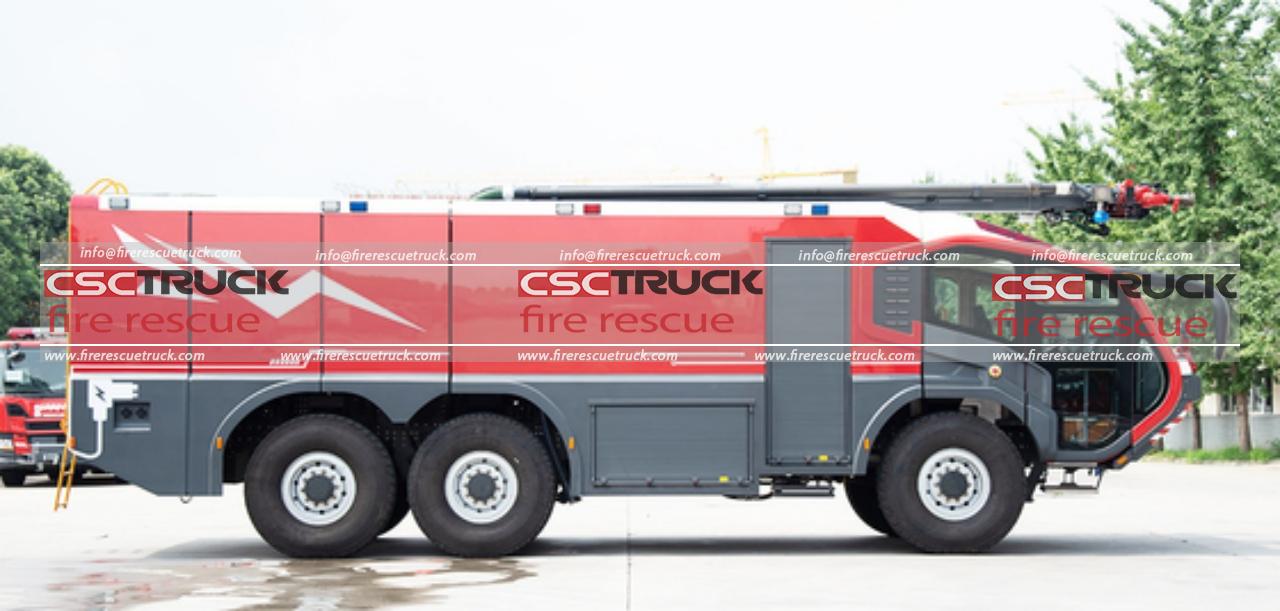

Aircraft Rescue and Firefighting (ARFF) trucks are specially designed to respond to aircraft accidents, aviation fuel fires, runway emergencies, and other incidents at airports. One of their most important advantages is their ability to carry large quantities of firefighting agents directly to the emergency scene, allowing crews to begin suppression before connecting to external water supplies.
But exactly how much water and foam does an ARFF truck carry? The answer depends on the vehicle’s size, airport category, aircraft types, local regulations, and firefighting system. In general, modern ARFF vehicles can carry several thousand to more than 15,000 liters of water, while foam concentrate capacity commonly ranges from several hundred to around 1,500 liters or more.
About CSCTRUCK Fire Rescue Truck
CSCTRUCK Fire Rescue Truck is a professional manufacturer and supplier of specialized firefighting vehicles, including ARFF trucks, airport crash tenders, water/foam fire trucks, rescue vehicles, and customized emergency vehicles.
CSCTRUCK Fire Rescue Truck offers ARFF configurations with different chassis, tank capacities, pumps, monitors, and firefighting systems to meet different airport requirements. For example, its Electric 6×6 Airport Firefighter Truck is equipped with an 11,000-liter water tank and a 1,000-liter foam tank, while other heavy-duty ARFF configurations can provide even greater agent capacity.
For airports purchasing an ARFF vehicle, understanding water and foam capacity is essential because tank volume directly affects firefighting endurance, vehicle weight, pump performance, and operational capability.
Typical ARFF Water Capacity
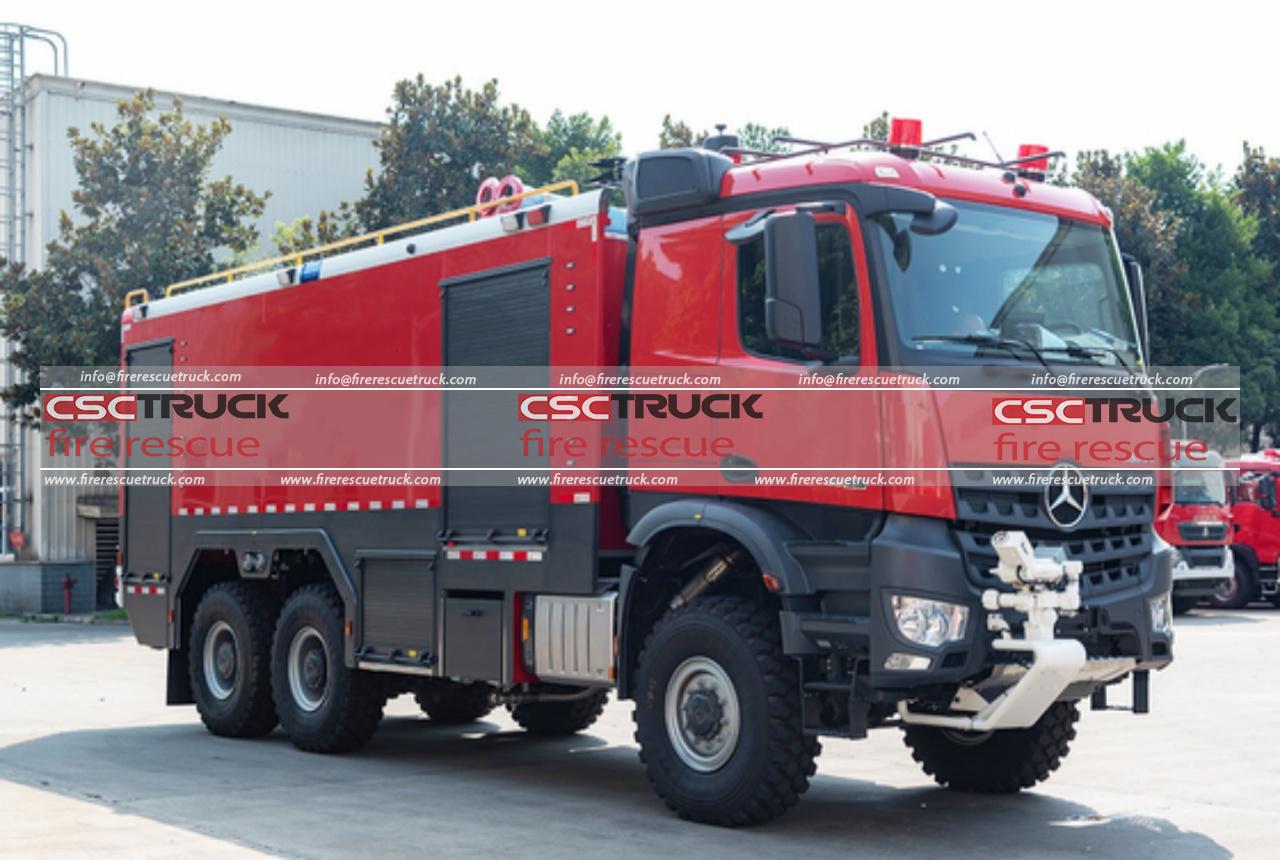
Water is the primary extinguishing medium carried by an ARFF truck. It provides cooling and is also used to create foam when mixed with foam concentrate through the vehicle’s proportioning system.
There is no single universal water-tank size for every ARFF truck. Depending on the vehicle class and airport requirements, common capacities include:
| ARFF Vehicle Type | Approximate Water Capacity |
|---|---|
| Small ARFF vehicle | 3,000–6,000 L |
| Medium ARFF vehicle | 6,000–10,000 L |
| Heavy ARFF vehicle | 10,000–15,000+ L |
| Large specialized ARFF | 15,000–20,000+ L |
CSCTRUCK Fire Rescue Truck‘s published specifications similarly show that airport fire trucks can range from several thousand liters to more than 10,000 liters of water capacity.
For example, the CSCTRUCK Fire Rescue Truck Electric 6×6 ARFF truck carries 11,000 liters of water, while its high-capacity configurations can carry 13,500 liters of water.
Why Do ARFF Trucks Carry So Much Water?
Aircraft emergencies can involve large quantities of aviation fuel. A fire can spread rapidly across a runway or around an aircraft, creating a requirement for high-volume, rapid application of extinguishing agents.
An ARFF truck therefore needs enough water to:
- Produce foam solution
- Cool aircraft surfaces
- Control fuel fires
- Protect escape routes
- Support rescue operations
- Provide an initial attack before additional resources arrive
The vehicle’s pump capacity is equally important. A large water tank is useful only when the truck can deliver that water rapidly and effectively.
How Much Foam Does an ARFF Truck Carry?
It is important to distinguish between foam concentrate and the finished foam solution.
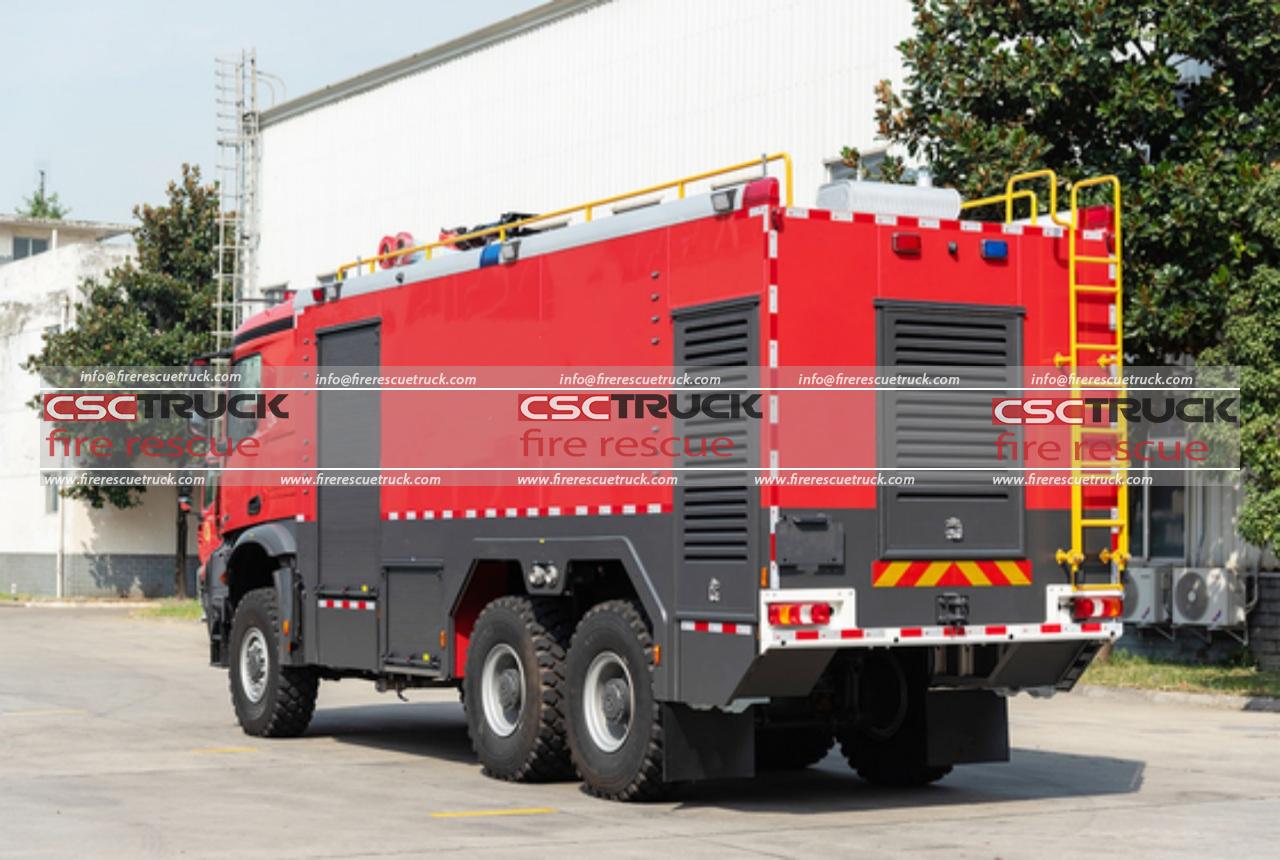
ARFF trucks normally do not carry thousands of liters of ready-made foam. Instead, they carry foam concentrate in a dedicated tank, which is automatically mixed with water at a specified proportion during discharge.
Typical foam-concentrate capacities may range from approximately 300 to 1,500 liters, depending on vehicle size and system design. CSCTRUCK Fire Rescue Truck‘s published ARFF information lists configurations with approximately 600–1,500 liters of foam concentrate, while its Electric 6×6 model carries 1,000 liters.
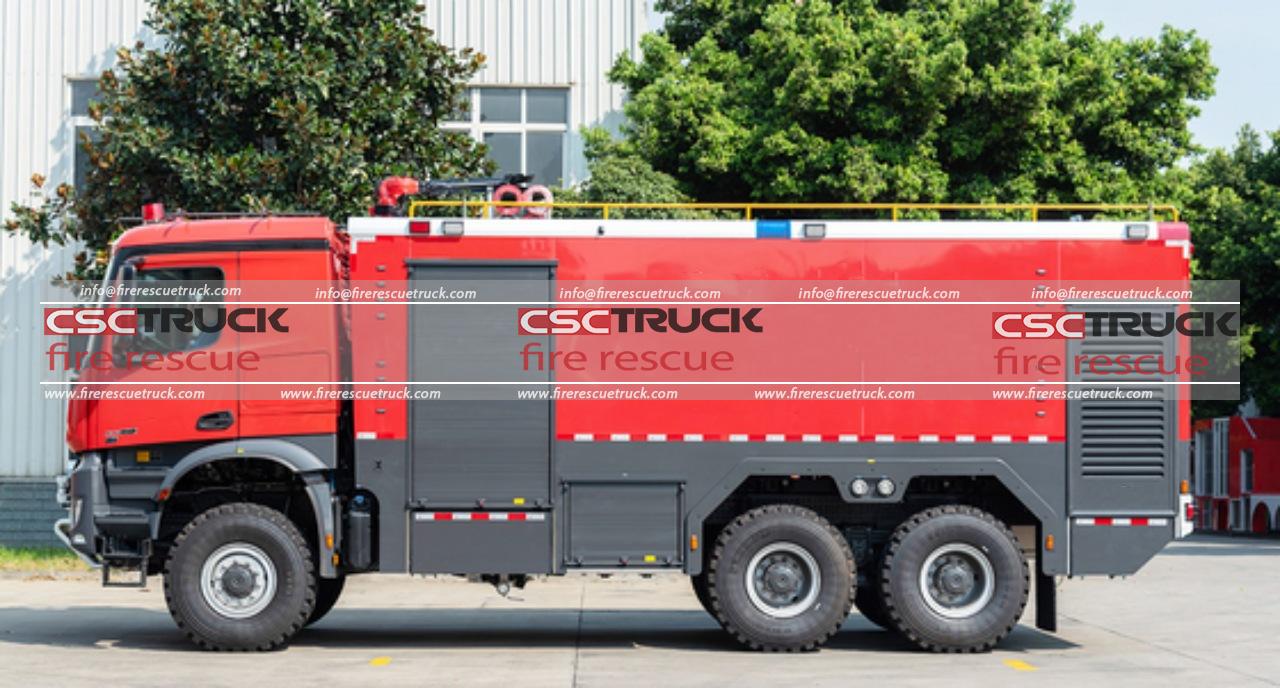
A CSCTRUCK Fire Rescue Truck Benz 11,000-liter Airport Fire Truck, for example, has:
- 10,000 L water
- 1,000 L foam
- 100 L/s fire pump
- 80 L/s roof monitor
- Water and foam discharge ranges of at least 85 meters
Water-to-Foam Ratio
The amount of foam concentrate required depends on the specified foam proportioning percentage.
For example, if a system uses a hypothetical 3% foam concentration, 3 liters of concentrate would be required for every 100 liters of total foam solution, subject to the manufacturer’s system design and applicable standards.
At 3%:
- 1,000 L foam concentrate can support roughly 33,333 L of foam solution.
- 1,500 L can support roughly 50,000 L of foam solution.
The exact calculation depends on how the proportioning system defines concentration and the usable capacities of the water and foam tanks.
FAA ARFF vehicle guidance specifies that the foam concentrate tank should have sufficient working capacity for 2 water-tank loads at the specified foam concentration and applicable tolerance.
This is an important point: Foam-tank capacity should not be evaluated separately from water-tank capacity.
Why Foam Is Critical for Aircraft Fires
Water is excellent for cooling, but aviation fuel fires require additional consideration because fuel can remain on the surface and continue burning.
Foam works by forming a blanket over the fuel surface. Depending on the foam system and concentrate, it can help:
- Separate fuel from oxygen
- Reduce vapor release
- Suppress flames
- Prevent or reduce re-ignition
- Protect a larger fuel-contaminated area
Modern ARFF vehicles may use conventional AFFF systems or fluorine-free foam concentrates, depending on local regulations and airport requirements.
Because different foam concentrates can have different characteristics, airport operators should specify the intended foam product when purchasing an ARFF truck. The proportioning equipment, tank materials, pumps, and other components must be compatible with the selected concentrate.
Does a Bigger Water Tank Always Mean a Better ARFF Truck?
Not necessarily.
Increasing tank capacity also increases vehicle weight. A larger ARFF truck therefore requires an appropriate chassis, suspension, engine or propulsion system, braking system, and pump system.
For example, CSCTRUCK Fire Rescue Truck‘s Electric 6×6 ARFF truck has an approximately 39,000 kg fully loaded weight, 6×6 drive, and a maximum speed of up to 130 km/h. Its 11,000-liter water tank and 1,000-liter foam tank are integrated with a high-performance firefighting system.
Airport operators should therefore evaluate the complete vehicle rather than looking only at tank volume.
Important specifications include:
- Water capacity
- Foam concentrate capacity
- Foam proportioning ratio
- Fire pump flow rate
- Monitor flow rate
- Monitor range
- Chassis and drivetrain
- Acceleration and maximum speed
- Vehicle gross weight
- Airport firefighting requirements
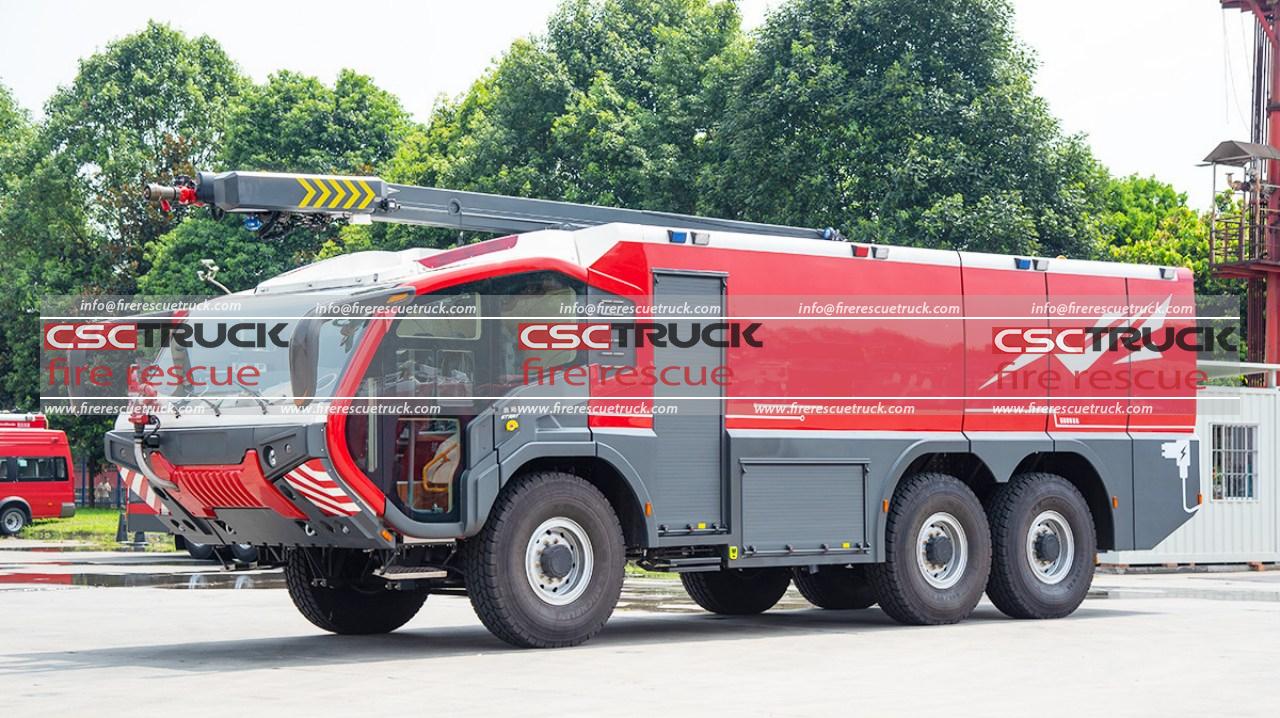
Example: 11,000-Liter Water + 1,000-Liter Foam ARFF Truck
Consider an ARFF truck with:
- Water: 11,000 L
- Foam concentrate: 1,000 L
- Fire pump: 100 L/s
- Roof monitor: 80 L/s
This configuration provides a substantial onboard supply for initial aircraft firefighting operations. The large water tank supports extended high-flow discharge, while the separate foam tank allows the proportioning system to produce foam solution when attacking aviation fuel fires.
However, the actual firefighting duration depends on the selected discharge rate.
For example, at a continuous theoretical flow of 100 L/s, 11,000 liters of water would correspond to about 110 seconds of water volume. Actual operation is more complex because water and foam may be discharged through different outlets at different rates, and the truck may not continuously operate at maximum pump capacity.
This illustrates why tank capacity and pump flow rate must always be considered together.
How to Choose the Right ARFF Tank Capacity
When purchasing an ARFF truck, airport operators should first determine the applicable regulatory and operational requirements rather than simply selecting the largest available tank.
Consider:
1. Airport Category
The required firefighting resources vary according to airport and aircraft characteristics.
2. Aircraft Size
Large passenger and cargo aircraft generally require greater firefighting capability than small aircraft.
3. Response Time
ARFF trucks are designed for rapid deployment, so onboard capacity must support the initial response period before additional vehicles or external water supplies become available.
4. Foam Type
The selected foam concentrate affects the required tank and proportioning-system configuration.
5. Pump and Monitor Capacity
A large tank combined with an undersized pump may not provide the desired firefighting performance.
6. Vehicle Weight and Mobility
The truck must remain fast and maneuverable even when fully loaded.
Conclusion
So, how much water and foam does an ARFF truck carry?
A typical ARFF vehicle may carry approximately 3,000–15,000+ liters of water, while foam concentrate capacity commonly falls within roughly 300–1,500 liters, with larger specialized vehicles potentially exceeding these ranges.
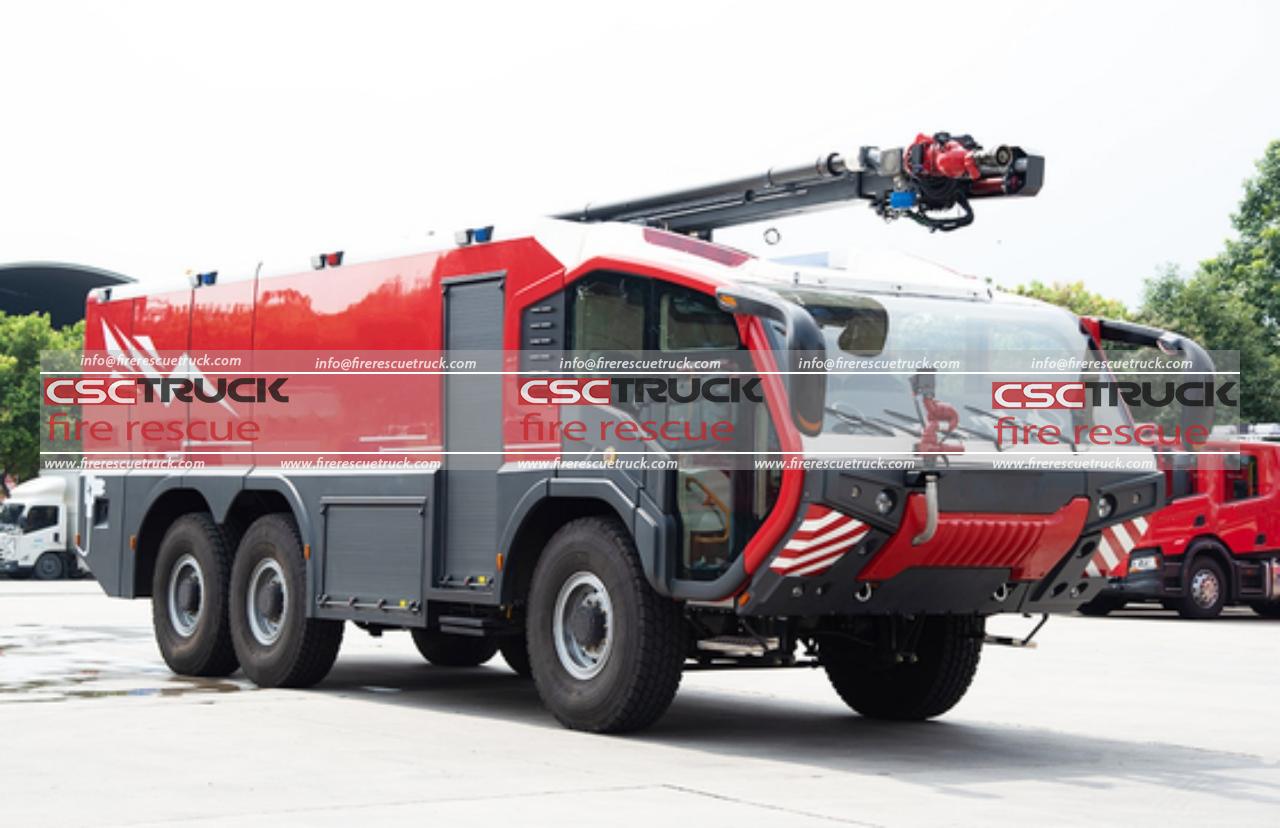
For example, CSCTRUCK Fire Rescue Truck offers an Electric 6×6 ARFF configuration with 11,000 liters of water and 1,000 liters of foam, while other heavy-duty models provide capacities such as 13,500 liters of water and 1,700 liters of foam.
Ultimately, the correct capacity depends on airport requirements, aircraft types, applicable standards, foam specifications, pump performance, and vehicle design. When comparing ARFF trucks, buyers should evaluate water and foam capacity together with pump flow, monitor performance, chassis capability, and overall response performance rather than choosing a truck based on tank size alone.