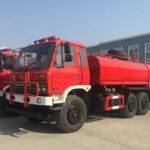

Introduction to CSCTRUCK Fire Rescue Truck
Modern firefighting operations often require vehicles that can travel far beyond paved roads. Wildfires, industrial accidents, airport emergencies, mining incidents, and natural disasters frequently occur in challenging environments where mud, sand, snow, steep slopes, and damaged roads can prevent conventional fire trucks from reaching the scene. This is why 6×6 fire trucks have become an important solution for high-mobility emergency response.
CSCTRUCK Fire Rescue Truck specializes in manufacturing advanced firefighting and rescue vehicles designed for demanding environments. Its range of 4×4 and 6×6 fire trucks combines powerful firefighting systems with heavy-duty off-road drivetrains, allowing emergency crews to operate effectively in extreme terrain. CSCTRUCK Fire Rescue Truck 6×6 fire trucks are equipped with advanced all-wheel-drive systems and differential locking technologies to maintain traction when operating under difficult conditions.
Among the key technologies that allow a 6×6 fire truck to overcome harsh terrain, differential locks play a critical role. They ensure that power from the engine is distributed effectively to the wheels, preventing wheel spin and maintaining vehicle mobility when traction conditions become unpredictable.
Understanding Differential Locks in a 6×6 Fire Truck
A differential is a mechanical device inside the vehicle drivetrain that allows wheels connected to the same axle to rotate at different speeds. This function is necessary because the outer wheels travel a longer distance than the inner wheels when the truck turns.
However, while a normal differential improves road handling, it can become a disadvantage in off-road situations. If 1 wheel loses traction on mud, ice, sand, or uneven terrain, the differential may send most of the available power to the spinning wheel, leaving the vehicle unable to move.
A differential lock solves this problem by mechanically connecting the wheels or axles so they rotate together. This allows the tires with traction to continue pushing the vehicle forward, even if another tire has limited grip.
For a heavy 6×6 fire truck carrying thousands of liters of water, foam, rescue equipment, and firefighting systems, maintaining traction is essential. A loss of mobility during an emergency response could delay firefighting operations and endanger personnel.

Types of Differential Locks Used in 6×6 Fire Trucks
A 6×6 fire truck normally uses multiple differential locking systems because it has 3 driven axles. Different manufacturers may use different drivetrain designs, but the most common differential locks include axle differential locks, inter-axle differential locks, and center differential locks.
1. Axle Differential Locks
Axle differential locks are installed inside individual axle differentials. Their purpose is to lock the left and right wheels on the same axle together.
Under normal driving conditions, the differential remains open, allowing the wheels to rotate at different speeds during cornering. When the truck enters difficult terrain, the driver can activate the axle differential lock, forcing both wheels to rotate at the same speed.
This is especially useful when:
- One side of the truck is stuck in the mud
- One wheel loses contact with the ground
- The vehicle crosses uneven terrain
- The truck climbs steep slopes
For example, CSCTRUCK Fire Rescue Truck‘s 6×6 ARFF fire trucks use heavy-duty axle systems with differential locks to improve off-road performance. Some configurations include a steerable front axle with a differential lock and rear axles equipped with additional locking capability to maximize traction.
2. Inter-Axle Differential Locks
A 6×6 truck has 3 driven axles, which means power must also be distributed between different axle groups. The inter-axle differential lock controls the power balance between front and rear drive axles.
Without an inter-axle lock, if 1 axle loses traction, the drivetrain may transfer power away from the axles with better grip. Engaging the inter-axle differential lock ensures that power continues reaching multiple axles.
This system is especially valuable for:
- Deep mud
- Loose sand
- Rocky trails
- Snow-covered roads
- Steep emergency access routes
For a fully loaded fire truck, inter-axle locking provides additional pulling power and improves climbing ability.
3. Center Differential Locks
Some advanced 6×6 fire truck platforms use a center differential between front and rear axle groups. The center differential allows smooth operation on normal roads while providing additional traction control when locked.
When the center differential lock is activated:
- Front and rear axles receive synchronized torque distribution
- Wheel slip is reduced
- Vehicle stability improves on low-grip surfaces
This type of system is common on specialized all-terrain emergency vehicles designed for both highway travel and off-road operation.
How Differential Locks Improve Firefighting Performance
1. Better Off-Road Mobility
The main advantage of differential locks is improved mobility. Firefighters often need to reach locations where roads are incomplete or damaged.
A 6×6 fire truck equipped with locking differentials can travel through:
- Forest trails during wildfires
- Muddy industrial areas
- Flooded roads
- Mountainous terrain
- Construction zones
CSCTRUCK Fire Rescue Truck 6×6 rescue and firefighting vehicles are designed for these types of environments, combining all-wheel-drive capability with traction-enhancing systems.
2. Improved Climbing Ability
Fire trucks are heavy vehicles. A fully equipped 6×6 fire apparatus may carry water tanks, foam tanks, pumps, hoses, rescue tools, and crew members, creating significant weight.
When climbing steep roads, maintaining consistent wheel torque is critical. Differential locks prevent individual wheels from spinning and allow the truck to continue moving upward.
Some CSCTRUCK Fire Rescue Truck 6×6 fire rescue models are designed with high-grade off-road capability and strong climbing performance for emergency environments.
3. Increased Safety During Emergency Response
Emergency vehicles must arrive quickly and reliably. Losing traction on slippery roads can cause delays or even dangerous situations.
Differential locks help drivers maintain:
- Better vehicle control
- Improved acceleration
- More predictable handling
- Reduced risk of becoming immobilized
This allows firefighters to focus on the mission rather than worrying about terrain limitations.

When Should Differential Locks Be Used?
Although differential locks provide major benefits, they should not always be activated.
On normal paved roads, keeping differential locks engaged can increase tire wear and drivetrain stress because wheels cannot rotate at different speeds during turns.
Drivers typically activate differential locks when encountering:
- Mud
- Snow
- Sand
- Gravel
- Steep slopes
- Uneven terrain
After returning to normal road conditions, the locks should be disengaged to protect drivetrain components.
Modern fire trucks often use electric, pneumatic, or hydraulic locking systems controlled directly from the driver’s cabin, allowing firefighters to quickly adapt to changing terrain conditions.
Differential Locks vs. Other Traction Systems
Differential locks are only one part of a 6×6 fire truck’s mobility system. High-performance emergency vehicles usually combine several technologies, including:
All-Wheel Drive System
Provides power to all 6 wheels, improving traction compared with conventional 4×2 or 6×4 trucks.
Heavy-Duty Tires
Special off-road tires improve grip on loose surfaces such as mud, sand, and gravel.
High Ground Clearance
Allows the vehicle to pass over obstacles without damaging critical components.
Advanced Suspension Systems
Helps maintain wheel contact with uneven terrain.
Together, these systems allow a 6×6 fire truck to operate in environments where standard firefighting vehicles cannot reach.

Conclusion
Differential locks are one of the most important drivetrain technologies used in modern 6×6 fire trucks. By preventing wheel spin and ensuring effective power distribution, they provide the traction needed for extreme firefighting environments.
The combination of axle differential locks, inter-axle locks, and advanced all-wheel-drive systems allows vehicles like CSCTRUCK Fire Rescue Truck 6×6 fire trucks to deliver reliable performance in wildfires, airport emergencies, industrial accidents, and disaster rescue operations.
For emergency teams operating in challenging terrain, differential locks are not simply a mechanical feature—they are a critical technology that helps ensure firefighters can reach dangerous locations quickly, safely, and effectively.