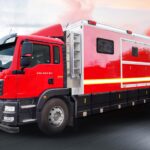
The SITRAK emergency recreational vehicle represents a significant advancement in comprehensive, all-factor, all-weather operational support. Designed to address a wide range of emergency and logistical scenarios, it offers a versatile and highly adaptable solution for field operations. The system encompasses a variety of specialized cabins, including accommodation cabins, shower cabins, washroom cabins, food supply cabins, and power and lighting cabins. Together, these form a coherent, series-based, and base-oriented product system, ensuring seamless integration across different operational needs. Each cabin is engineered not only to serve its functional purpose but also to provide a high level of comfort, safety, and efficiency for personnel deployed in challenging environments.
Taking the accommodation cabin as an illustrative example, the rescue fire truck is outfitted with a comprehensive set of essential facilities designed for practical use and comfort. These include upper and lower bunk beds, water dispensers, and washbasins, ensuring that personnel can maintain basic living standards even in temporary deployments. Beyond these essentials, the cabin incorporates advanced features, including thermal insulation to maintain stable internal temperatures, a fully functional air conditioning system, and audio-visual equipment to support communication and entertainment needs. Protective systems and efficient ventilation mechanisms are also incorporated, creating a safe and comfortable living environment. Every design element reflects a human-centered approach, emphasizing ergonomics, convenience, and the well-being of users under operational stress.
The SITRAK emergency recreational vehicle demonstrates exceptional value in emergency response scenarios, where rapid deployment is critical. In situations such as natural disasters, sudden accidents, or large-scale relief operations, the SITRAK accommodation cabin can be quickly mobilized to establish temporary living quarters. This capability is particularly vital for rescue teams, who often operate under extreme conditions and require reliable rest and recuperation facilities to maintain efficiency. For instance, during flood or earthquake relief missions, rescuers can rely on these cabins for secure and comfortable lodging after long hours in the field. The presence of a well-equipped, climate-controlled environment allows personnel to recover effectively, directly enhancing their operational performance and overall mission success.
Beyond its immediate functional benefits, the accommodation cabin also contributes to the broader development of emergency support and modular infrastructure industries. By incorporating advanced design concepts, robust materials, and reliable operational performance, it sets a high benchmark for similar products in the market. The system’s modular nature allows for scalable deployment, enabling organizations to tailor the configuration and number of cabins to the specific demands of each mission. This adaptability ensures that resources are used efficiently while maintaining consistent standards of safety and comfort.
Furthermore, the modular cabin system encourages innovation in related sectors, including temporary housing, disaster management, and field logistics. Its combination of durability, mobility, and user-centered design makes it an ideal solution for both routine operational support and crisis scenarios. As organizations increasingly recognize the value of rapid, reliable, and comfortable field accommodations, the SITRAK accommodation cabin exemplifies a forward-thinking approach to operational readiness and personnel welfare. By prioritizing comfort, safety, and deployability, this system ensures that responders and support teams can perform their duties effectively, regardless of environmental challenges or logistical constraints.
In conclusion, the SITRAK emergency recreational vehicle is more than just temporary accommodation—it is a strategically designed, high-performance solution that enhances operational efficiency, protects personnel’s well-being, and sets a new standard for emergency and large-scale event support infrastructure. Its thoughtful integration of comfort, safety, and rapid deployability ensures that it remains an essential asset in modern emergency management and field operations.